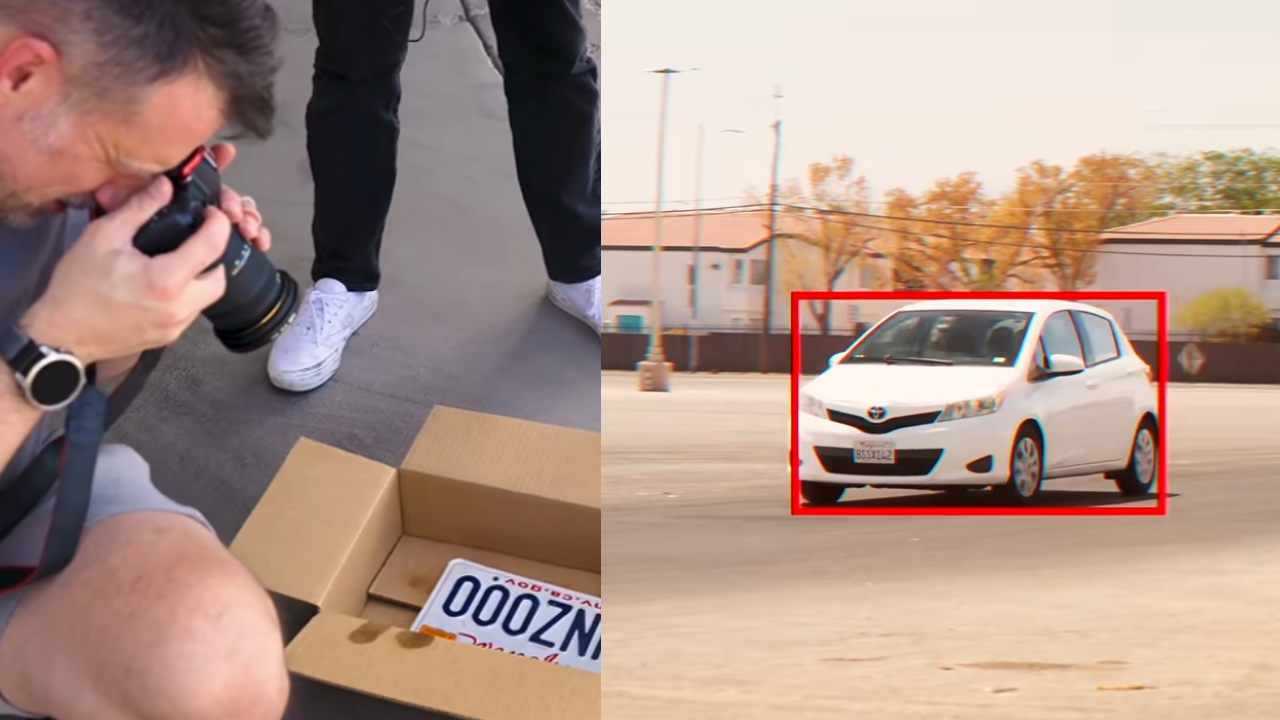
A small Toyota Yaris covered in a strange pattern confused an AI surveillance camera during a test in Las Vegas. The car was still easy for people to see, but the computer struggled to identify what it was looking at.
The YouTube channel Donut shared the experiment on September 1, 2026. Its goal was to see whether a car could pass a Flock Safety camera without its vehicle-detection software flagging it.
Police departments use Flock cameras to record license plates and track vehicle details. Donut wanted to find out whether a special design could fool the software before it even recognized a passing car.
With help from two cybersecurity researchers, the team tested the idea. Getting the camera to ignore the little Toyota, however, took more work than expected.
A Strange Makeover
Embedded media follows; please allow a moment to load.
Before changing the Toyota, Donut tested some products sold to block license plate cameras. These included a plate cover and a spray that claimed to make plates harder to read.
Neither impressed the team. During one test, the spray actually made the plate letters easier to see through an infrared camera.
There was another problem. Even when a license plate cannot be read, Flock systems can still collect details about a vehicle, including its color and other visible features.
The team had a different idea. A cybersecurity expert named Bill designed a special pattern meant to confuse AI software that looks for familiar shapes. The design uses what researchers call *adversarial noise*, which can make an object harder for a computer to recognize.
Donut covered its Toyota Yaris in the unusual wrap and prepared to see whether the pattern worked.
Still Spotted
For the test, Bill used a Flock Falcon camera connected to a computer. His custom display showed how confidently the detection software recognized a passing vehicle.
The team used 75% confidence as its target. Anything below that counted as a success under the rules of the experiment.
At first, the Yaris failed. Despite the new wrap, the camera still recognized it as a vehicle.
The researchers reviewed their footage and found that the software was still picking out familiar parts of the car. Its windows and wheels were especially easy to recognize.
After further changes, including covering the windows, the results improved. On several later passes, the team’s display stopped identifying the Toyota as a car. Another run under different lighting also produced a successful result.
There’s A Catch
Donut celebrated the result, but the experiment had limits. The successful setup involved covering the Toyota’s windows, making it impractical for ordinary road use.
The test also used one camera and a custom detection display. It did not prove that the Toyota would avoid every Flock camera or disappear from an actual police database.
Security researcher and YouTuber Ben Jordan, who joined the discussion, offered another option for drivers concerned about surveillance. Rather than trying to hide their vehicles, he suggested speaking at city council meetings and asking local officials about the cameras used in their communities.
Jordan also encouraged residents to talk with their neighbors and organize petitions if they want changes to local camera programs.