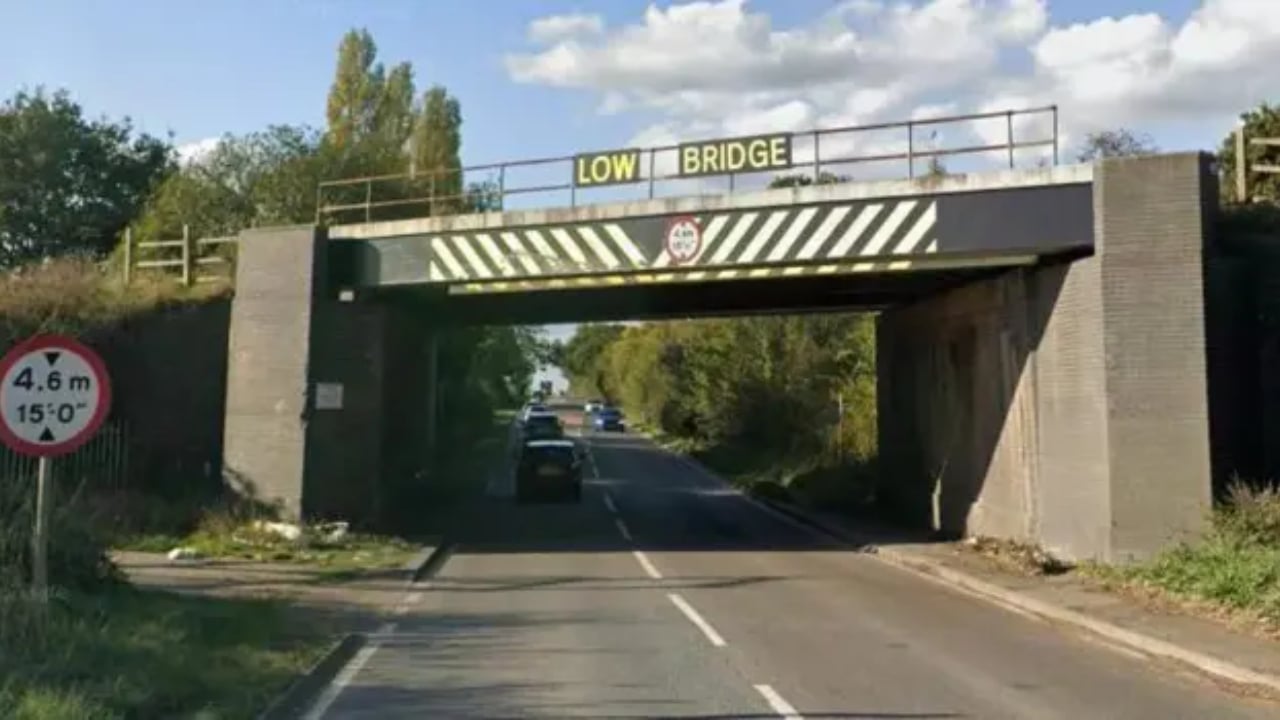
A section of the A5 in Leicestershire was forced to close after a lorry (or semi-truck, for us Americans) struck Britain’s most frequently hit railway bridge, adding another incident to the structure’s long history of collisions.
Emergency services were called to the railway bridge over Watling Street in Hinckley at around 11.30 am on Monday after the lorry hit the bridge. Leicestershire Police closed the road between the Dodwells Road roundabout and Nutts Lane while the incident was dealt with, urging motorists to find alternative routes.
The road reopened at around 12.30 pm, with police confirming that no injuries had been reported.
The bridge has become notorious for repeated collisions involving overheight vehicles, despite warning signs and restrictions in place on the busy trunk road.
Bridge Struck 22 Times in a Single Year
The latest crash comes after the bridge was officially named Britain’s most bashed railway bridge.
Leicester Mercury reported that Network Rail figures show it was struck 22 times between April 2024 and March 2025 – an average of once every 17 days. That represents an increase from the previous 12-month period, when it was hit 15 times.
Each collision has the potential to cause widespread disruption, as rail infrastructure must be inspected before trains can safely pass beneath or over the bridge. While Monday’s incident was resolved within around an hour, previous bridge strikes have led to lengthy delays for both motorists and rail passengers.
The bridge’s reputation has made it one of the country’s most well-known transport bottlenecks, with repeated calls for a long-term solution to prevent further collisions.
Residents and Commuters Continue To Feel the Impact
Bridge strikes do not only affect drivers using the A5. Whenever the road is closed, traffic is diverted through nearby residential streets in Hinckley, bringing increased congestion, noise and vibration for local communities.
Residents living along diversion routes such as Nutts Lane have regularly experienced the knock-on effects of closures, with additional traffic creating disruption and safety concerns.
Previous analysis by Midlands Connect (via BBC) examined several bridge strike incidents and found the resulting traffic delays carried a significant economic impact. The organization estimated that four separate collisions generated around $168,884 in road delay costs, while rail delays from 10 incidents in 2019 affected almost 4,000 passengers and cost an estimated £43,000.
It also calculated that recurring bridge strikes were responsible for more than 4,400 hours of road delays each year, adding that the true economic cost is likely to be considerably higher.
Long-Term Solution Now Underway
The problem has persisted for years, but work has now begun on a major engineering scheme to reduce the number of future bridge strikes.
The project will lower the road beneath the railway bridge, allowing taller vehicles to pass safely without colliding with the structure. The work is expected to take up to a year to complete.
Until then, authorities are likely to continue dealing with further incidents at the bridge, which has become an unwanted national record holder for vehicle collisions.
Although Monday’s crash caused no injuries and the road reopened relatively quickly, it serves as another reminder of the ongoing challenges posed by one of Britain’s most notorious railway bridges.
With collisions continuing despite repeated warnings, local residents, motorists and rail passengers will be hoping the planned improvement works finally bring an end to the disruption.