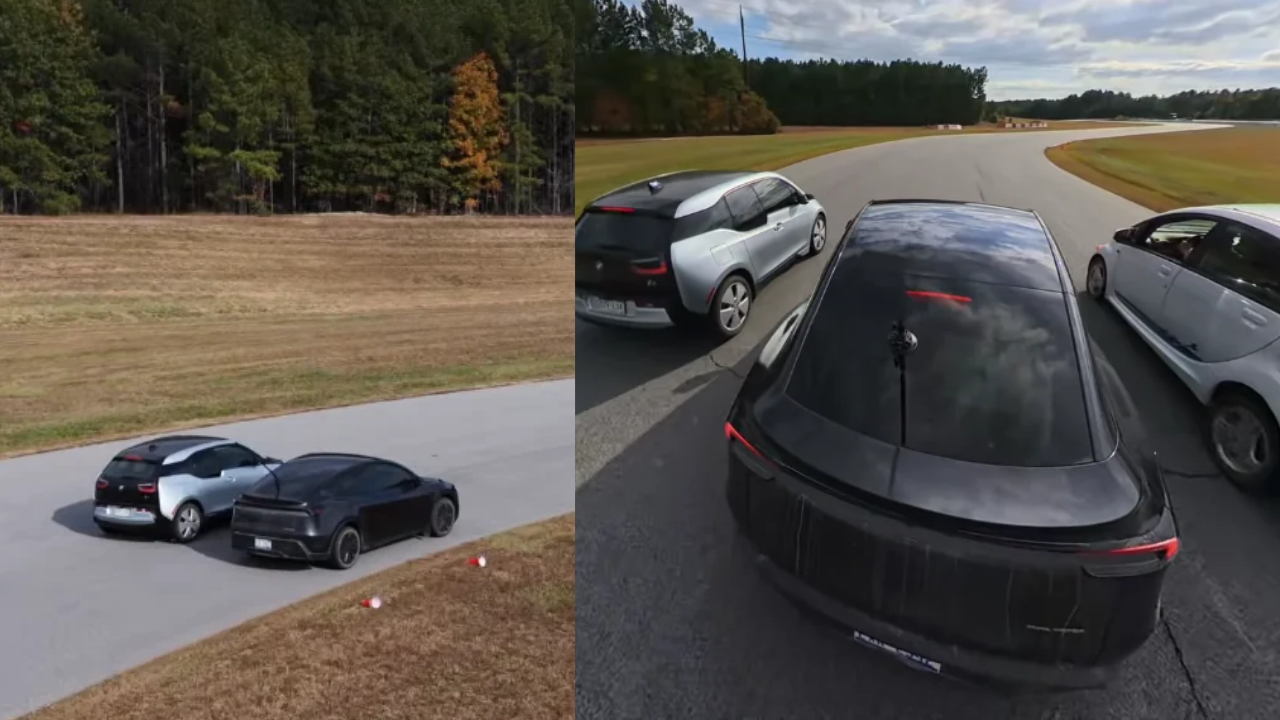
A group of drivers set out to make life miserable for a self-driving Tesla. Their plan involved cutting it off, boxing it in, and even driving straight toward it. They wanted to find out how much trouble the car could handle.
YouTube creator Dirty Tesla returned to a private track for another round of tests involving Tesla’s Full Self-Driving (FSD) software. Joined by Devin Olsen of Canada FSD and other drivers, the team used several vehicles to create dangerous situations on purpose.
Instead of watching the Tesla handle normal traffic, the drivers tried to trap it. Some blocked its path, while others made sudden moves that could lead to a crash. Each new challenge gave the software another problem to solve.
The video, published November 9, 2026, follows an earlier test of the same technology. This time, the team added more vehicles and created situations where avoiding one car could put the Tesla in the path of another.
Testing the Limits of FSD
Embedded media follows; please allow a moment to load.
While they have tried this test previously the November 9 follow-up takes the challenge further by using multiple moving vehicles to create more complex threats.
One of the biggest challenges involves cars closing in from different directions. With little room available, the Tesla must track the surrounding vehicles and choose how to respond.
Other tests involve drivers suddenly moving across its path. These cutoffs force the software to react to a vehicle that appears where the Tesla was planning to travel.
The team also creates head-on encounters. Rather than using a parked obstacle, another driver approaches the Tesla directly, leaving the Tesla to judge the closing distance and available space.
Combining these moves makes the test more difficult. Braking to avoid one vehicle might not solve the problem if another car is approaching from behind.
Don’t Try This at Home
These challenges were staged on a private track with drivers working together. They should not be attempted at home or on public roads. Deliberately driving toward another vehicle or trying to force it into a crash can cause serious injuries, even when the people involved expect the danger.
Tesla also makes clear that its Full Self-Driving (Supervised) system does not make a vehicle fully autonomous. Someone behind the wheel must watch the road and remain ready to take control.
The software can steer, brake, change lanes, and respond to surrounding traffic. However, Tesla warns that drivers may still need to intervene, especially when facing oncoming vehicles or other unusual road conditions.
Closer Than It Looks
The latest experiment drew plenty of reactions from viewers, including some who questioned whether the Tesla was responding quickly enough.
One commenter pointed out that the head-on encounters looked quite different depending on the camera angle. From the driver’s seat, the car seemed slow to react. From the drone footage, however, its movements appeared much more reasonable.
Another viewer shared an experience with FSD on a public road. According to the commenter, a driver suddenly entered their lane, and the Tesla moved into an adjacent lane before they could react themselves.
Others focused on the risk involved in putting several cars so close together. One commenter warned, “It’s all fun and games until someone crashes.”
Despite that concern, the unusual experiment left some viewers asking for more. One requested a dedicated emergency collision-avoidance test, while another wanted the team to repeat the challenge with a newer version of Tesla’s software.
The November 9 video also drew praise from viewers who appreciated that Dirty Tesla was using its own vehicle for the experiments. As one commenter put it, “This is crazy to do with your own car. Nice job for science.”