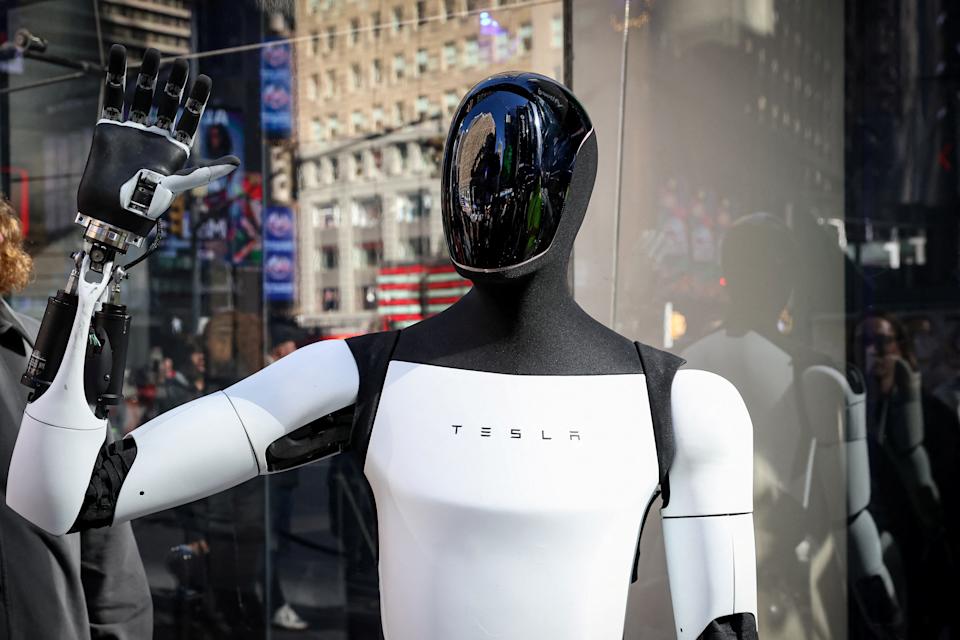
Tesla has never been a stock for the faint of heart. It trades on visions of the future, bet sizes that make traditional auto investors dizzy, and the singular gravitational pull of Elon Musk’s ambitions. But a new note from Piper Sandler analyst Alexander Potter takes the bull case to a genuinely interesting place: what if the company’s entire humanoid robot operation is basically a freebie right now?
Potter dropped what he calls a “Definitive Guide to Investing in Tesla,” and the headline finding is striking. After running a detailed discounted cash flow model across 17 different Tesla product lines, including vehicles, energy storage, insurance, supercharging, FSD subscriptions, and the robotaxi business, Piper Sandler landed on a core valuation of roughly $400 per share. Tesla stock recently traded around $445. Do the math and you get something unusual: the gap between the model and the share price is essentially the Optimus robot business, sitting there unpriced.
That is either a fantastic deal or a sign that one of the two numbers is wrong. Potter seems to believe it is actually a fantastic deal. His price target on the stock sits at $500, and the $100 difference between that target and his $400 base valuation is what he is reserving for Optimus, AI inference services, and whatever else Tesla has not fully revealed yet. He even admits that $100 per share might be too stingy.
To be fair, Tesla stock has been on quite the ride. Shares jumped nearly 4% in a single session to hit $445, a reminder that this is a name that can move fast in either direction. The broader context matters too. Tesla is navigating declining vehicle deliveries, a shrinking contribution from regulatory credits, and what Potter himself admits are consensus earnings estimates that are probably too optimistic. And yet, here we are, talking about robots.
What Piper Sandler Actually Built and Why It Matters
The Piper Sandler model is not a simple one-line guess. Potter broke Tesla into 17 distinct revenue streams and ran a 20-year discounted cash flow analysis on each of them. That is a level of granularity most Wall Street models skip entirely. According to Potter, most sell-side analysts overlook the financial weight of things like in-house insurance, Supercharger network revenue, and the FSD subscription business. When you fold those in properly, the numbers move.
The model also incorporates the 2025 CEO compensation plan for Musk, which prior versions apparently glossed over, and it now assigns a specific dollar value to the robotaxi business as its own line item. These additions pushed Piper’s earnings multiple estimate from 180 times to 233 times fiscal year 2027 earnings. That is an aggressive multiple by any traditional measure, but Potter argues Tesla is no longer a traditional company, and the multiple reflects that shift.
Tesla Is Quietly Changing the Metrics That Matter

One of the more interesting signals buried in Potter’s report is what Tesla has started disclosing publicly. The company’s investor relations team has begun sharing FSD subscriber counts, and as of the fourth quarter of 2025, there were 1.1 million active users on the platform. That is a meaningful number, and Potter sees it as a sign that the old way of evaluating Tesla, through delivery volumes and automotive margins, is losing relevance.
Think about what that means practically. If Tesla misses delivery numbers but FSD adoption keeps climbing and robotaxi milestones keep hitting, Potter argues the stock likely shrugs off the miss. Traditional auto metrics are becoming a sideshow. The real scoreboard, at least in Piper’s view, is whether autonomy is actually getting deployed and whether subscribers are paying for it.
What Investors Can Learn From the Optimus Framing
There is a lesson here that goes beyond Tesla specifically. When an analyst says you are getting something “for free,” it is worth pausing to ask what assumptions that framing rests on. In this case, the “free Optimus” argument only holds if you accept Piper’s $400 base valuation, which itself requires a 233x earnings multiple on a company whose near-term revenue and EPS estimates are being cut. That is a lot of scaffolding.
That said, the exercise is genuinely useful as a thought framework. Rather than trying to slap a number on a business that has no real revenue yet, Potter simply says: here is what we can model, here is what that is worth, and here is what you get on top of that if the bigger bet pays off. For a company like Tesla, where the transformational upside is real but also deeply uncertain, that kind of layered thinking is more honest than pretending a single price target captures everything.
The Optimus robot program, if it delivers, could reshape labor markets in ways that make Tesla’s current vehicle business look like a warm-up act. Potter acknowledges that directly. He just also acknowledges that no one, including him, can model it responsibly yet. So for now, investors are essentially deciding whether they trust Elon Musk to eventually make the robot story real, and whether today’s price is a reasonable entry point for that bet.
The Bottom Line on Tesla Right Now
Potter’s bottom line is that Tesla’s modeled businesses justify roughly the current share price, and Optimus is an unpriced option on top. His $500 target assumes that option is worth at least $100 per share, which he personally thinks may be underselling it.
The risks are real. Deliveries are slowing. Regulatory credit revenue is shrinking. The earnings multiple is historically stretched. But if robotaxis scale, FSD subscriptions grow, and Optimus eventually ships in commercial volumes, the bull case does not need a lot of imagination to run well past $500. Whether that plays out is a question of execution, and that has always been the central bet on Tesla.