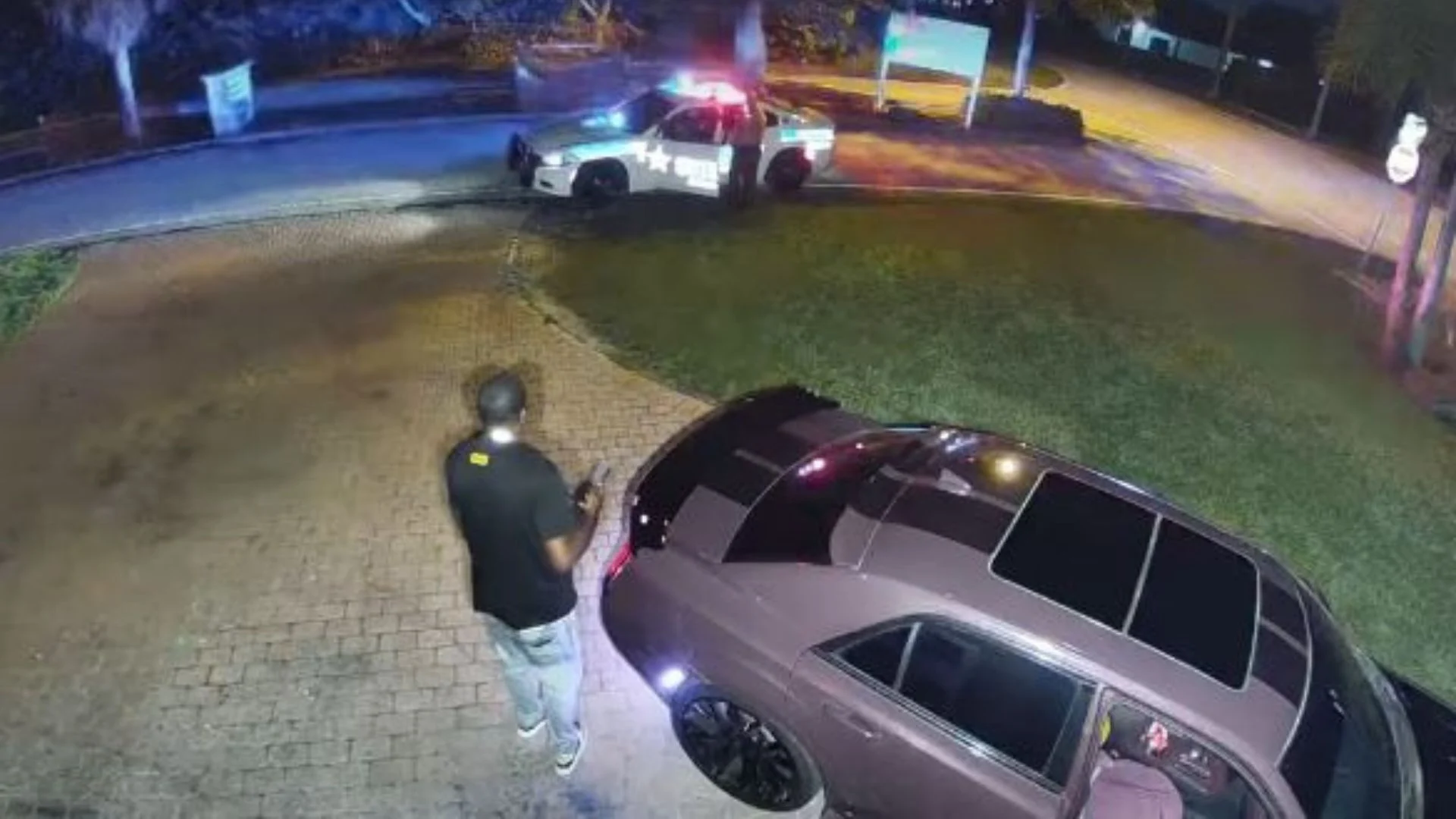
A driver says he was already standing in his front yard when a police officer attempted to stop him, leading to a tense confrontation that has since gone viral across social media. The unusual encounter was captured on camera, with both the driver and the officer offering conflicting accounts of what happened moments earlier.
Throughout the video, the driver repeatedly insists the officer never pulled him over while he was behind the wheel, arguing that he had already parked and stepped out of his vehicle before the patrol car’s emergency lights were activated. The officer, however, appears to disagree, setting the stage for a tense back-and-forth outside the man’s home.
As the conversation continues, the driver asks for a supervisor and tells the officer he has multiple cameras recording the entire encounter. The interaction eventually comes to an end without the confrontation escalating any further, but not before sparking widespread discussion online.
Since the video surfaced, thousands of viewers have debated whether the officer was acting within the law, while others questioned whether the driver’s own footage tells the full story. The incident has also renewed interest in what police can—and cannot—do when a driver reaches home before a traffic stop begins.
“I’m Already Home”: The Exchange Quickly Became Heated
The video, shared by Instagram user @mopardon, opens with the driver standing beside his vehicle in the front yard of his home as he repeatedly questions why the officer is trying to stop him.
“What? I’m home, bruh. I’m home,” the driver says. “Bruh, you’re on my property.”
As the exchange continues, the driver repeatedly argues that the officer never attempted to pull him over while he was still driving. According to him, the patrol car’s emergency lights weren’t activated until after he had already parked and stepped out of his vehicle.
“I was already parked when you decided to put your light. It’s on camera,” he tells the officer while pointing toward his cameras. The officer appears to dispute the driver’s version of events, prompting the driver to ask for a supervisor. Confident that his cameras captured the entire encounter, he repeatedly tells the officer that the footage will show exactly when the emergency lights were activated.
View this post on Instagram
Although the officer appears to disagree, the discussion never escalates beyond a verbal exchange. The clip ends shortly afterward, with the officer returning to his patrol vehicle and leaving the scene without issuing a citation. The encounter leaves viewers with only the recorded interaction and competing accounts of what happened before the video began.
The Viral Video Left Viewers Deeply Divided
As the video spread across social media, viewers quickly split into competing camps, with many reaching very different conclusions after watching the same footage.
Some believed the officer’s decision to leave without issuing a citation spoke for itself. “As soon as he told the cop he was on camera, that cop dipped out,” one commenter wrote. Another added, “The cop driving off at the end explains it all,” while others argued that the driver’s home security cameras may have discouraged the officer from taking the encounter any further. “That Ring camera probably saved your life,” one viewer commented.
Others, however, argued that simply reaching home doesn’t erase an earlier traffic violation. Several commenters pointed out that if an officer had already observed a violation and initiated a lawful stop before the driver parked, the location of the encounter would not necessarily prevent a citation from being issued. “Bro, if you commit a traffic violation you can still get pulled over for it. Just because you make it home don’t mean nothing,” one person wrote. Another added, “If the police was following him with lights on prior to him parking at his home then the police is right in this situation.”
Many viewers also focused less on who was legally correct and more on the importance of video evidence. “The camera is a cop’s worst enemy, for it shows the truth,” one commenter wrote, while another praised the driver for documenting the encounter, saying, “He knew his rights!! It’s a must!!”
Without footage showing what happened before the confrontation, or an official statement explaining the officer’s account, the debate has continued well beyond the original video. For many viewers, the clip became less about one traffic stop and more about the importance of understanding both legal rights and police authority during encounters that can quickly become contentious.
Why Traffic Stops at a Driver’s Home Can Become Legally Complicated
One reason the video has generated so much discussion is that encounters like this often fall into a legal gray area. While many viewers assumed a driver cannot be stopped after reaching home, legal experts say the answer depends on how and when the stop actually began.
In general, a driver does not automatically avoid a citation simply by pulling into a driveway or parking at home. If an officer witnesses a traffic violation, they may still investigate or issue a citation, even if the driver has already exited the vehicle. What often becomes more complicated is whether officers may enter private property or continue pursuing someone into a home without meeting additional legal requirements.
That issue reached the U.S. Supreme Court in Lange v. California, a 2021 case involving a driver who entered his garage before an officer made contact. The Court ruled that officers do not automatically have the authority to enter a home without a warrant simply because they are pursuing someone suspected of committing a misdemeanor. Instead, courts must evaluate the specific circumstances of each case, including whether there were urgent or “exigent” circumstances that justified immediate action.
Because the viral video does not show what happened before the confrontation, it does not answer every legal question raised by viewers. Whether the officer initiated the stop before the driver reached home, or only after he had already parked, is one of the central issues fueling debate online, and no official statement has been released publicly to clarify that sequence of events.