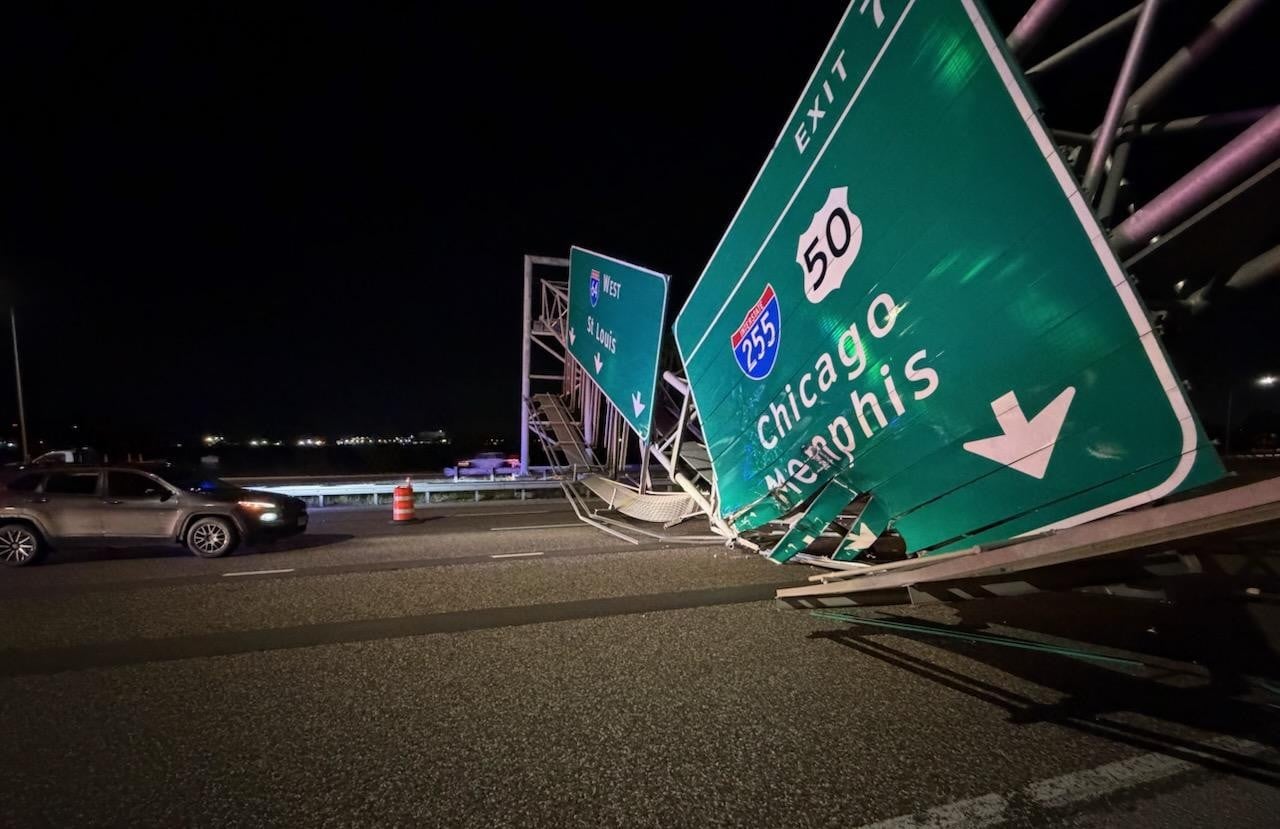
A major stretch of Interstate 64 in southern Illinois, near St. Louis, was shut down after a dump truck struck an overhead sign structure, sending metal crashing onto the roadway and backing up traffic for miles.
According to reporting by NBC Chicago, the crash happened late Wednesday night in a construction zone near Washington Park in St. Clair County, where the truck reportedly failed to lower its dump bed before hitting the overhead sign truss spanning the westbound lanes.
That impact caused the structure to collapse across the interstate. No injuries were reported, but as of Thursday morning, all westbound lanes remained closed, with traffic diverted and delays stretching for miles as crews worked to clear the damage.
The Illinois Department of Transportation confirmed the closure and warned drivers to avoid the area, noting that cleanup and repairs were expected to take hours.
The Moment Everything Went Wrong
Embedded media follows. Please allow a moment for it to load
Footage aired by FOX 2 St. Louis shows the moment the crash unfolds, with a dump truck entering frame with its bed still raised before striking the overhead truss and bringing the entire structure down in seconds.
There is no buildup and no evasive move, just a raised bed and a fixed structure meeting at speed.
What Drivers Are Saying
The reaction under IDOT’s Facebook post offers a real-time look at how drivers process something like this, with some focused on whether the road was still closed and how severe the backups had become, while others questioned how a truck could hit a structure that high.
“I don’t see how a truck would hit that..those signs are high.”
That reaction is common in incidents like this, but the issue is not the height of the sign; it is the height of the vehicle once a dump bed is left raised. There were also comments suggesting the roadway could have been reopened more quickly.
“Road could have opened 30 minutes tops. Cut it off and drag it off the road.”
In practice, cleanup is more complex, as a collapsed sign truss can leave twisted steel under tension and unstable sections, requiring crews to secure and remove debris carefully before reopening lanes. Some commenters also raised concerns about how quickly information was shared and why overnight repairs were not completed sooner, reflecting the real impact of a closure on a major commuter route where delays can ripple for hours.
This Is Not a One-off
Incidents like this are uncommon, but they are not isolated. We have recently seen multiple cases where raised dump beds or overheight vehicles struck overhead infrastructure, leading to damaged signals, bridge inspections, and, in some cases, full highway closures.
The failure point is consistent. When a dump bed is not lowered, the vehicle’s height can exceed the clearance of overhead structures, creating a direct risk of impact.
The Part That Matters
There is a tendency to treat events like this as unpredictable, but the video suggests otherwise. This is a preventable scenario, a raised bed, a fixed structure, and a moment where a routine drive turns into a major infrastructure incident.
It is also happening against a backdrop where more attention is being paid to how commercial drivers are trained, tested, and licensed, and in incidents like this, questions about CDL standards and accountability tend to follow quickly, whether in official investigations or in public reaction. That does not mean every case points to a systemic issue, but it does mean that when something this visible happens on a major interstate, the conversation goes beyond a single driver.
At the time of writing, there is no publicly confirmed information about the driver involved or what, if any, consequences they may face. What is clear is the scale of the damage, and if there is one safe bet here, it is this: you would not want to be that driver, or their insurance company, right now.