
Porsche just took the wraps off the new range-topping 911 at IAA Mobility, and it is a blistering mix of old-school Turbo swagger and new-school electrified brains. Officially called the 2026 911 Turbo S, the coupe and Cabriolet pair a twin-turbo flat-six with Porsche’s T-Hybrid system for a combined 701 hp, making this the most powerful production 911 ever.
Zero to 60 mph takes 2.4 seconds, top speed is 200 mph, and around the Nürburgring, it is roughly 14 seconds quicker than its predecessor. This marks a new chapter in Porsche’s long history book.
Two E-Turbos and a Compact Hybrid Pack
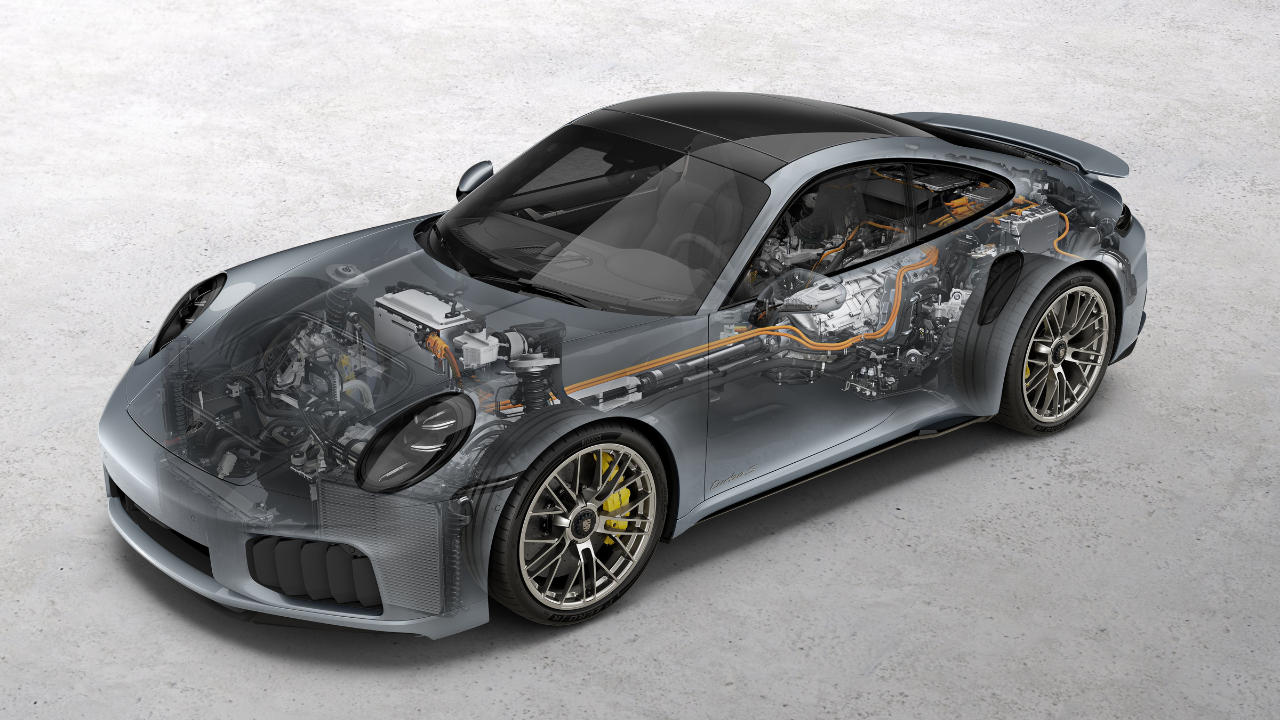
If you followed the GTS T-Hybrid last year, consider this the boss level. The Turbo S swaps that car’s single electric exhaust-gas turbo for two eTurbos, sharpening response and helping deliver a broad 590 lb-ft plateau from 2,300 to 6,000 rpm. Energy comes from a compact 1.9-kWh high-voltage battery, and an eight-speed PDK with an integrated e-motor feeds all-wheel drive through Porsche Traction Management. On paper, you get the best of both worlds: instant shove off-boost, relentless pull at the top, and the kind of repeatable performance Turbo buyers expect.
Porsche’s numbers back up the talk. Launch Control cuts the 0–60 sprint to 2.4 seconds, down two-tenths versus the previous Turbo S coupe, and 0–124 mph falls to 8.4 seconds, a half-second improvement. The headline stat for track nerds is the 7:03.92 Nordschleife lap set during late-2024 development, notarized and nearly 14 seconds clear of the old car. The new model carries extra mass from the hybrid hardware, but Porsche’s test driver Jörg Bergmeister stated that it feels lighter on its feet thanks to grip and agility gains.
Aero, Chassis, and Brakes: Big Hardware, Bigger Brains

Power is only half the story. The Turbo S gets a serious aero rethink with active, vertical cooling flaps, a new active front diffuser, a deployable front lip, and an extendable, tilting rear wing. Depending on the scenario, the system trims drag by up to 10 percent or piles on downforce when you need stability and bite. There is even a wet mode that closes the front cooling flaps to help keep water off the rotors for more consistent braking in rain.
Chassis control moves to an electro-hydraulic PDCC that taps the 400-volt system for quicker, smoother roll control than the old hydraulic setup. Paired with a wider-tired footprint — 255/35 ZR 20 up front and 325/30 ZR 21 at the rear — the car should feel calmer over crests yet more alert at turn-in. Stoppers are equally serious: standard PCCB with motorsport-derived pads and the largest carbon-ceramic setup Porsche has ever fitted to a two-door, including 420-mm front rotors and newly upsized 410-mm rears.
Design and Cabin: Turbonite Tells You It Is the Top Dog

Visually, this looks every inch a modern Turbo S: wider body than a Carrera, signature side intakes, and a face that now uses light and aero surfaces where older cars leaned on vents and open grilles. Porsche is also pushing a unified Turbo identity across model lines with Turbonite, a satin-metallic hue used for badging, wheel center locks, trim strips, and interior accents. Inside, you get 18-way Sport Seats Plus, HD Matrix LED headlights, Sport Chrono, PASM, the new ehPDCC, and a titanium sport exhaust as standard. The coupe is a two-seater by default, with no-cost rear seats if you want them; the Cabriolet remains a 2+2.
Personalization junkies will have a field day. Porsche Exclusive Manufaktur offers lightweight carbon roof panels, carbon rear intakes, Exclusive Design rear lights, and even carbon windshield wiper arms that cut weight versus the standard pieces. Paint to Sample returns, and the matching Porsche Design chronograph can be spec’d with Turbonite details, your car’s exterior color ring, and a wheel-style winding rotor. It’s fitting that your watch can be customized with as many bespoke touches as your car.
Order books are open now in the U.S. The 911 Turbo S coupe starts at $270,300, and the Cabriolet at $284,300, before a $2,350 delivery, processing, and handling fee. First U.S. arrivals are expected by spring 2026. Expect the usual early allocations to vanish quickly.
Quick Take
Purists will debate the hybridization of a Turbo the same way they discussed turbos on a 911 decades ago. The reality is simple: Porsche used electrification here as a performance multiplier, not a lifestyle accessory. Two eTurbos for response, a compact battery for punch, aero that thinks ahead, and a chassis brain running on 400 volts add up to a car that is meaningfully quicker without losing daily-driver credibility.
If the numbers hold up on the road and track, this Turbo S does precisely what the badge promises: it moves the goalposts for everyone else.
If you’re a Porsche purist, you may not care about the additional power or performance offered by the new hybrid-style drivetrain, and you’re not alone. In fact, we could easily make the argument that the additional power doesn’t really matter, and you can read more about our thoughts here: The 2026 Porsche 911 Turbo S Has 701 Horsepower and I Don’t Think That Matters.