A high-speed crash in Palm Springs ended with one car overturned on top of another and a driver who would not survive.
According to the Palm Springs Police Department, officers were dispatched around 2:18 a.m. to a rollover crash near the airport in Parking Lot B. When they arrived, they found a vehicle resting on top of a parked car.
The outcome was severe, and the details released so far point to a violent sequence of events.
At the time of publication, details remain limited to what police have released, and the driver’s identity has not been made public as authorities work to notify next of kin.
Based on what the police described, the path the vehicle took required a speed well beyond what the roadway is designed to handle. Police have not released any images from the crash scene as of publication.
From City Street to Airborne Crash
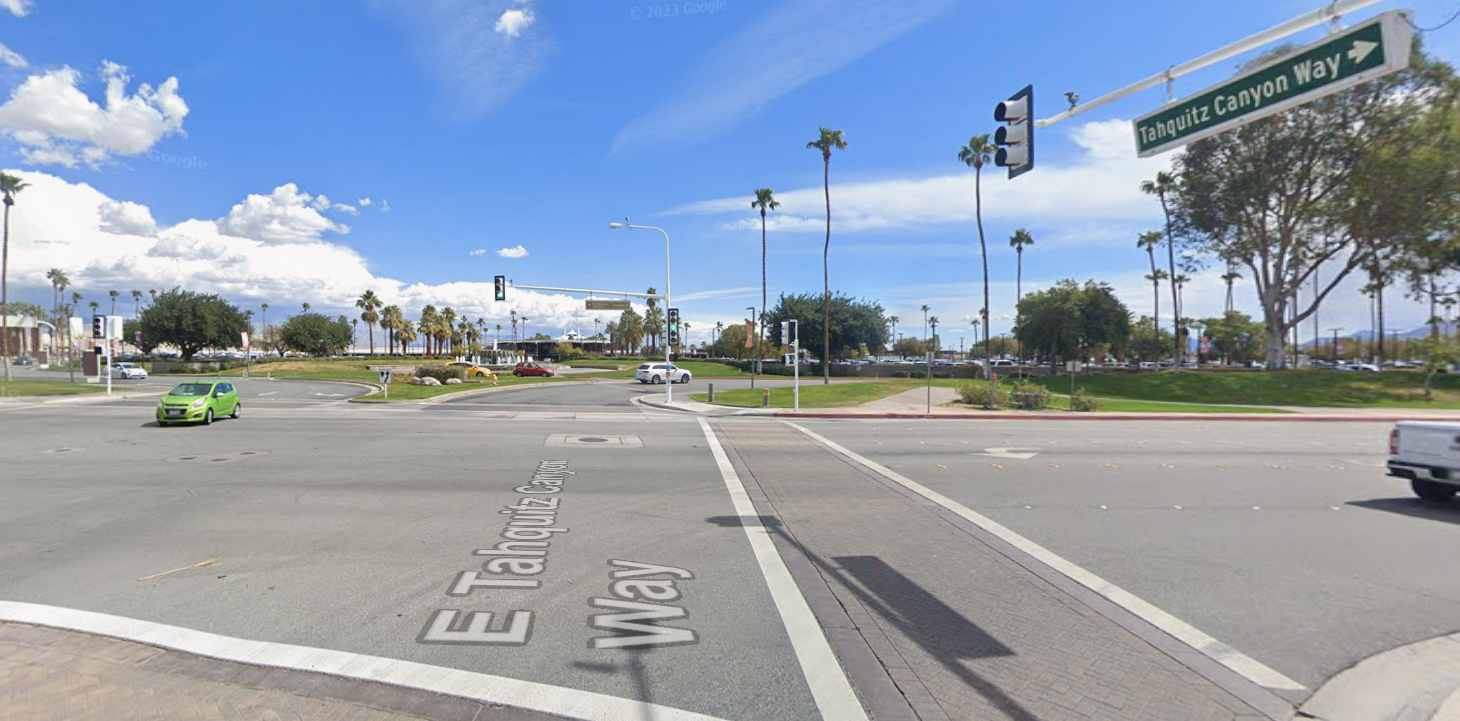
Investigators say the driver was traveling eastbound on East Tahquitz Canyon Way at a high rate of speed as the vehicle approached El Cielo Road.
The car left the roadway, cut across a grass area near the fountain, and became airborne. It then passed between two palm trees before crashing into the parking lot and ultimately coming to rest on top of another vehicle.
You do not need a full reconstruction report to understand what that sequence means. Vehicles do not travel that path, clear obstacles, and land on top of parked cars without a significant loss of control at high speed.
Why We Say “About 40 MPH”
The stretch of East Tahquitz Canyon Way where this happened is a wide, signal-controlled arterial with a posted speed limit of about 40 mph, based on city speed zone records for that corridor.
We use “about” intentionally. While city data shows 40 mph along this stretch, the exact signage can vary slightly block to block, and officials have not yet publicly confirmed the posted speed at the crash point.
A review of the area using Google Street View did not show a clearly visible speed limit sign in close proximity to the intersection, which is another reason we are careful not to overstate the exact posted limit at that precise location.
What does not vary is the design. This is not a highway. It is a city street with traffic signals, turn lanes, and a landscaped median. It is not engineered for anything close to the speed needed to send a vehicle airborne across the median and into a parking lot.
Driver Ejected, Dies at Hospital
The driver, who was the sole occupant of the vehicle, was ejected during the crash and suffered critical injuries.
Officers and emergency personnel performed life-saving measures at the scene before the driver was transported to Desert Regional Medical Center. Despite those efforts, the driver was pronounced dead at 3:03 a.m.
Authorities have not released the driver’s identity pending notification of next of kin.
Investigation Ongoing
The department’s Traffic Unit is handling the investigation. At this time, it is not known whether drugs or alcohol played a role in the crash.
No other injuries were reported, and airport operations were not impacted.
The Part That Matters
If this feels extreme, it should. This is what excessive speed does.
Speed does not just increase risk. It changes the physics of a crash entirely. It reduces reaction time, increases impact forces, and, in cases like this, turns a vehicle into something that can lift off the ground and travel far beyond where it was ever meant to go.
There is a reason speed limits exist on roads like this. They are not random numbers. They are based on how the road is designed and what it can safely handle.
This crash is a reminder of something simple. If you want to push a car, there are places built for that. City streets are not one of them.