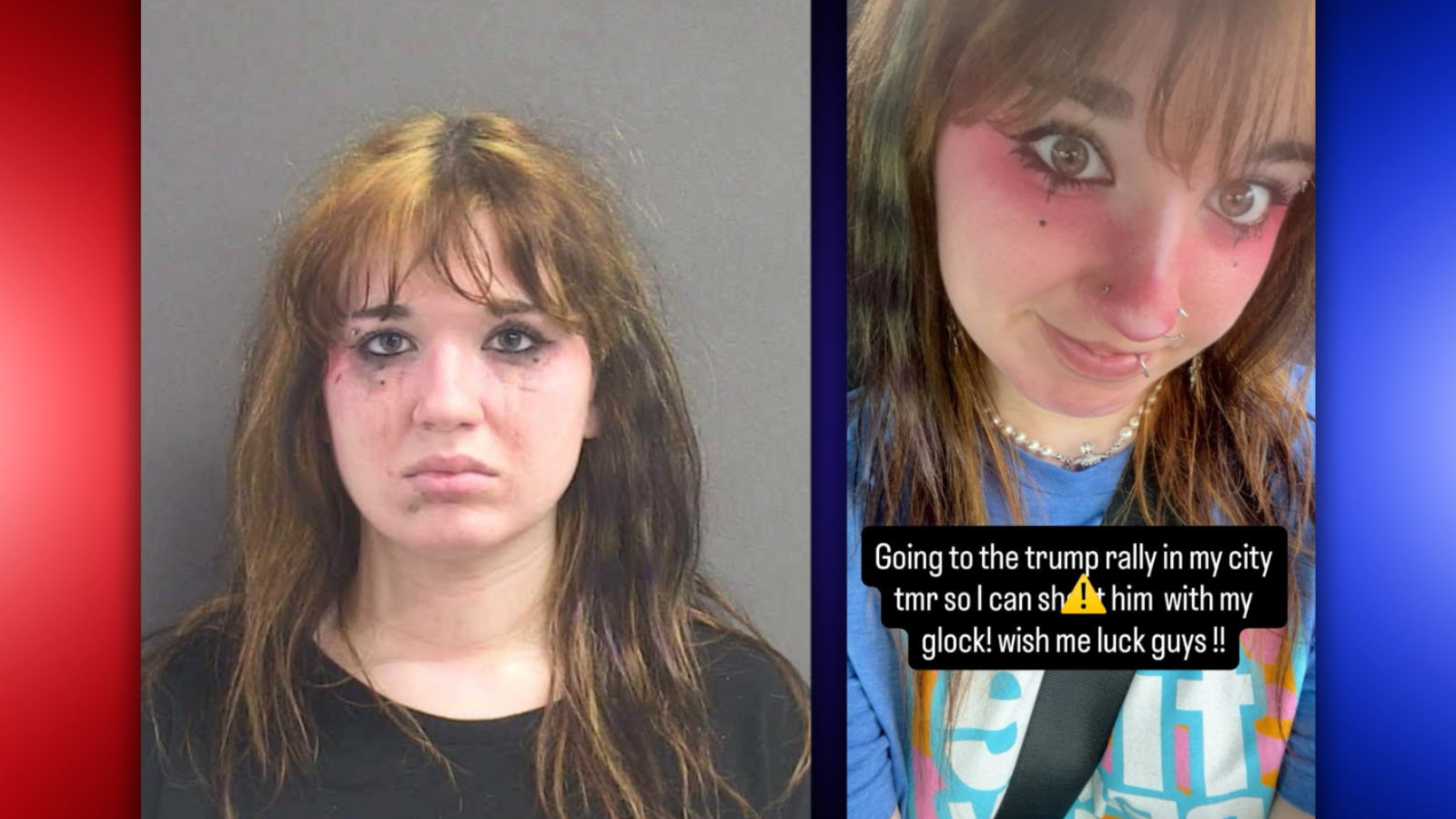
A 21-year-old Florida woman is facing two felony charges after deputies say she threatened to shoot President Donald Trump at a rally in Daytona Beach. When deputies and federal agents came to question her, she reportedly told them the Instagram post was a joke.
Allison Jeanne Albro, of Daytona Beach, posted Thursday, October 29, that she was going to the Trump rally in her city the following day so she could “shoot him with my glock!” The message caught the attention of the Volusia County Sheriff’s Office ahead of Trump’s scheduled Friday evening appearance.
Sheriff Mike Chitwood said members of his Domestic Security Unit and the U.S. Secret Service visited Albro. She reportedly told them she had no access to a Glock or any other weapon and would never hurt anyone.
That explanation did not prevent her arrest. Chitwood announced the charges Thursday and published images of Albro’s Instagram post alongside her booking photo, drawing hundreds of Facebook comments and an argument over where free speech ends and criminal threats begin.
The Joke Meets the Booking Desk
Sheriff Mike Chitwood shared the original Instagram post and booking photo on Facebook.
Volusia County jail records confirm Albro was charged with written threats to kill or do bodily injury under Florida Statute 836.10(2) and unlawful use of a two-way communications device to commit a felony under Statute 934.215.
The first charge carries no bond, while the second lists a $2,500 bond. Both are state felony charges. Her arrest case number is VP260023090.
Among the Facebook reactions, John Domo observed, “The difference of being behind the screen and now posing for a mugshot in front of one.”
Other commenters questioned whether posting an offensive statement should lead to criminal charges. Robert E. White argued that it should not be a crime until someone acts on a threat. Another commenter cited Supreme Court rulings protecting certain political statements.
When Is a Threat Just Talk?
The Supreme Court addressed a remarkably similar question in Watts v. United States in 1969. An anti-war protester was convicted after saying President Lyndon Johnson would be his target if he were drafted and given a rifle. The Court overturned the conviction, finding that the conditional statement, made during political discussion and accompanied by laughter, was political hyperbole.
More recently, the Court ruled in Counterman v. Colorado that prosecutors must establish at least recklessness about whether a statement would be understood as threatening. They do not have to prove that the speaker intended to carry out the violence.
Albro’s circumstances differ from those in Watts. Her post referred to a specific event taking place the following day. Whether prosecutors can establish the necessary elements remains a question for the courts.
Trump’s rally is scheduled for 7 p.m. Friday at the Ocean Center in Daytona Beach.
All parties are presumed innocent unless and until proven guilty in a court of law.