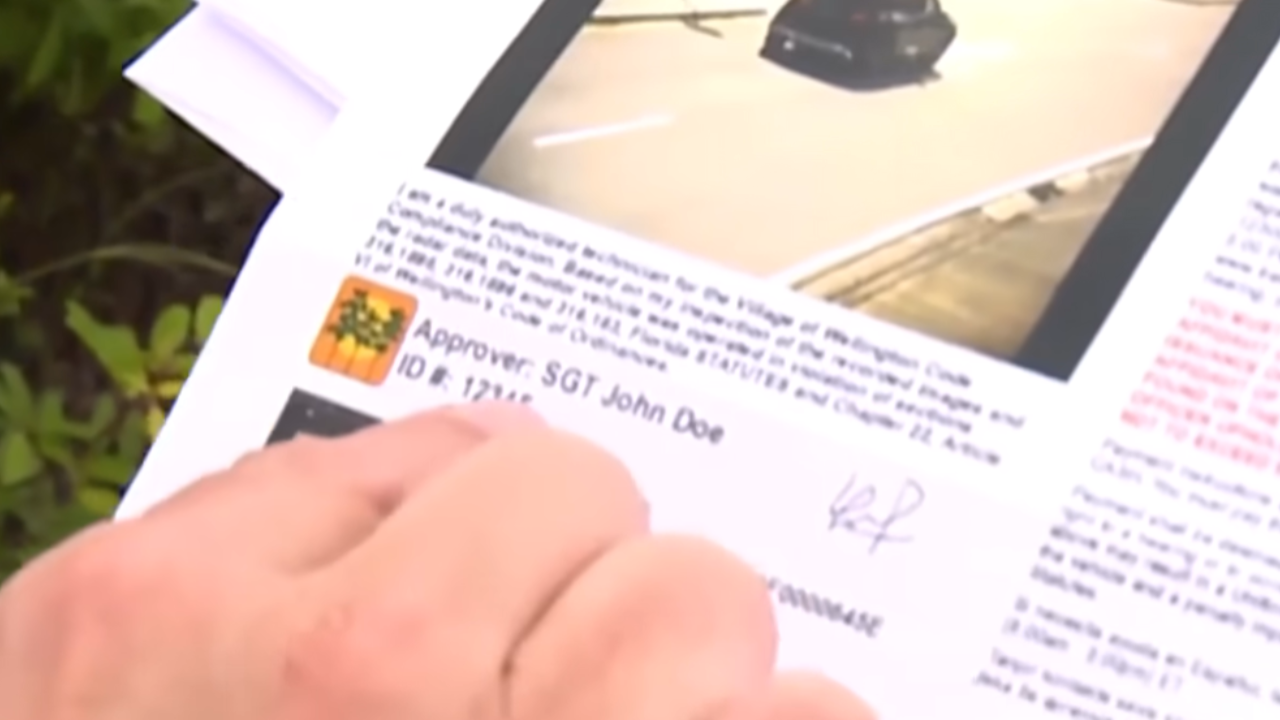
Wellington, Florida, uses a $100 Notice of Violation for its automated school-zone speed program. One notice carried a less convincing detail: “Sergeant John Doe.”
WPBF reported Sept. 4 that Wellington accidentally mailed 246 test notices.
Wellington’s actual program is a partnership with camera vendor Jenoptik. The village says its automated system can generate a violation when a vehicle is recorded traveling 11 mph or more over the applicable limit during covered school hours.
For ordinary enforcement, Wellington describes a human review step. The village says all violations are reviewed and approved by a duly authorized technician before a Notice of Violation is issued.
A Test Run
Embedded media follows; please allow a moment to load.
The village’s public materials distinguish that $100 notice from a Uniform Traffic Citation. The initial notice goes to the registered vehicle owner, carries no license points, and gives the recipient 30 days to pay, submit an affidavit, or request a hearing before a local hearing officer.
Florida law sets out who participates if a recipient chooses the hearing route. Testimony is taken under oath, and the local hearing officer must hear from a traffic infraction enforcement officer and the person challenging the notice. The hearing officer must also review the camera image or video and the recorded speed evidence before deciding whether to uphold or dismiss the violation.
A valid notice that is neither paid nor contested can later become a Uniform Traffic Citation. Wellington lists the initial notice at $100 and the later citation at $206.
Paper Trail
Wellington says its automated system uses radar-based cameras to detect speed and capture a license plate. Its FAQ says the speed radars receive daily diagnostic checks and annual third-party certification, and that only approved, verified violations are issued.
Recipients can review the evidence behind a notice using its violation number and PIN. They can also request a local hearing without paying first.
Florida’s statute makes the evidence part of that hearing. The photograph or video and the recorded speed are admissible, and they create a rebuttable presumption that the vehicle shown was used in a qualifying speeding violation.
The hearing officer can uphold or dismiss the violation. If it is upheld, the recipient can be required to pay the original penalty and local administrative costs allowed by law.