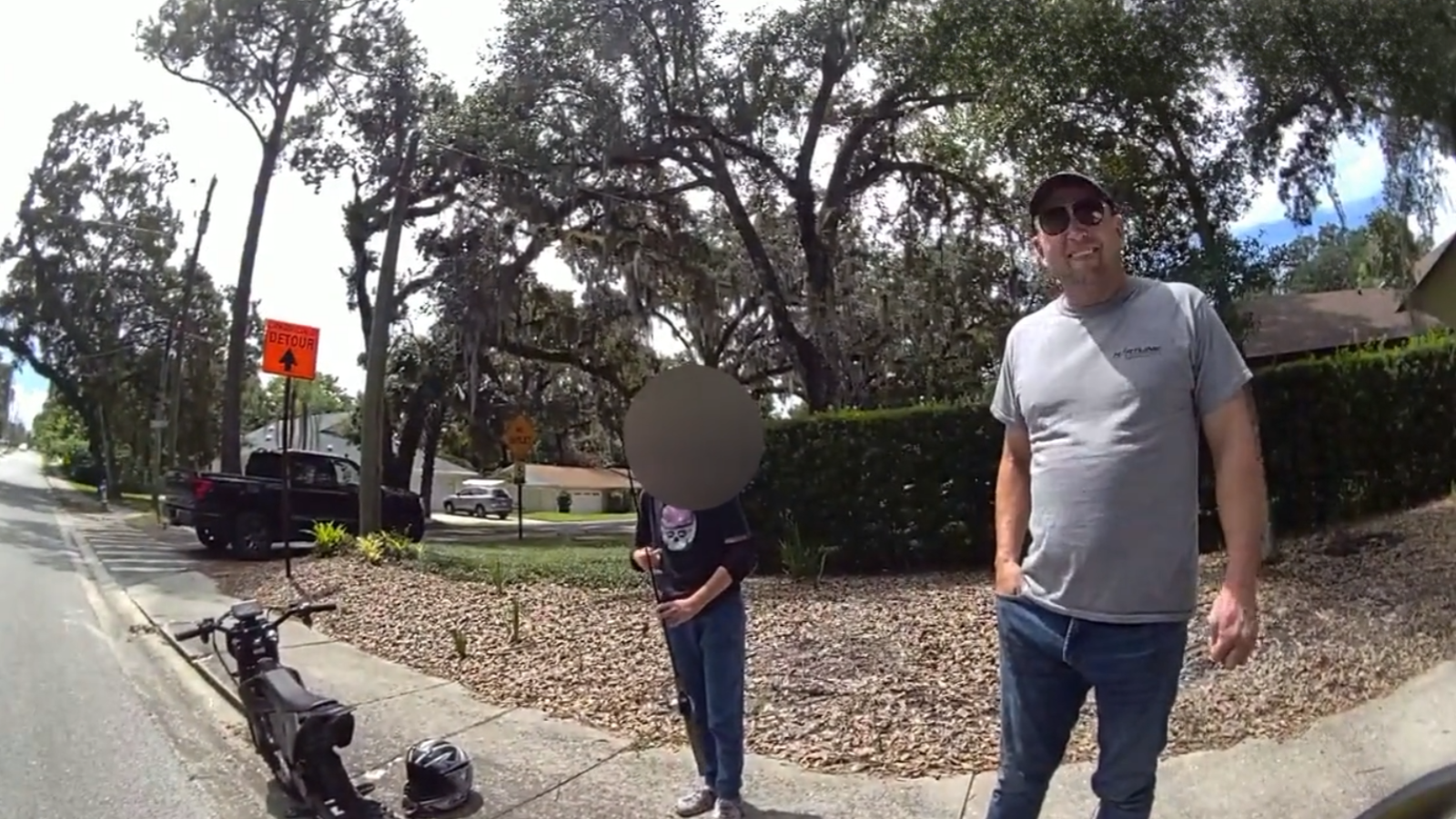
An 11-year-old Florida boy who spent the summer selling squirrel tables had saved roughly $900, earned good grades, and was headed toward a fishing spot with his rod when an Oviedo police officer stopped him on Sept. 7.
His father later criticized the encounter, saying police treated the child “like an adult on a motorcycle.” The boy was fingerprinted, given a criminal traffic citation, and had the machine towed.
Body-camera video shows the boy readily acknowledging that he knew he was riding a motorcycle, while the officer repeatedly calls him “buddy,” explains what she is doing, and ultimately writes one citation despite saying several others could have applied.
His parents push back once they arrive. An adult asks why the motorcycle cannot simply be loaded into a truck, his father requests a supervisor, and the officer repeatedly tells him to remain on the sidewalk.
He Already Knew
Embedded media follows; please allow a moment for it to load.
Editor’s note: The Oviedo Police Department redacted portions of the body-camera recording before releasing it. Sections containing no usable audio or visual information because of those redactions were removed. Otherwise, the video is presented as received from the department.
The stop began around 1:30 p.m. near North Division Street and Shady Lane.
“I’m gonna tell you right now, you’re riding a motorcycle. Do you know that?” the officer asks.
“Yes,” the boy replies.
When she asks why he is riding it, he says he is trying to reach a fishing spot. He has a fishing pole with him, says he owns a regular bicycle, and tells the officer his parents know he is using the electric machine. Later, she asks why his parents had apparently told police that they did not know anything about it.
Police records describe a QRonge electric dirt bike with pegs instead of pedals and a 4,500-watt motor. The probable-cause affidavit identified the model as capable of 50 mph, although it does not say the officer measured the boy at that speed, and the citation’s speed fields were blank.
Florida law defines an electric bicycle as having fully operable pedals and a motor rated below 750 watts. The boy’s machine had no pedals and six times that power ceiling.
Police said the motorcycle therefore needed to be registered and meet roadway requirements, while its rider needed a driver’s license with a motorcycle endorsement.
At 11, he could not have one.
Before the Crash
The U.S. Consumer Product Safety Commission estimated 698,500 emergency-department-treated injuries involving micromobility products from 2017 through 2024, with annual injuries rising from an estimated 37,300 to 149,100 during that period.
Earlier CPSC data found children 14 and younger accounted for about 36% of micromobility injuries from 2017 through 2022 despite representing roughly 18% of the population.
Some crashes have hurt people who were not riding.
In Orange County, California, prosecutors say a 14-year-old doing wheelies on a Sur-Ron electric motorcycle struck 81-year-old substitute teacher and Vietnam veteran Ed Ashman near El Toro High School. Ashman died two weeks later.
The Orange County District Attorney’s Office later charged the rider’s mother with involuntary manslaughter, alleging she continued allowing him to use the motorcycle after previous warnings. The allegations remain pending in court.
The same office has prosecuted another parent after a 12-year-old was critically injured running a red light on an electric motorcycle modified to reach as much as 60 mph. Prosecutors said the father and son had previously been warned.
Before anyone is injured, an underage rider can look like a small problem beside more serious calls for service. After a child is critically hurt or a pedestrian is killed, the questions become who knew, who had intervened, and why the machine was still being ridden.
Oviedo had already been receiving complaints about children using electric motorcycles, e-bikes, and similar devices on roads and sidewalks. Months before this stop, the department warned parents about riders weaving through traffic, impeding vehicles, and traveling the wrong way while officers conducted stops, spoke with families, and issued citations.
One Ticket
The boy remains cooperative throughout the bodycam. When the officer asks about his business, he tells her he makes squirrel tables, the summer venture that helped him save for the motorcycle.
The adults are more argumentative. One asks why the bike cannot simply go into the truck.
“No, I’m sorry,” the officer says. “He knows it’s a motorcycle.”
She then has to tell the adult several times to stay on the sidewalk before the father requests a supervisor, a request also recorded in the police event log.
When the officer returns to the boy, she tells him, “You could have gotten six criminal violations, but I’m giving you one, okay?”
The paperwork documents one citation under Florida Statute 320.02 for operating an unregistered motor vehicle. The officer also noted no insurance, no motorcycle endorsement, no eye protection, and the 4,500-watt motor, but those observations did not become separate charges.
She explains that signing the citation is not an admission of guilt and takes his right thumbprint because he cannot present a driver’s license. He was not booked into jail.
The officer initially reads the wrong mandatory court date, telling him Sept. 26 at 9 a.m., then returns and corrects it to Sept. 29.
“Our officers work diligently to educate parents and kids on what an e-bike is and what is not considered an e-bike, as well as how to be safe when riding,” the department said.
“The goal of the police department is to keep the pedestrians, bicyclists, and the motoring public safe.”
All parties are presumed innocent unless and until proven guilty in a court of law.