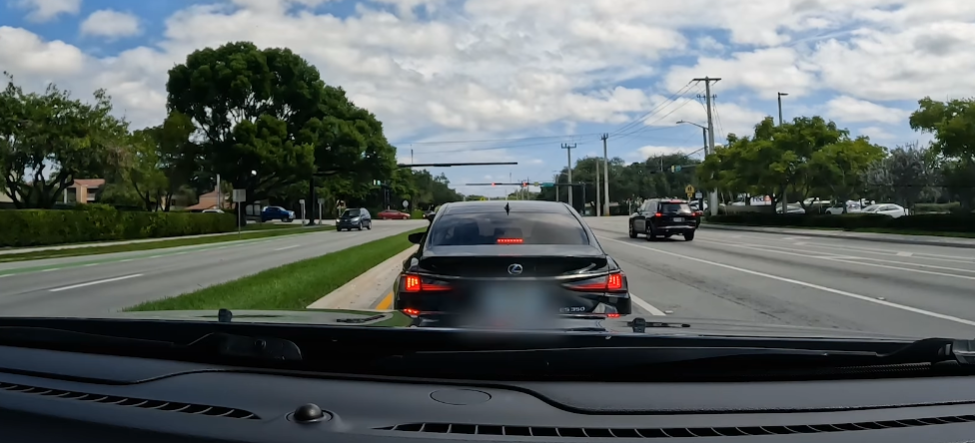
The Coral Springs Police Department has been running a social media series called “Traffic Thursdays,” and episode 41 might be the most entertaining one yet. A driver got pulled over going nearly double the speed limit and immediately had an excuse ready to go. The only problem? The officer had questions. Very logical, very reasonable questions that the driver could not quite answer.
The stop involved a Lexus clocked at 64 miles per hour in a posted 35 mph zone. That is not a “oops, I got a little heavy-footed” situation. That is a full-on, nearly double the speed limit situation, and it warranted a conversation. The driver, however, was ready with a defense: the car had malfunctioned and was going faster than he intended.
Now, vehicle malfunctions do happen. Throttle cables get stuck. Software glitches have been blamed for runaway acceleration. There is a universe where a car malfunction story holds water. But this particular story had some holes in it, and the officer on scene was not shy about pointing them out, one very calm, very reasonable question at a time.
The entire exchange was posted by the Coral Springs PD on Facebook as part of their ongoing “Traffic Thursdays” series, a recurring look at what their traffic enforcement officers deal with out on the roads. Episode 41 has people talking, not just because of the excuse, but because of the officer’s measured, almost philosophical response to it.
The Officer’s Logic Was Absolutely Airtight
When the driver explained that the car had malfunctioned and that was why it was going so fast, the officer asked a perfectly sensible follow-up: if you already knew the car had a speed problem, why were you driving it at all instead of calling a tow truck?
The driver pushed back and said the car does not actually go fast. The officer, without missing a beat, noted that 64 in a 35 is, in fact, fast. It is not a debatable point. The math is right there.
The officer also mentioned that if someone knows their vehicle has a malfunction, the responsible move is to not be driving it around public roads where other people could get hurt. The phrase used was pointed: “almost killing or hurting someone.” That is not hyperbole. A vehicle traveling at nearly double the speed limit in a residential or local road zone is genuinely dangerous to pedestrians, cyclists, and other drivers.
Is a “Speed Malfunction” Even a Real Thing?
The driver added one more detail: the speedometer inside the car was showing a lower speed than what the officer’s radar was detecting. It is an interesting claim, and in theory, speedometer inaccuracies do exist. Aftermarket wheel sizes, tire pressure variations, and sensor issues can all cause a speedometer to read slightly off.
But here is the thing: slightly off and nearly 30 mph off are very different conversations. A speedometer that reads 35 when you are actually doing 64 is not a calibration quirk. That is a catastrophic instrumentation failure. And when the officer glanced inside the vehicle, there was no check engine light, no warning indicators, nothing blinking on the dashboard to suggest the car was in any kind of distress.
That absence mattered. “I can’t take your words on it,” the officer said, and that was the end of the malfunction defense. A $281 speeding ticket was issued, and the stop was wrapped up.
What We Can All Learn From This Traffic Stop
There are a few takeaways here beyond the entertainment value of a very calm officer dismantling a very creative excuse.
First, if your car genuinely has a mechanical problem that affects speed or safety, driving it is not the move. That is what tow trucks, roadside assistance programs, and mechanics exist for. Getting behind the wheel of a vehicle you know is behaving unpredictably puts everyone around you at risk, and “it malfunctioned” does not become a legal shield after the fact.
Second, traffic officers hear a lot of explanations. The Coral Springs PD’s “Traffic Thursdays” series is actually a smart public engagement move because it gives people a window into what these stops look like in real life. Officers are trained to listen, ask follow-up questions, and look for evidence that either supports or contradicts what a driver is telling them. An absent warning light is evidence. A functioning speedometer is something a driver would reasonably be expected to notice.
Third, radar guns do not lie, and 64 in a 35 is not a gray area. Speeding ticket fines vary by state and by how far over the limit a driver is going. In Florida, going more than 30 mph over the posted speed limit can result in a mandatory court appearance, not just a fine, and can count as reckless driving. At 29 mph over the limit, this driver was right at that line.
Coral Springs PD’s Traffic Thursdays Is Must-Watch Content
The Coral Springs Police Department deserves credit for the way they have leaned into transparent, community-focused social media content. “Traffic Thursdays” is not about dunking on drivers or making people look bad. It is about showing real interactions, real conversations, and the reasoning that goes into traffic enforcement decisions.
Episode 41 went over well with commenters precisely because the officer in the video was not aggressive, not dismissive, and not condescending. He was just logical. He asked the questions anyone would ask if someone told them their car drove itself to 64 mph. He gave the driver every opportunity to provide something verifiable. When nothing verifiable appeared, he did his job.
The $281 fine stands, the Lexus presumably made it home without any further “malfunctions,” and the internet has a new favorite traffic stop video.