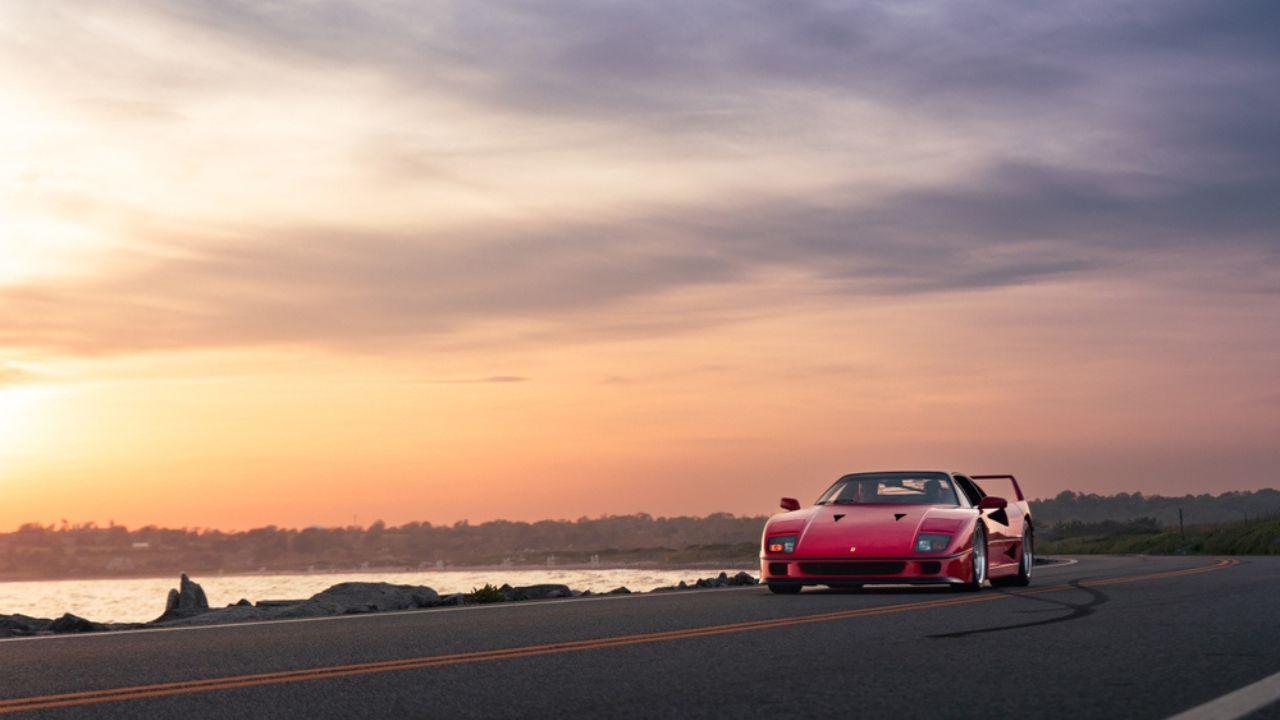
The Ferrari F40 doesn’t need much of an introduction. When it rolled out of Maranello in 1987, it was Ferrari’s way of saying goodbye to Enzo Ferrari himself while simultaneously proving that supercars could still be raw, uncompromising machines.
Decades later, it remains one of those cars that makes people stop mid-conversation when one drives by.
A Farewell Gift from Enzo

The F40 holds the distinction of being the last Ferrari personally approved by Enzo Ferrari before his death in 1988. Created to celebrate Ferrari’s 40th anniversary, it was conceived as a no-compromise supercar that would capture the essence of what Ferrari racing had always been about.
Enzo wanted something that felt more connected to his racing heritage than the increasingly refined road cars Ferrari had been producing. Ferrari now calls it “Enzo’s last masterpiece.”
Built for Pure Performance

Unlike today’s supercars with their creature comforts, the F40 was refreshingly spartan. The interior was famously minimal, with lightweight materials, racing-style fabric seats, and pull straps/cables instead of conventional interior door handles.
Air conditioning was available, and fitment varied by car and market, and many F40s were delivered without any stereo at all—sending a clear message about priorities.
That Unmistakable Design

The F40’s aggressive styling came from Pininfarina, but it wasn’t just about looking fast. Every curve, vent, and angle served a purpose, from the prominent rear spoiler to the side air intakes that fed the turbocharged V8.
The result was a car that looked purposeful rather than pretty, though many would argue it achieved both.
Engineering Excellence Under the Hood

The heart of the F40 was a 2.9-liter twin-turbocharged V8 that produced about 478 PS (around 471 hp) and had a claimed top speed of 324 km/h (about 201 mph), Ferrari’s first production model claimed to exceed 200 mph. The engine was paired with a five-speed manual transmission and rear-wheel drive, creating a driving experience that demanded skill and respect.
The extensive use of carbon fiber and Kevlar helped keep weight low, around 2,425 lb (about 1,100 kg) in dry-weight form, giving it a power-to-weight ratio that still impresses today.
Rarity Drives Desirability

Ferrari originally planned to build just 400 F40s, but demand was so overwhelming that production ultimately reached about 1,311 cars, with the main road-car run completed in the early 1990s. This relative rarity, combined with the car’s significance in Ferrari’s history, has made it highly sought after by collectors.
Today, well-maintained examples regularly sell for over $1.5 million, with pristine, low-mileage cars commanding even higher prices. One of the highest auction sales on record was over $3.96 million, according to Classic.
A Lasting Legacy

The F40’s influence extends far beyond its production run, establishing a template for what an ultimate supercar could be. It proved that even in an era of increasing computerization, there was still a place for analog driving experiences that connected driver to machine.
Modern Ferrari halo cars like the LaFerrari and high-performance flagships such as the SF90 Stradale still carry DNA from the F40’s philosophy of uncompromising performance over comfort.
The Bottom Line

The Ferrari F40 earned its iconic status by being exactly what Enzo Ferrari intended: a pure, unfiltered expression of automotive passion.
It arrived at a time when supercars were becoming more civilized and reminded everyone that sometimes the best approach is the most direct one. In a world of increasingly complex hypercars, the F40’s straightforward approach to going fast continues to resonate with enthusiasts who appreciate authenticity over technology.