There was a time when a Corvette concept debut felt more like a Hollywood red-carpet premiere than an auto show. Giant reveal curtains, spotlights on swooping bodywork, and crowds whispering over glowing sketches; those moments promised rocket-ship rides on real roads. Flip-book renderings in magazines and grainy show-floor photos became talismans for dreamers, proof that the future of speed might just bend the rules of physics.
And then… crickets. Gullwing doors that never opened on our driveways, bubble cockpits that stayed sealed in showrooms, and shark-nose grilles that vanished before ever tasting asphalt. These Corvette “almosts” linger in our daydreams—phantom rides we scroll back to on vintage-car blogs when the daily grind feels too ordinary. Let’s revisit those wistful sketches and half-built prototypes, the Corvette concepts that teased our imaginations and left us longing for more.
Corvette XP-87 (1959)

Hidden from public view and crafted on a leftover racing frame, the XP-87 Stingray swept into sight like a sculpted dream. Its razor-sharp contours and low-slung profile looked as though wind itself was its only rival.
According to Hagerty, Bill Mitchell took it on moonlit test drives along coastal roads, imagining a Corvette future that never arrived. Today, it lives on in posters, museum corners, and every designer’s mood board as the concept that almost rewrote Corvette history.
Corvette Mako Shark I (1961)

Mako Shark I burst onto show floors like a great white crashing out of the water, its shark-inspired paint glinting under every spotlight. Bill Mitchell’s fishing trip brag became the car’s color story, a two-tone scheme so real you half-expected it to swim off the platform.
Its prow-like nose and fluid hips felt alive, like the promise of speed carved into fiberglass. Though it never made it to dealer lots, its predatory lines left a mark on every Corvette that followed.
Corvette Mako Shark II (1965)

Mako Shark II burst onto show floors like a Corvette auditioning for Blade Runner, with hidden headlights that flickered open as if waking from a deep-sea slumber. Its sculpted hips and razor-sharp angles felt borrowed from a sci-fi blockbuster, promising warp-drive thrills on every corner. Climbing inside was like strapping into George Jetson’s weekend cruiser, gauges glowing with unspoken adventures.
Then it vanished. No dealer lots, just glossy magazine spreads and wistful aftermarket sketches that still haunt every C3 Stingray.
Corvette Aerovette (1970s)

Aerovette rolled onto show floors in the early 1970s like a silver rocket from a sci-fi film, its glass canopy and sculpted hips demanding every eye. Its gullwing doors rose with Batmobile flair, turning each reveal into a small celebration. Even though it never left prototype status, its long, low silhouette and sharp angles inspired Corvette design for decades.
Today, Aerovette lives on in glossy photos and museum galleries as a dream that still ignites hope for jet-age Corvettes.
Corvette CERV II (1964)

CERV II arrived like a Corvette from another planet, its broad shoulders and swooping lines daring us to imagine new racing frontiers. It looked more at home on Le Mans tarmac than Main Street, a rolling laboratory hinting at tomorrow’s technology. For a moment, we pictured moonlit test runs and secret track days, fuelled by pure Corvette ambition.
Then, as quickly as it came, it vanished. Proof that even the boldest dreams can fall victim to balance sheets.
Corvette Indy (1986)

Corvette Indy rolled into view like a spaceship dressed up as a sports car, its canopy cockpit and scissor doors daring us to dream bigger. Designers sketched mid-engine magic years before it ever hit the asphalt, fueling fantasies of jittery racetrack starts and rooftop chase scenes. For a moment, we pictured boulevard blasts turning into rocket-ship launches, then the show lights dimmed and it disappeared like a shooting star.
Today, every time Chevrolet teases a mid-engine Corvette, we tip our helmets to this phantom that refused to settle for ordinary.
Corvette Rondine (1963)

The one-off Corvette Rondine emerged in 1963 from a Chevrolet-Pininfarina collaboration, rebodying a C2 chassis in steel with flowing, elegant lines by Tom Tjaarda and showcasing the Corvette’s 327-ci V8 under a sleek coachbuilt skin. Debuting at the Paris Motor Show, it earned praise as “an American car in an Italian suit,” blending raw muscle with European poise.
Though it never reached dealer floors, the Rondine endures in museum halls and collectors’ dreams as proof that bold partnerships can create automotive art.
Corvette Moray by Italdesign (2003)

When Chevrolet marked Corvette’s 50th anniversary, it turned to Italdesign’s Giorgetto and Fabrizio Giugiaro for the Moray, a one-off that felt born from the sea as much as the road. Crafted on a C5 chassis, its steel body swept in organic curves, tapering headlights like a gliding stingray, and gullwing doors that rose with cinematic flair. According to Italdesign, under the hood sat a 6.0 L V8 developing over 400 hp, a nod to Corvette’s muscle wrapped in Italian elegance.
Though it never reached showrooms, Moray endures in glossy spreads and design lore as proof that Corvette’s spirit can cross oceans.
Corvette Stingray Concept (2009)

Stingray Concept blasted onto the Chicago Auto Show stage like a Corvette from another dimension, its split-window homage to 1963 and glow of futuristic lighting stealing every spotlight. Designed to star as Sideswipe in Transformers: Revenge of the Fallen, its cockpit felt more fighter jet than sports car, with carbon-fiber pods and sci-fi switches under your fingertips. Chevrolet called it pure exploration, yet the sharp creases and bold silhouette steered the C7 Corvette toward reality.
Today, it lives in glossy galleries and online mood boards, proof that Corvette dreams often start as clay sketches before conquering the road.
Corvette CX Concept

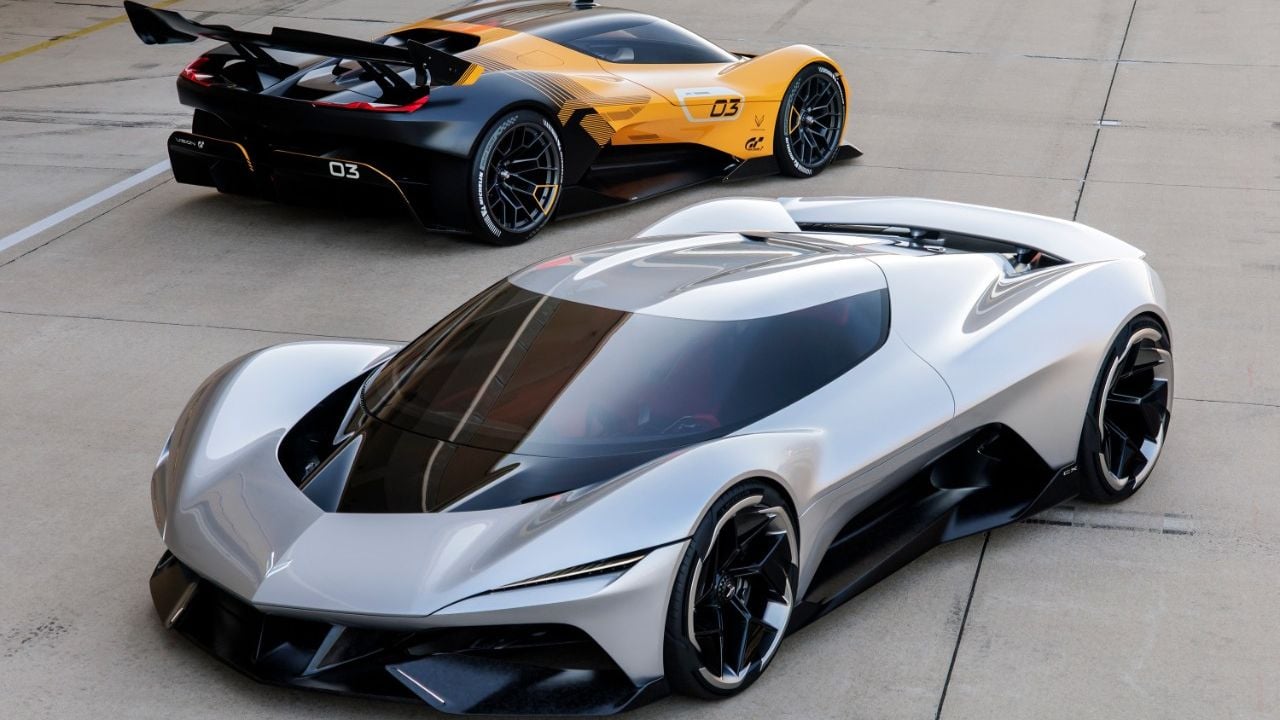
When the CX Concept glided into Monterey Car Week, it felt like a Corvette from tomorrow slipping through a time warp. Its canopy roof flowed back in one uninterrupted glass wave, inviting you into a cockpit that looked plucked from a sci-fi blockbuster. Inside, a single yoke and a digital dash glowed like control panels on a starship, promising adventures beyond asphalt. Underneath its sculpted skin, an electric heartbeat pulsed quietly; proof that horsepower can whisper instead of roar.
Though it never left the silver carpet of its debut, the CX Concept still ignites our hopes for a Corvette that cruises the future in silence.
Corvette CX.R Vision Gran Turismo

When the CX.R Vision Gran Turismo roared into Gran Turismo 7, it wore the CX’s futuristic shell but with a full race tune—an enormous rear wing, aggressive splitters, and diffusers honed for circuit use. Its hybrid powertrain pairs a compact twin-turbo 2.0 L V8, capable of screaming past 15,000 rpm, with three electric motors (two at the front axle, one tucked into an eight-speed gearbox) for a blend of endurance efficiency and explosive bursts of speed.
Inside, the stripped-back cockpit features carbon-fiber race seats, minimal padding for weight savings, and a button-studded steering wheel built to withstand brutal G-forces. Though it exists only in a simulator, the CX.R Vision Gran Turismo proves Corvette’s identity can stretch into hybrid racing frontiers without losing its signature fire.
When Dreams Stay on Paper but Live in Memory

Concept cars live in our imaginations long after the show lights dim, each Corvette prototype a testament to Chevrolet’s relentless ambition. Though many never wore license plates, their daring ideas, from bubble canopies to video games, paved the way for future generations. They remind us that automotive design is as much about dreaming as it is about producing, sparking excitement whether you see them in photos, galleries, or museum halls.
Which of these lost legends would you most want to drive, and what does that choice say about the driver you are at heart?