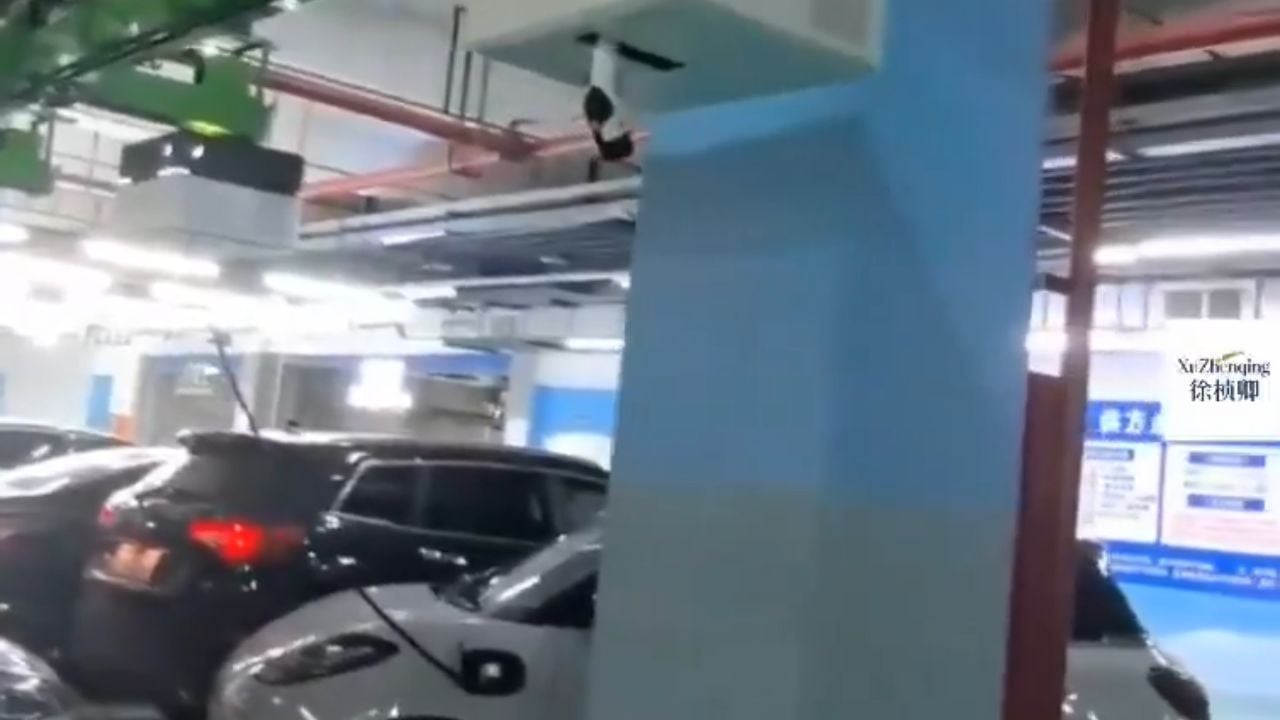

You may already be familiar with the futuristic yet real parking system in China, where ceiling-mounted robotic arms glide along rails in a multi-level garage, autonomously handling cars with precision. Drivers pull in, leave their cars, and the system takes over—lifting, transporting, and slotting cars into tight spaces without human intervention.
Now, imagine pulling into a parking garage and, instead of hunting for a charging bay, a robot glides silently along the ceiling, stops above your car, lowers a connector, and begins charging your vehicle.
That is not science fiction.
It is happening today in China, where parking garages are being outfitted with roof‑mounted EV chargers that travel on motorized tracks to meet drivers where they park. The system transforms every space into a potential charging station, effectively eliminating the bottleneck of limited chargers and the frustration of waiting in line.
How China’s Ceiling-Mounted Charging Robots Work

The technology works by installing rails along the ceiling of the garage. Chargers mounted on these rails move automatically to the location of a parked car. Once in position, the connector is lowered and plugged in, either manually or through semi‑automated guidance.
The result is a seamless charging experience that feels more like a service than a chore. Videos of these systems have gone viral on social, sparking global curiosity and admiration for China’s rapid innovation in electric vehicle infrastructure.
The contrast is striking. In the United States, EV adoption is growing steadily, but the charging landscape remains fragmented. Most garages and public lots rely on fixed charging stations, often limited in number and sometimes poorly maintained.
Drivers must plan routes around charging availability, and in busy urban centers, competition for a plug can be fierce.

While Tesla’s Supercharger network has set a high standard for speed and reliability, it is still based on the traditional model of designated charging bays. The idea of every parking spot being instantly convertible into a charging station is not yet part of the American conversation.
Pilot Programs, Not Yet a Nationwide Standard
It’s important to note that while China’s ceiling‑mounted EV charging robots, as seen on social media, are real, they are not yet a universal feature across the country.
Reports confirm that these systems have been deployed in multiple garages in several Chinese cities, particularly in dense urban areas where space efficiency is critical. They are part of pilot programs and early rollouts rather than a nationwide standard.
In other words, they are visible enough to spark viral videos and media coverage, but they remain innovative showcases rather than widespread infrastructure.

So, while China is ahead in experimenting with bold charging solutions, most EV drivers there still rely on more conventional charging stations. The ceiling‑mounted robots are a glimpse of what could become common in the future if adoption scales, which means the West is welcome to borrow a leaf or two from this emerging technology.
China vs. America: A Tale of Two Kings
China’s approach reflects its broader philosophy of scaling infrastructure quickly to match the pace of EV adoption. The country already leads the world in EV sales, with millions of units sold annually, and its government has aggressively supported charging innovation.
By embedding chargers into the very architecture of parking garages, China is solving two problems at once: maximizing space efficiency and democratizing access to charging.
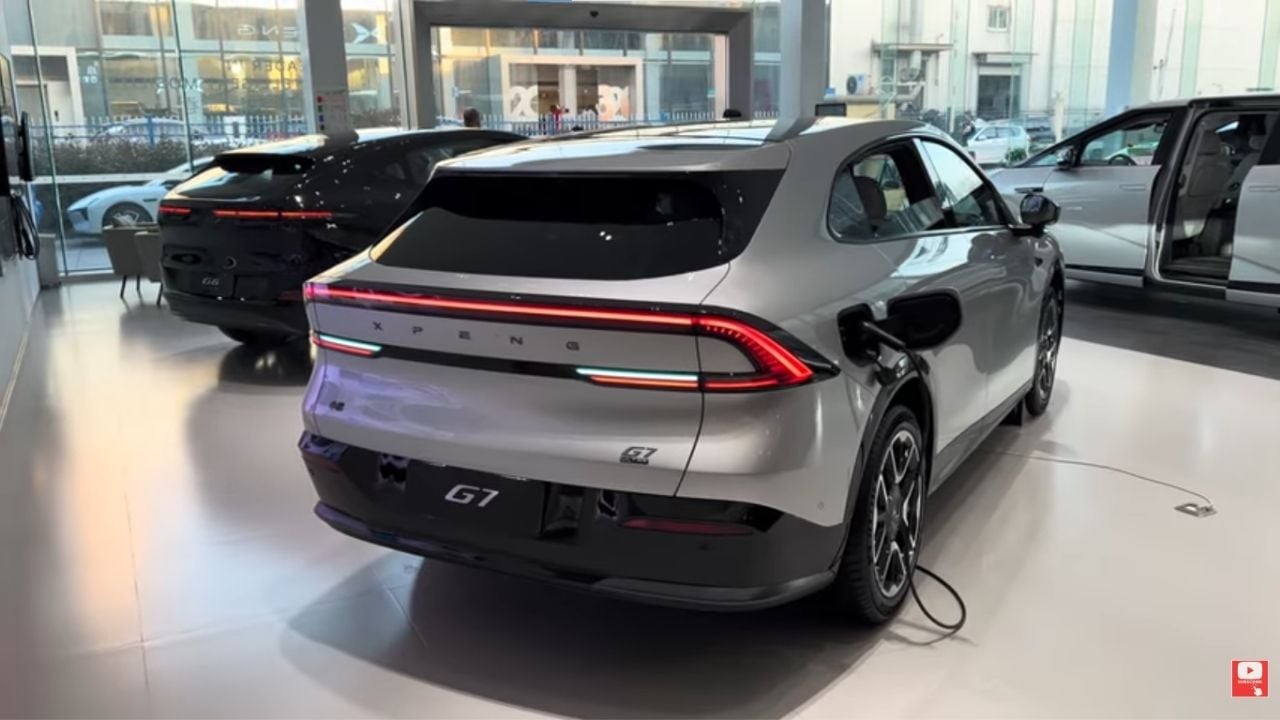
In effect, the garage itself becomes a smart grid, capable of serving dozens or even hundreds of vehicles simultaneously without requiring massive ground‑level installations.
The United States, by contrast, is still wrestling with questions of standardization, investment, and consumer confidence. Federal funding is flowing into charging networks, and automakers are beginning to converge on common connector standards, but the rollout is slower and more cautious.
American garages remain largely conventional, with charging stations added as afterthoughts rather than integrated into the design. The difference is not just technological but cultural. China is willing to experiment boldly, while the U.S. tends to prioritize incremental improvements and market‑driven solutions.
In China, some parking garages have roof-mounted EV chargers on motorized tracks that automatically travel to your parking spot so you can charge…
— Tansu Yegen (@TansuYegen) February 21, 2026
Which country is ahead? On sheer scale and innovation, China currently holds the advantage. Its willingness to deploy futuristic systems like ceiling‑mounted chargers demonstrates a seriousness about making EVs as convenient as they are accessible.
The U.S. excels in high‑performance charging technology, particularly with fast‑charging networks, but doesn’t quite match China’s creative infrastructure design. If America wants to catch up, it may need to embrace more radical ideas that rethink how and where charging happens.