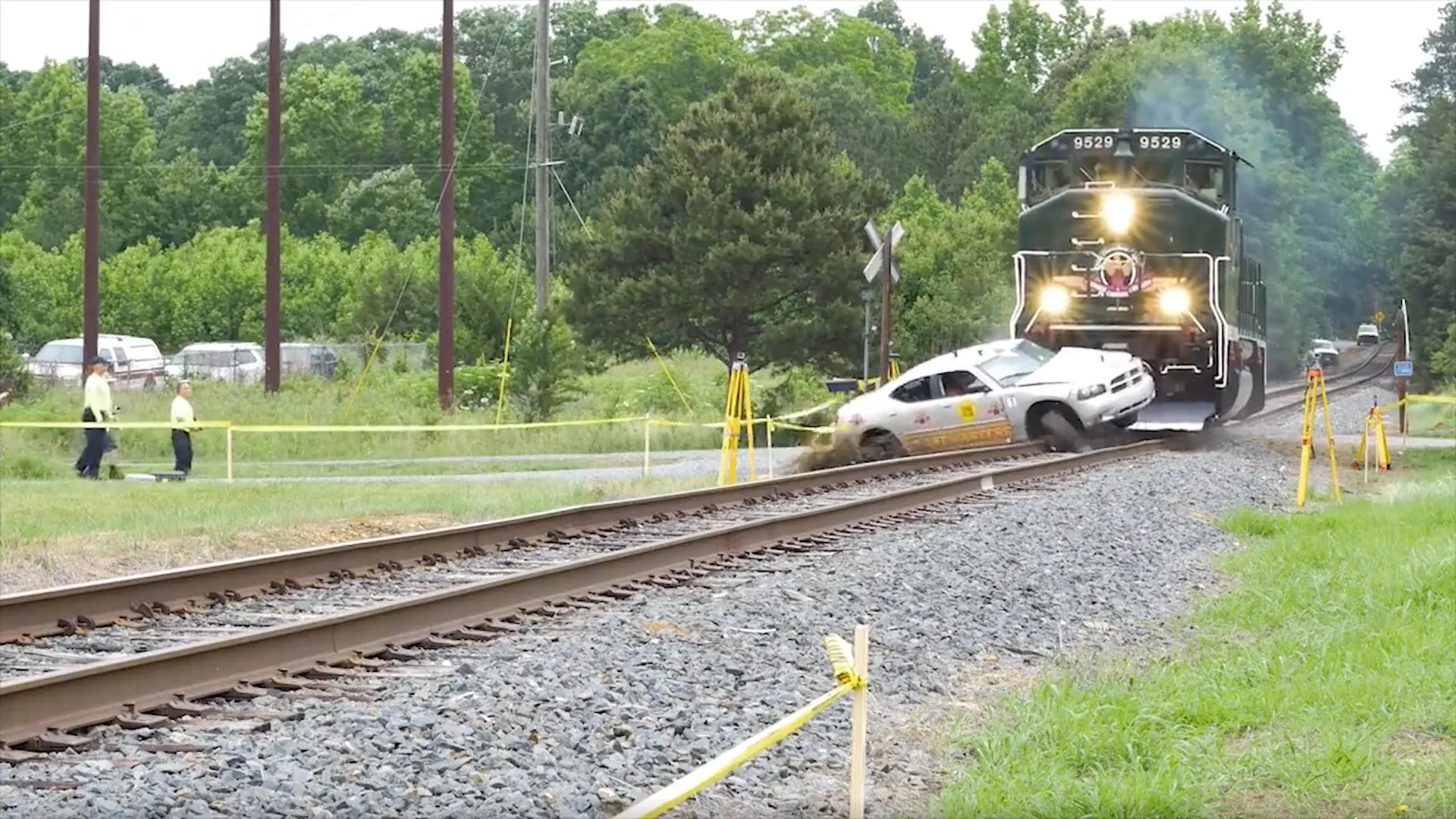
Wednesday afternoon in rural Linn County, Iowa, looked like a pretty ordinary day right up until a Honda Civic met a Canadian National freight train at a railroad crossing and lost. The collision, which happened just after 2 p.m. on Red School Road near Central City, left two people seriously injured and sent multiple emergency agencies scrambling to the scene. It was the kind of crash that serves as a blunt reminder of just how unforgiving rural railroad crossings can be.
The Linn County Sheriff’s Office confirmed the crash took place in the 5000 block of Red School Road, a stretch of road quiet enough that you might not expect anything to go wrong. But wrong is exactly what went. A 2004 blue Honda Civic, heading northbound, ran straight into a moving Canadian National train and then rolled into the ditch on the west side of the road. The scene that followed required the coordinated response of multiple agencies across the region.
Both the driver and the passenger in the Civic were transported to St. Luke’s Hospital by Center Point Ambulance with serious injuries. As of now, their identities and exact conditions have not been publicly released. The fact that both survived a direct collision between a small passenger car and a freight train is, frankly, remarkable, though “serious injuries” leaves plenty of room for concern.
The crash is still under active investigation by the Linn County Sheriff’s Office. That means questions about speed, visibility, crossing signals, and what exactly happened in those final seconds before impact are still being worked through by investigators. Until that picture is complete, a lot remains unknown.
Who Responded and How Fast They Got There
The scale of the emergency response tells its own story. Deputies from the Linn County Sheriff’s Office were joined by Linn County Rescue 57, Center Point Ambulance, Central City Fire, and Coggon Fire. That is a significant turnout for a rural crash, and it speaks to both the severity of the situation and the coordination required when a collision involves a train.
First responders were on scene around 2:08 p.m., just minutes after the crash was reported. In emergencies like this, response time matters enormously. The prompt arrival of multiple units almost certainly played a role in stabilizing the injured before transport to St. Luke’s.
What We Know About the Canadian National Railroad
Canadian National, commonly referred to as CN, is one of North America’s largest freight rail networks. The railroad operates thousands of miles of track across the United States and Canada, including routes through rural Iowa. Freight trains can stretch for over a mile in length and travel at speeds well above what most drivers account for when approaching a crossing.
That size and speed combination is part of why train collisions, even survivable ones, tend to result in serious injuries. A freight train cannot stop quickly. Physics simply does not cooperate. By the time an engineer sees a vehicle on the tracks, stopping the train before impact is often not a realistic option regardless of how fast they react.
What This Crash Can Teach Us About Railroad Crossing Safety
Rural railroad crossings are disproportionately dangerous compared to their urban counterparts, and crashes like this one are part of a persistent national pattern. According to the Federal Railroad Administration, thousands of incidents occur at highway-rail crossings across the country each year, and many of them involve roads that look exactly like Red School Road: quiet, rural, and easy to let your guard down on.
A few things drivers should keep in mind at every railroad crossing: never assume a track is inactive just because it looks quiet, always look both ways even if lights and gates are absent, and remember that trains are much closer and moving much faster than they appear at a distance. The deceptively slow look of an approaching train is one of the most dangerous optical illusions on the road.
Rural crossings often lack the full suite of warning infrastructure that urban crossings have. Some have lights and bells. Some have gates. Some have very little at all. Knowing what type of crossing you are approaching and slowing down accordingly is one of the most straightforward things a driver can do to reduce risk.
Investigation Continues
The Linn County Sheriff’s Office has not yet released details about what may have caused the driver to enter the crossing at the moment the train was passing. Whether signals were active, whether visibility was compromised, or whether other factors were involved remains part of the ongoing investigation.
Anyone with information relevant to the crash is encouraged to contact the Linn County Sheriff’s Office. Updates are expected as the investigation progresses and as the conditions of the two injured individuals become clearer.