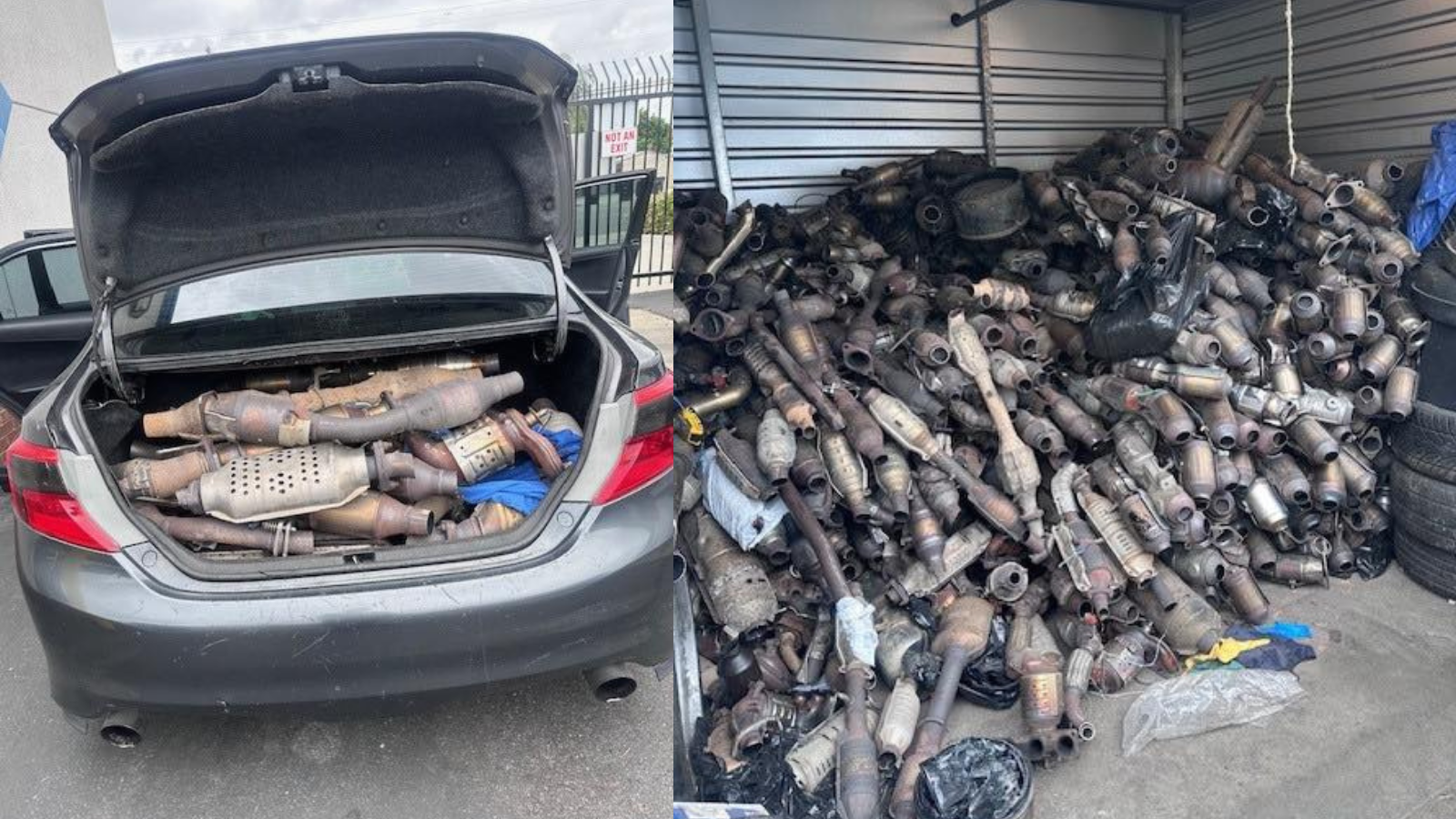
A months-long investigation in Southern California has led to the recovery of approximately 1,800 stolen catalytic converters, offering a clear look at the scale these theft operations can reach and the kind of coordinated effort required to shut them down.
Authorities say this was not a short-term effort, but a sustained investigation involving multiple agencies working together across jurisdictions.
The case highlights both the continued presence of catalytic converter theft and the impact of coordinated enforcement when resources and intelligence are shared. While individual thefts often happen quickly and quietly, operations like this show what can happen when law enforcement steps back and targets the larger network behind them.
Authorities say the operation disrupted an organized system responsible for moving stolen parts across multiple communities, cutting into a pipeline that likely extended well beyond a single city.
1,800 Converters Recovered in Multi-Agency Operation
Embedded media follows. Please allow a moment for it to load.
According to the Baldwin Park Police Department, detectives working with regional partners recovered approximately 1,800 stolen catalytic converters during a major operation centered in Norwalk. The scale of the recovery suggests this was not a small or localized theft ring, but a broader operation handling large volumes of stolen parts.
Authorities estimate the value of the recovered converters at more than $500,000. Police also noted that replacing a stolen catalytic converter can cost vehicle owners between $1,500 and $2,000, meaning the real-world financial impact on victims can quickly add up.
The department said the investigation led to multiple arrests, the seizure of vehicles, and the disruption of what it described as an organized theft operation impacting communities across the region. The investigation remains active, with additional arrests expected as authorities continue to follow leads.
A Coordinated System Behind the Theft
Details reported by SFGATE indicate investigators identified a South Los Angeles location where stolen converters were allegedly being purchased, along with a secondary storage site in Norwalk. That combination of buying location and storage hub points to a structured process rather than isolated incidents.
This type of setup allows stolen parts to move quickly from theft to resale, making it harder to trace individual crimes back to a single source. It also suggests that multiple thefts across different areas may have been feeding into the same operation.
Taken together, it paints a picture of a system designed for efficiency, where stolen converters are collected, consolidated, and prepared for resale with minimal delay.
The Vehicles Most Often Targeted
Data compiled by Carfax shows that thieves tend to target some of the most common vehicles on the road, including models like the Ford F-150, Honda Accord, Toyota Prius, Honda CR-V, and Toyota Tacoma.
These vehicles are not necessarily targeted because they are rare or exotic, but because they are widely available and often parked in predictable locations. That combination makes them easier to find and quicker to access.
Hybrids like the Prius can be especially appealing because their catalytic converters often contain higher concentrations of precious metals, increasing their resale value compared to some traditional vehicles.
Why These Parts Remain Targets
Catalytic converters continue to be targeted because they contain valuable materials such as platinum, palladium, and rhodium, which can be resold for profit, according to Carfax.
Even as theft patterns shift and enforcement increases, that underlying value keeps the incentive in place. A part that can be removed in minutes and sold for quick cash remains attractive to thieves.
While falling metal prices and increased oversight have reduced some of the upside, they have not eliminated the opportunity entirely.
How Drivers Can Reduce the Risk
While no method can guarantee prevention, there are several steps drivers can take to make their vehicles less appealing targets. Parking in well-lit, high-traffic areas can increase visibility, while using a garage when possible adds another layer of protection.
Installing an anti-theft device or protective shield can make removal more difficult and time-consuming, which may be enough to deter a thief looking for a quick opportunity. Even small delays can make a difference.
Some owners also choose to have their VIN etched onto the catalytic converter, making it easier for law enforcement to identify and recover stolen parts if they are found.
The Takeaway
This case stands out for its scale, but it also reflects the kind of coordinated enforcement effort needed to address organized theft. Rather than focusing on individual incidents, this investigation targeted the structure behind them.
Recovering nearly 2,000 stolen parts in a single operation is a significant result, and one that likely prevented further losses across multiple communities.
It also serves as a reminder that while the problem persists, focused investigations like this can make a meaningful impact.