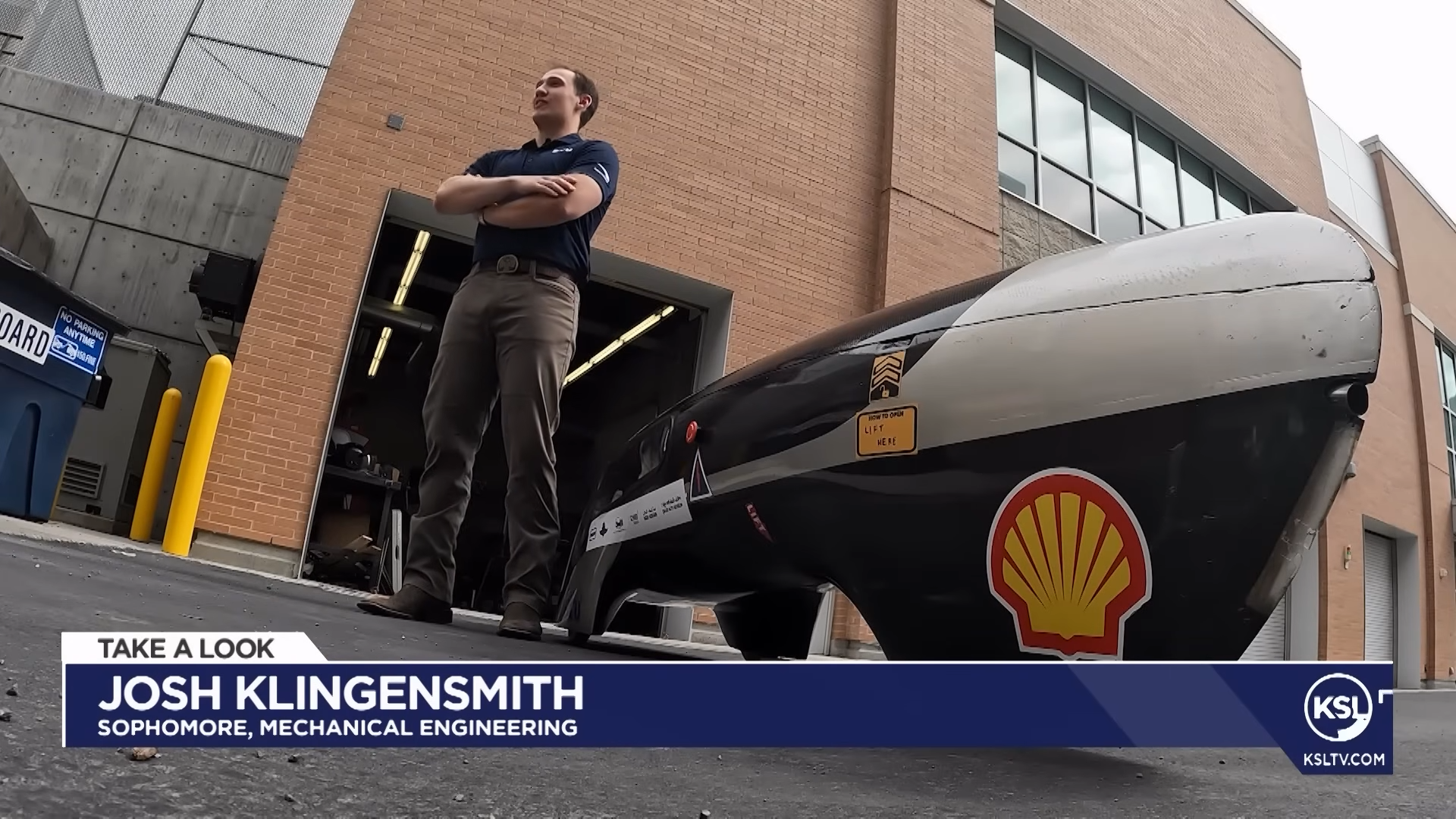
A group of 20 Brigham Young University students just made history by engineering the most fuel-efficient vehicle in the entire Western Hemisphere. The car runs on ethanol, tops out at a blistering 23 miles per hour, and fits a driver only if they weigh around 120 pounds and stand no taller than 5’4″. It is not exactly a Tesla Cybertruck, but in terms of pure engineering achievement, it might be even more impressive.
The student team competed in the Shell Eco-Marathon in Indianapolis, one of the most demanding fuel efficiency competitions in the world. Their custom-built vehicle was tested over a 10-mile circuit, where efficiency is calculated as an average across the entire run. No shortcuts. No lucky laps. Just consistent, precise performance that their car delivered with room to spare.
To put the number in perspective: 2,000 miles per gallon means you could theoretically drive from Provo, Utah to New York City on a single gallon of ethanol. Your everyday sedan would need somewhere between 40 and 50 gallons to do the same trip. The BYU vehicle would stop for fuel somewhere around every 15 to 20 miles since the tank is tiny by design, but the math still holds up in a spectacular way.
This is not a project born out of one person’s garage daydream. A team of 20 students, guided by Professor Dale Tree, spent serious time and effort stripping every unnecessary gram and component from this machine to see just how far engineering ingenuity could take them. The answer, apparently, is very far.
How They Actually Built a 2,000 MPG Vehicle
The secret to the car’s staggering efficiency is radical simplicity. The students designed the body out of carbon fiber, which is lightweight and stiff, and engineered custom components rather than relying on off-the-shelf parts. Every piece of the car was analyzed and optimized. If it added weight without adding function, it was cut.
The drivetrain runs on ethanol, a cleaner-burning alternative to gasoline that also plays nicely with high-compression engine designs. Professor Tree noted that the auto industry is already trending toward higher compression ratios and more aerodynamic shapes, meaning BYU’s students were not just playing a competition game. They were practicing the same problem-solving that automakers are actively working through right now.
The result is a vehicle so lean it has no air conditioning, no audio system, and barely enough interior space to call it a cockpit. Comfort was not the point. Physics was.
The Driver Has to Be a Very Specific Human Being
One of the more surprising details about this record-setting car is its strict driver requirements. The person behind the wheel must weigh approximately 120 pounds and be under 5’4″ in height. That is not an arbitrary rule from a quirky rulebook. It is a direct consequence of how aggressively the team minimized everything, including the space allotted for a human being.
The driver also needs specialized training because even at 23 mph, the car’s behavior is nothing like a normal vehicle. Every startup requires deliberate technique. The throttle response is immediate and sensitive, which is a funny thing to say about a car barely faster than a bicycle, but precision matters when you are trying to squeeze efficiency out of every single drop of fuel.
Fitting into this vehicle is genuinely a job requirement, not a suggestion. It is the automotive equivalent of being a jockey, where the human body becomes part of the engineering calculation.
What the Rest of the Car Industry Can Learn from 20 College Students
The most valuable thing about projects like this is not the headline number. It is the methodology. Professor Tree emphasized that no single person builds a car, even a tiny, ultra-efficient competition car. Every component is the work of a team. Each student owned a piece of the puzzle, whether that was aerodynamics, the fuel system, the body structure, or the drivetrain. That mirrors exactly how professional automotive engineering works at companies like Ford, Toyota, and every other major manufacturer.
The technologies being pushed in this car, including high-compression engines, ultra-aerodynamic body shapes, and lightweight materials, are already showing up in production vehicles. Hybrid engines use compression efficiency tricks. Electric vehicles are designed in wind tunnels. Carbon fiber is creeping into mainstream cars as the cost of the material drops. BYU’s team is essentially a fast-forward preview of where the whole industry is heading, just without the cup holders.
The broader takeaway is that dramatic efficiency gains are possible when you are willing to let go of assumptions about what a vehicle has to be. Most of what we call “standard” in a car is standard because of habit, not necessity.
Could Anything from This Car Ever Make It to Your Driveway?
The honest answer is: not this car, but absolutely some of what is in it. Nobody is going to commute to work in a carbon fiber pod that maxes out at 23 mph and requires a 120-pound driver. That market is probably limited.
But the engineering principles are already being absorbed into real-world vehicles. Automakers study competitions like the Shell Eco-Marathon specifically because they surface solutions that laboratories sometimes miss. When students with limited budgets and a lot of creativity manage to outperform decades of conventional automotive thinking, engineers take notice.
The future of fuel efficiency will probably not look like the BYU car. It will have air conditioning. It will have seats that fit actual adults. It will probably go faster than a casual jog. But it will owe something to the students in Provo who decided to find out what happened when you took every possible shortcut out of the equation and replaced it with pure engineering.