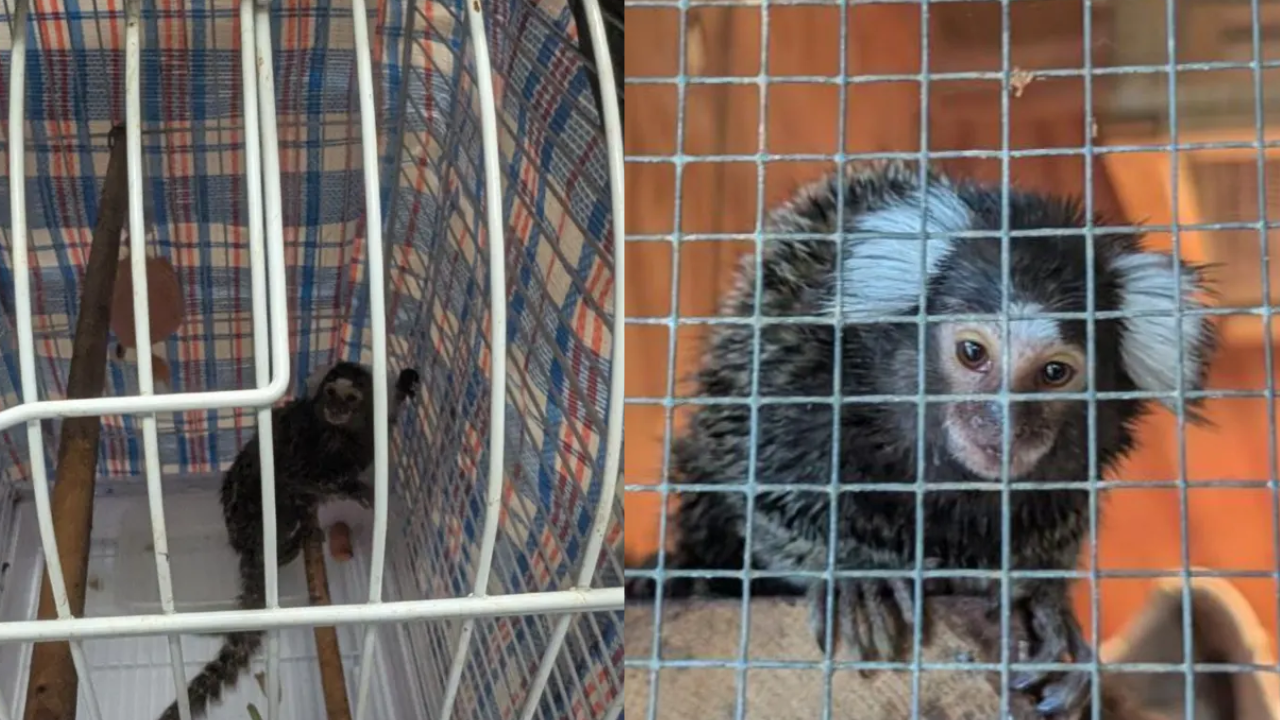
A bus driver in northwest London found a live monkey abandoned inside a laundry bag on board his vehicle Friday morning. The animal is a female common marmoset, and she had been shut inside a small white metal bird cage that was then wrapped in a checkered plastic laundry bag with handles. According to the BBC, the bag had been left in the luggage bay of a route 302 bus, and the driver found her toward the end of the run from Mill Hill Broadway to Kensal Rise.
A mother trying to get off the bus with a stroller couldn’t pass down the aisle, according to the RSPCA. The laundry bag was sticking out of the luggage bay and blocking the walkway. The driver came over to help her, and as he pushed the bag aside, the animal inside started chirping and jumping around. He looked into the bag and found the marmoset in her cage.
The driver, who has not been identified, took the marmoset to the Metroline bus depot at Willesden bus station. Staff there put her somewhere dark and cool to keep her calm, then contacted the RSPCA. Clare Dew, the charity’s chief inspector for London, told CNN that the monkey had been left with some apples and was stressed and dehydrated. No one on the bus had noticed anything unusual before the driver opened the bag.
Staff have since nicknamed the marmoset Oyster, after the travel card used on London public transportation. She’s now healthy and living at a sanctuary with specialist primate facilities, the RSPCA says. She had not been microchipped, which is a requirement under the primate licensing rules that took effect in England in April. It is still unknown who left her on the bus.
Why the RSPCA Thinks Oyster Was Abandoned Deliberately
Inspector Dew is investigating the case, and the RSPCA says the abandonment was intentional. The charity has tied it directly to the primate licensing rules that came into force in England in April, and it says it warned that abandonments of this kind would follow. Investigators plan to review CCTV footage and the records of passengers scanning on and off the bus to try to identify the person who left her there.
Dew thanked the driver and the Metroline team for keeping the animal calm and calling the charity. She also asked anyone struggling to care for a pet primate, or unable to obtain a license for one, to contact specialists, veterinarians or charities instead of abandoning the animal.
Evie Button, the RSPCA’s exotic animals expert, said primates are intelligent, social wild animals that need space, mental stimulation and appropriate companions, and that human company alone can’t meet those needs.
What England’s New Primate Licensing Rules Require
The Animal Welfare (Primate Licences) (England) Regulations 2024 took full effect on April 6, 2026. Anyone who keeps a primate in England without a license from their local authority is now committing a criminal offense under the Animal Welfare Act 2006.
Government guidance says licensed keepers must meet the welfare standards set for licensed zoos, covering enclosure specifications, diet, water, enrichment, social housing, temperature, and veterinary care. Existing keepers were able to apply from April 2025.
A license lasts a maximum of three years, and keepers face at least one inspection during that period and a reassessment before renewal. Penalties for keeping a primate without one include an unlimited fine, removal of the animal and up to six months in prison. Marmosets were not covered by the Dangerous Wild Animals Act 1976, so no license was needed to keep one in England before April.
The RSPCA estimates that around 5,000 primates are kept privately in the UK.