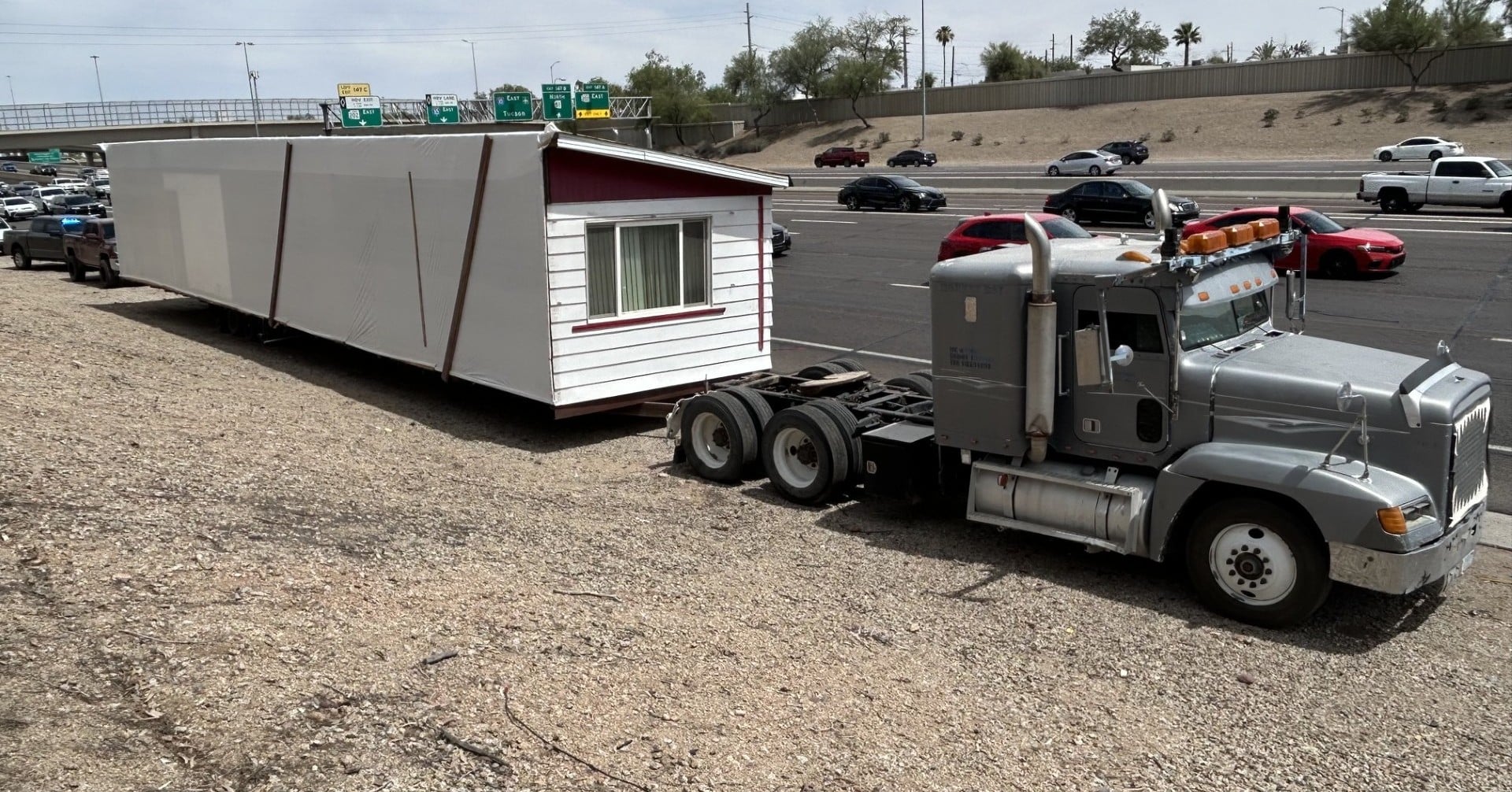
A Phoenix-area traffic stop on one of Arizona’s busiest interstates turned into something straight out of a highway safety horror story, with a trooper uncovering violation after violation on what was supposed to be a routine oversize haul.
On May 28, 2026, an Arizona Department of Public Safety Highway Patrol trooper with the Commercial Motor Vehicle Enforcement Unit pulled over an oversize load on Interstate 10 just east of the tunnel in Phoenix. The driver was headed from Mesa to Tonopah, and from the outside, it was already clear something was very wrong. The trailer had no lights and no flags — two of the most basic safety requirements for any oversize load operating on public roads in Arizona.
That was just the beginning. Once the trooper dug into a full inspection of the combination vehicle, the violations kept stacking up. No commercial driver’s license. No insurance. No oversize permit. No certified pilot car. And, perhaps most alarming of all, 10 of the 14 brakes on the vehicle were completely inoperative. In other words, if something had gone wrong on one of the Phoenix metro area’s most traveled stretches of freeway, there would have been very little stopping this load — literally.
By the time the inspection wrapped up, the driver had racked up 32 total violations. The vehicle was towed from the scene, and the driver faced numerous citations. AZDPS didn’t mince words about the situation, publicly sharing the stop with a simple message: “Please do not try this yourself.”
What Arizona Actually Requires for Oversize Loads
Moving an oversize load in Arizona is not something you improvise. The state has a detailed web of requirements that exist for a reason, and this stop is a case study in what happens when someone ignores all of them at once.
In Arizona, a vehicle requires an oversize permit if it exceeds 8 feet 6 inches wide, 14 feet high, 65 feet long, or 80,000 pounds. Beyond the permit itself, the visual requirements are strict. All overwidth loads and vehicles must be flagged with red or fluorescent orange flags at least 18 inches square on all four corners and at the widest points of the load, and any front or rear overhang must be flagged or lighted.
Oversize loads can only move during daylight hours, and no oversize movement is permitted through the greater Phoenix area during morning and evening rush hours. The load in this case was moving just after morning rush hour on I-10 — cutting it close even if everything else had been in order.
Pilot car requirements are also non-negotiable for many loads. Escort vehicle operators in Arizona must meet training and certification standards set by the Commercial Vehicle Safety Alliance, including traffic control techniques. The driver stopped by AZDPS had none of that in place.
The Brake Situation Is Alarming
Of all the violations logged during this stop, the brake failure stands out as the most dangerous by a wide margin. Ten out of 14 brakes being inoperative means the driver was essentially piloting an unstoppable mass through one of the most congested corridors in the Phoenix metropolitan area.
Arizona imposes specific weight limits on commercial trucks, and the maximum weight on any one axle cannot exceed 20,000 pounds. Oversize loads by definition push well beyond standard vehicle dimensions and weights. When a vehicle that large loses braking capacity, the consequences in a populated urban freeway environment can be catastrophic. AZDPS noted the haul was “legitimately unstoppable” — and that’s not hyperbole. It’s physics.
Federal trucking regulations under FMCSA rules require commercial vehicles to maintain braking systems that can bring the vehicle to a controlled stop within defined distances. Inspectors use brake adjustment standards as a core component of roadside safety checks for exactly this reason.
Why Oversize Hauling Is So Heavily Regulated
The rules around oversize loads aren’t bureaucratic red tape — they reflect real risk management for everyone sharing the road. A large, slow-moving load with wide dimensions and significant weight creates hazards that don’t exist with a standard passenger vehicle.
Every state and locale has its own oversize permits and regulations, and permits are often issued for one trip, 30 days, or annually depending on the need. Coordination with state authorities, advance route planning, and pilot car escorts all exist to give other drivers warning and give road crews time to manage traffic around unusual loads. Without those safeguards, an oversized vehicle becomes an unpredictable obstacle on a road designed for much smaller traffic.
Proper “Oversize Load” or “Wide Load” banners must be displayed on the uppermost front of the overall shipment, no less than 5 feet from the pavement line, with black lettering at least 6 inches high on a yellow background. These aren’t suggestions. They are the warning system that tells every other driver on the road to adjust their speed, change lanes, or slow down in advance of a large slow-moving vehicle.
What Happens When You Get Caught
This particular driver found out the hard way that cutting corners on an oversize haul has real consequences. Multiple citations, a towed vehicle, and a very public callout from AZDPS on social media made this one of the more memorable commercial vehicle stops in recent Arizona highway history.
Commercial vehicle violations in Arizona can carry significant fines, and operating without a CDL while driving a vehicle that requires one is a serious offense at both the state and federal level. To obtain a CDL in Arizona, drivers must meet age requirements, pass a background check, pass both a knowledge test and a practical driving skills test, and obtain a medical exam certificate. There are no shortcuts in that process for good reason.
Authorities have not released the driver’s identity, and AZDPS has not provided any information regarding the driver’s citizenship or immigration status. At this time, the documented violations involve commercial vehicle safety, licensing, permitting, insurance, and equipment compliance. If additional information is released through official records, we will update this story.
AZDPS put it plainly: “Oversize loads are a strategic move with every safety precaution in mind.” For everyone else on the road that morning on I-10, it’s a good thing a trooper with a sharp eye caught this one before it became something far worse than a traffic stop.
Of course it’s an American citizen, along with a healthy dose of meth judging by the picture. No immigrant would act so reckless or irresponsible.
AZ DPS did not release any identifying information, and it woudl be irrespsible for us to specualte. The full AZ DPS release was embed in the post, you can rach out to them if you like.
No name, no citizenship or immigration status tells you everything you need to know!
AZ DPS did not release the name or any idetifiying information in their release, if we had that information we would of shared it. If you are concerned that the lack of information please take it up with the AZ DPS there release was embed in its entirtiy in the article so you can reach out to them.