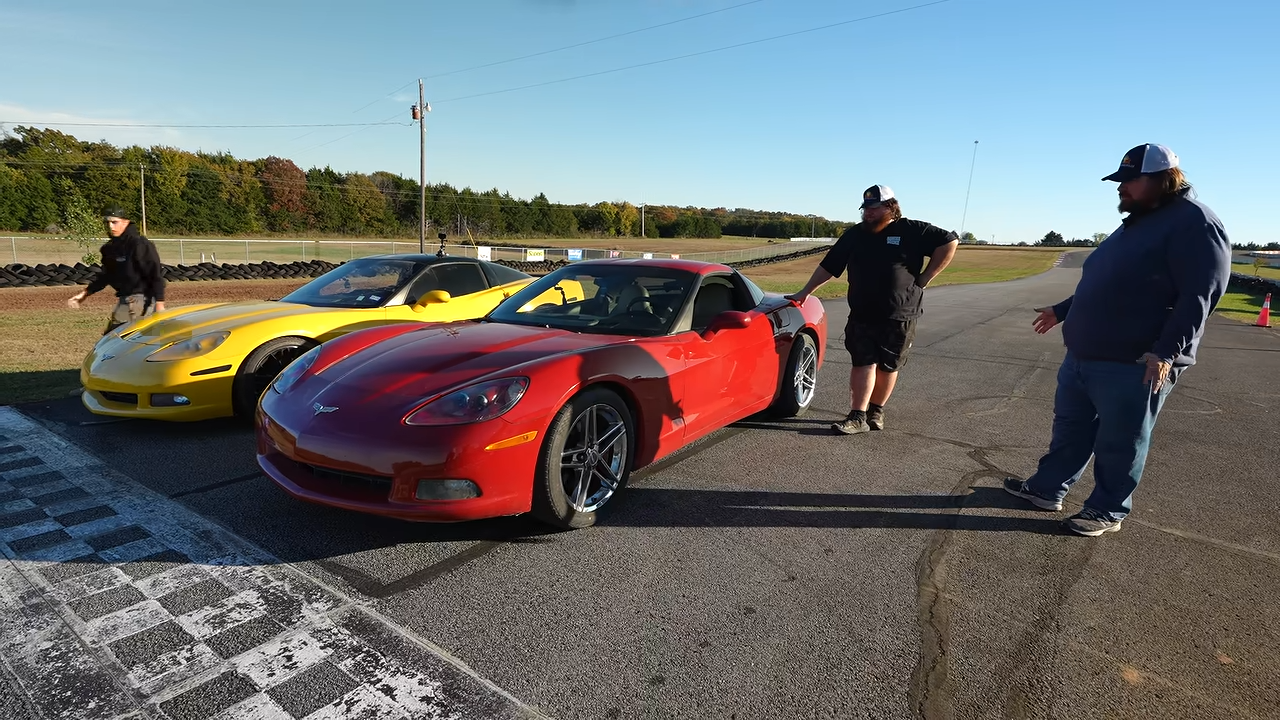
Westen Champlin has a simple philosophy when it comes to modifying cars: more horsepower makes everything better. His friend Garrett isn’t convinced. He believes a car that can brake harder and carry more speed through corners has a better chance of winning on a racetrack, even with less power under the hood.
To settle the argument, the two started with C6 Chevrolet Corvettes and took opposite approaches. Champlin installed a ProCharger supercharger on his red Corvette, while Garrett focused on the brakes, suspension, and handling of his yellow one. He also added a nitrous system for extra power.
Their destination was Hallett Motor Racing Circuit in Jennings, Oklahoma, where a series of challenges would put both theories to the test. The course has enough straightaways to reward a powerful engine, but its tight corners and elevation changes leave little room for mistakes.
In a video published on November 21, Champlin documents the builds, the mechanical headaches, and the competition that follows. What starts as a disagreement about modifications becomes a much more interesting question once he discovers how difficult his newly supercharged Corvette is to control.
Two Very Different Builds
Embedded media follows; please allow a moment to load.
Before changing anything, the two drivers raced their Corvettes in what turned out to be a remarkably close contest. Garrett’s manual-transmission car narrowly beat Champlin’s automatic, establishing a useful starting point before either build received its upgrades.
Garrett’s shopping list included Wilwood brakes, adjustable coilovers, QA1 suspension components, and a nitrous system. His plan was to improve the Corvette’s ability to slow down, change direction, and accelerate out of corners without relying entirely on engine output.
Champlin was considerably less interested in balance. He planned to leave the factory brakes and suspension alone and install a centrifugal supercharger, forcing additional air into the engine to produce more horsepower.
The installation required considerably more than simply bolting a new component onto the engine. Champlin and his helpers removed the front bumper, worked around the steering rack, and pinned the crankshaft pulley to prevent slipping under the additional load.
Garrett’s suspension installation presented a different problem. The upgraded components interfered with the front sway bar, requiring a clearance modification before the work could continue. His team also had to finish the nitrous plumbing, wiring, and brake installation.
Power Meets Pavement
Champlin initially expected to use the tune supplied with the ProCharger system, but a software delay threatened their schedule. Instead, a friend in Australia supplied a remote tune. The team also corrected a vacuum-line problem before taking the car out for its first proper drive.
The result impressed him immediately. He estimated that the Corvette now produced around 600 horsepower, although the video does not establish that figure with a dynamometer test.
Once the cars reached Hallett, however, the limitations of his approach became harder to ignore.
According to the circuit’s official specifications, Hallett is a 1.8-mile road course with 10 turns and more than 80 feet of elevation change. It rewards drivers who can carry speed through corners rather than simply accelerate along a straightaway.
Champlin quickly discovered that his Corvette’s rear tires struggled to put the added power onto the pavement. Garrett’s car, meanwhile, appeared more predictable through the corners, allowing him to maintain speed where Champlin had to back off the throttle.
At one point, Champlin compared his Corvette to a badger: cute and cuddly until it unexpectedly tries to kill you. The description was colorful, but his concern was genuine. The rear end repeatedly threatened to slide whenever the supercharger delivered its power.
The Braking Question
The first official challenge was a drag race, and the supercharged Corvette made its advantage obvious. Champlin pulled away from Garrett, winning by a comfortable margin.
Next came a braking test. Both drivers accelerated to approximately 60 mph before applying their brakes at a designated line. Garrett’s Corvette stopped in a shorter distance, giving his suspension-and-braking approach its own victory.
During the build, Garrett’s team suggested that the upgraded four-piston brakes could provide roughly twice the stopping power of the original two-piston setup. That claim should not be confused with a demonstrated halving of stopping distance. As Tire Rack explains, brake performance depends on factors including pad friction, operating temperature, and resistance to brake fade. Tire grip also limits how quickly a vehicle can stop.
The video doesn’t provide measured stopping distances or enough test data to determine precisely how much improvement came from the upgraded brakes.
The two Corvettes had now split the first challenges. Champlin had the quicker car in a straight line, while Garrett’s modifications appeared better suited to bringing a car under control.
That left the competition’s most demanding event: a timed run around the full circuit.
A Difficult Two Laps
Each driver would complete two laps, with the combined time deciding the winner.
Champlin’s first attempt went wrong almost immediately. His Corvette began smoking and appeared to enter a reduced-power mode before he could complete the opening section. After the car recovered, the drivers agreed to restart his attempt.
Even with the mechanical problem behind him, the run was anything but smooth. Champlin repeatedly fought for rear traction, describing the car stepping sideways as he tried to accelerate out of corners. On the straights, the additional horsepower made the Corvette exceptionally quick.
Garrett’s run looked different. His yellow Corvette carried speed more confidently through the turns, and its upgraded brakes let him attack corners. By the finish, the brakes were visibly smoking from the effort.
Neither driver lacked confidence, although Champlin admitted his Corvette was probably more entertaining than it was easy to drive.
When the results were announced, the difference between their driving experiences made the numbers particularly interesting.
Seven Seconds Apart
Despite struggling through the corners, Champlin won. His supercharged Corvette completed the two laps in a reported 3 minutes, 33 seconds, compared with Garrett’s 3 minutes, 40.1 seconds.
Garrett could hardly believe the difference. His car had appeared so much more composed, yet Champlin’s advantage on the straights had been enough to overcome the time he lost in the turns.
The individual lap times offered another perspective. Champlin’s fastest lap was reportedly 1 minute, 46.71 seconds, while Garrett managed 1 minute, 46.95 seconds, a difference of just 0.24 seconds.
That narrow margin complicates the claim that horsepower alone settled the debate. The Corvettes had different transmissions, tires, and mechanical setups, and the drivers weren’t necessarily extracting the same percentage of performance from their cars. The video also doesn’t establish that the lap times were independently verified.
Still, Champlin was delighted with the outcome. He declared that horsepower was the only modification a Corvette needed, although the experience had already given him an idea for another experiment: putting Garrett’s suspension and braking upgrades on his supercharged car.
Garrett had a competing proposal. He wanted to put Champlin’s power upgrades on the yellow Corvette instead. Neither seemed particularly interested in letting the other have the final word.