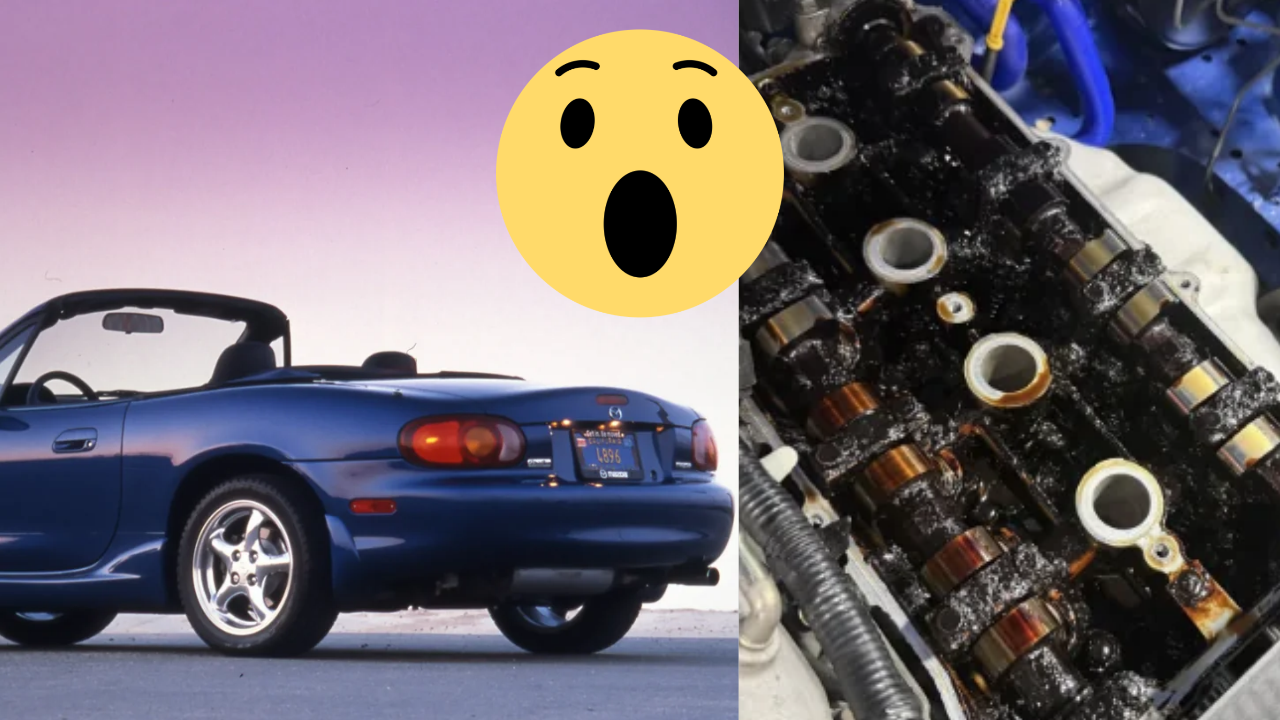
A routine gasket replacement on a 1999 Mazda Miata should have been a fairly straightforward job. Instead, one owner removed the valve cover and uncovered a mess that had them questioning whether the engine was worth saving.
The car was no ordinary Miata, either. It was a 10th Anniversary Edition with just 65,000 miles on the odometer, making the condition beneath its valve cover particularly difficult to stomach.
Photos shared on Reddit show thick, black sludge coating the exposed engine components. The owner immediately suspected the previous owner had neglected oil changes, although the car’s actual maintenance history remains unknown.
What followed was an outpouring of advice from fellow Miata enthusiasts, some insisting that the engine could be rescued with a few oil changes and others warning that cleaning it too aggressively might make things worse. The owner was left weighing a potentially expensive engine replacement against a repair that could carry risks of its own.
A Nasty Surprise
Embedded media follows; please allow a moment to load.
Just fell to my knees in my garage
by
u/interesting-lotus in
Miata
The owner, posting as u/interesting-lotus, explained that the discovery came while changing a valve-cover gasket. They had expected to find the engine’s valvetrain, not an alarming amount of sludge covering much of what should have been exposed metal.
“Shout out to the old man who owned it before me and clearly thought oil changes were optional,” the owner wrote. The frustration was understandable, especially given that this was a limited-edition Miata rather than an ordinary high-mileage project car.
Mazda introduced the 10th Anniversary Edition for the 1999 model year to celebrate a decade of the MX-5. The special edition featured a six-speed manual transmission, Bilstein suspension components, a Torsen limited-slip differential, and distinctive Sapphire Blue Mica paint.
Those details make the car desirable to enthusiasts, but none protect its engine from poor maintenance. Even a special-edition roadster needs regular oil changes, and a low odometer reading offers little reassurance when the internals look like this.
Can It Be Saved?
The Reddit discussion quickly turned into an informal rescue operation, with commenters offering everything from repeated oil changes to specialized cleaning products. One popular suggestion involved using Valvoline Restore & Protect oil and shortening the intervals between changes to gradually remove deposits.
The owner wasn’t entirely convinced. “I’m just worried about blocking oil inlets and starving,” they replied, raising the possibility that dislodged sludge could interfere with oil circulation and leave engine components without adequate lubrication.
Another commenter suggested trying to clean the engine before committing to a replacement. The owner eventually acknowledged the argument, joking that the worst outcome would be the engine blowing up anyway.
That concern about oil starvation is more than an internet theory. According to O’Reilly Auto Parts’ engine sludge guide, accumulated sludge can restrict oil passages and prevent proper lubrication, potentially causing severe internal damage.
The guide also cautions that flushing an engine with serious sludge buildup can be dangerous if oil circulation has already been compromised. Since chemical flushes generally require the engine to run, attempting to clean a severely restricted lubrication system could cause additional damage.
For extreme cases, O’Reilly recommends mechanical cleaning, including removing the oil pan and clearing deposits from the oil pump pickup. More extensive contamination may require partial engine disassembly, making professional evaluation particularly important.
What Went Wrong?
Although the owner blamed missed oil changes, there are several possible explanations for severe sludge buildup. Oil can deteriorate over time, while repeated short trips, unsuitable operating conditions, and problems with the positive crankcase ventilation system can contribute to contamination.
Mazda’s own maintenance guidance makes clear that oil service is not something owners should put off indefinitely. The 2000 MX-5 Miata owner’s manual, for the following model year, specifies oil and filter changes every 7,500 miles or six months under normal driving conditions.
For vehicles frequently driven short distances, left idling for extended periods, or operated under other demanding conditions, Mazda specifies a more frequent schedule of 5,000 miles or four months. The intervals are based on whichever limit comes first, making time just as important as mileage for a vehicle that spends much of its life parked.
That distinction matters for an older enthusiast car with relatively few miles. An engine that has traveled only 65,000 miles over more than two decades could still have suffered from infrequent servicing, particularly if oil was left sitting through long periods of limited use.
The Reddit owner has not provided service records establishing exactly what caused the buildup. Their photographs document the condition beneath the valve cover, but they do not establish how much internal damage has occurred or whether the engine can be recovered.
For now, the owner has been considering cleaning attempts and the possibility of an engine swap. No confirmed outcome was provided in the discussion, leaving the future of this 10th Anniversary Miata dependent on what further inspection reveals.