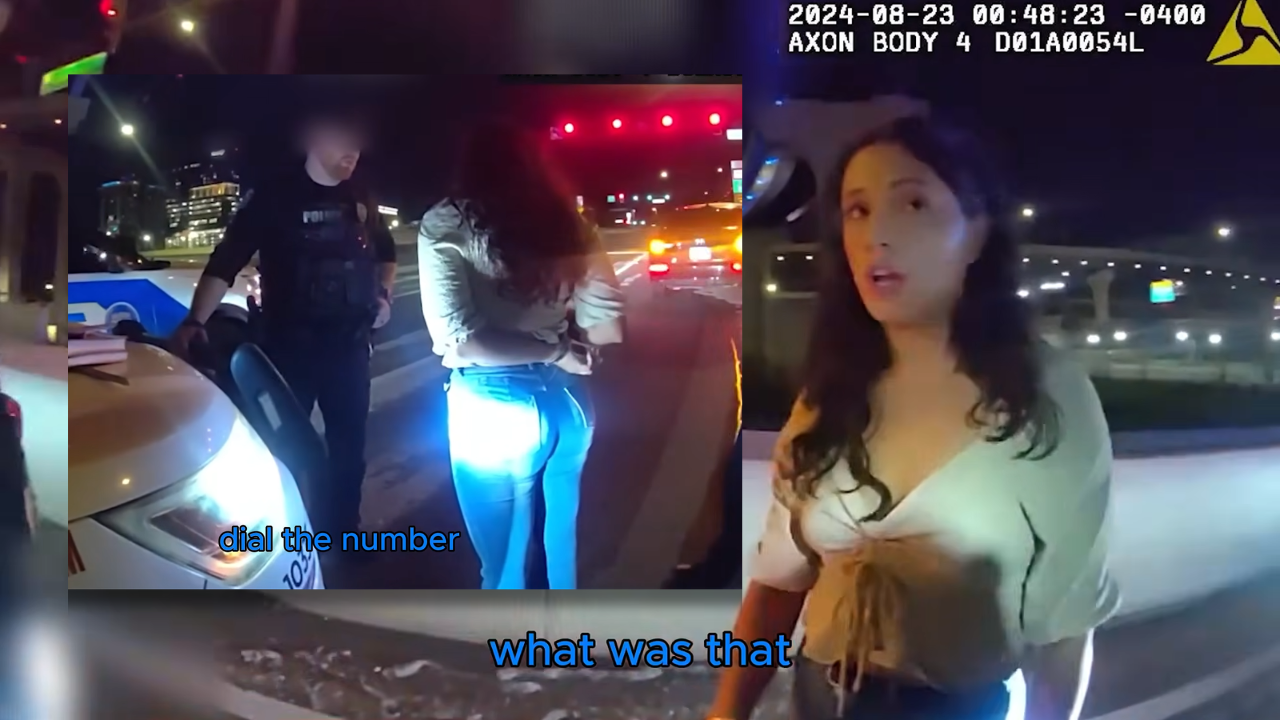
An older Orlando traffic stop is drawing fresh attention after a bodycam channel posted an exchange between a driver and police. What began with a dispute over a turn signal ended with the woman in handcuffs, asking why she was being arrested.
Bodycam Exposed TV published the video on October 30, 2026, showing an August 23, 2024, encounter involving the Orlando Police Department. The channel adds its own legal commentary between portions of the bodycam footage.
During the stop, an officer questioned 25-year-old Benita Elisabeth Feliciano about drinking and smoking before asking her to perform roadside sobriety exercises. She agreed but disputed his account of her speech and later challenged his decision to arrest her.
Orange County court records obtained and reviewed by Guessing Headlights confirm that Feliciano was arrested on suspicion of driving under the influence and charged with refusing DUI testing. Prosecutors subsequently dropped the misdemeanor charge on November 1, 2024. The court filing does not explain why.
A Closer Look
Embedded media follows; please allow a moment for it to load.
According to the arrest affidavit, Orlando Police Officer Edwin Rosario observed Feliciano driving a black Honda Civic shortly after 12:40 a.m. He reported that she failed to signal before turning left from Gore Street onto Division Avenue and subsequently stopped her near Division Avenue and Anderson Street.
At the driver’s window, Rosario said she had used her signal but had not signaled before making the left turn. He then asked where she was coming from and whether she had smoked that night.
Feliciano denied smoking that night and said she had consumed two shots earlier in the day. A wristband drew another question about whether she had been at a bar, and she explained that it was from brunch.
As the questions continued, Rosario said the car smelled of freshly burned cannabis and accused her of slurring her speech. She rejected that description and objected when he opened her door.
The arrest affidavit provides additional details about the officer’s observations. Rosario reported that Feliciano repeatedly dropped her purse while searching for her driver’s license. He also questioned her account of traveling between Casselberry and Maitland, two communities located northeast of the traffic stop.
After pointing out what he described as a blunt, Rosario ordered her out of the car. Outside, he asked about her sleep, food, health, and medication before turning to the sobriety exercises.
Drawing the Line
Asked to rate her level of impairment from zero to 10, Feliciano answered two. She again said she had last consumed alcohol that afternoon and agreed when Rosario asked whether she would perform the exercises.
He explained an eye-tracking exercise, a heel-to-toe walk, and a one-leg stand. Afterward, he directed her to turn around and announced that she was under arrest for driving under the influence.
“I passed the test,” Feliciano protested during the exchange.
Rosario replied, “I never said pass or fail.”
His arrest affidavit provides a more detailed account of what he observed during those exercises. During the horizontal gaze nystagmus test, which examines involuntary eye movements, Rosario documented six of six possible clues associated with impairment.
During the walk-and-turn exercise, he reported four of eight possible clues. Although instructed to take nine steps in each direction, Feliciano took 17 steps forward and 16 returning, according to the affidavit. Rosario also reported that she stopped walking, had difficulty maintaining her balance during the instructions, and made an incorrect turn.
During the one-leg stand, Rosario reported two of four possible clues, including swaying and using her arms for balance.
Those observations formed part of Rosario’s stated basis for the arrest. They were the officer’s assessments, however, and the exercises did not establish a measured blood alcohol concentration.
Attention then shifted to her Honda and whether someone could pick it up. She asked for her phone, but the attempt to arrange a pickup led to another dispute as officers pressed her to make the call.
One officer eventually announced that the car would be towed, and repeated warnings about a resisting charge followed. Feliciano denied resisting, and the arrest records reviewed do not show that she was charged with resisting an officer.
Near the end of the exchange, she asked where they were going. An officer answered, “The jail.”
What Happened After the Arrest
The bodycam video ends before Feliciano’s time at the Orange County DUI Testing Center, but documents filed with the Orange County Clerk of Courts establish what happened next.
Feliciano arrived at the testing facility, where a breath-test operator began a required 20-minute observation period at 1:16 a.m.
According to the operator’s report, Feliciano refused to take a breath test and asked to speak with her attorney after Rosario explained the consequences of refusing.
The operator prepared an Intoxilyzer 8000 anyway, giving her an opportunity to provide a sample. The official test record shows two attempts, at 1:47 a.m. and 1:52 a.m. Both were recorded as “NSP,” meaning no sample provided.
The operator reported that Feliciano made no attempt to provide a valid breath sample during either opportunity. Rosario formally recorded the refusal at 1:54 a.m.
Feliciano was booked into the Orange County Jail at 3:24 a.m. on a misdemeanor charge of refusing to submit to DUI testing under Florida Statute 316.1939(1). Her arrest affidavit listed a $1,000 bond. Although Rosario arrested her on suspicion of DUI, the court records reviewed do not show a separate criminal DUI charge.
The criminal case ultimately ended without a conviction.
On November 1, 2024, the Ninth Judicial Circuit State Attorney’s Office filed a nolle prosequi, formally dropping the refusal-to-submit charge against Feliciano. The filing identifies the charge but provides no explanation for the prosecution’s decision.
Under Florida law in effect at the time, a criminal charge for refusing a breath test generally required a qualifying previous refusal. A first refusal ordinarily resulted in an administrative driver’s-license suspension rather than a separate criminal refusal prosecution. The records reviewed do not establish whether Feliciano had a qualifying prior refusal or whether that legal requirement influenced the decision to dismiss her case.
The documents also do not establish whether she faced an administrative license suspension, which is separate from the criminal proceedings.
For viewers encountering the footage more than two years after the traffic stop, the court records provide an important ending. Feliciano was arrested after an officer reported multiple signs of impairment, declined to provide a valid breath sample at the testing center, and was booked into jail. The only criminal charge documented in the reviewed case was subsequently dropped by prosecutors.
All parties are presumed innocent unless and until proven guilty in a court of law.