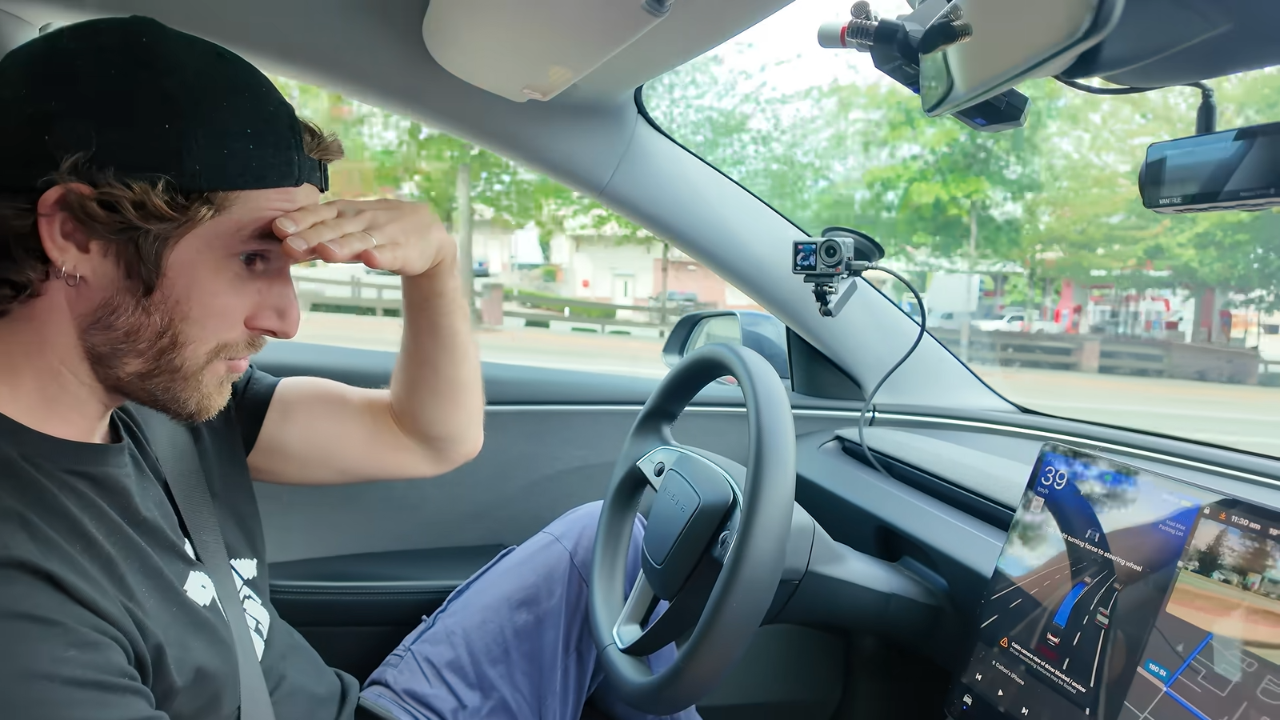
Linus Sebastian had gone from picking apart a Tesla’s controls to praising how little he had to do behind the wheel. Then an intersection left him reaching for the brake and asking for a minute to decompress.
In a Linus Tech Tips video shared November 5, the tech host borrows colleague Colton’s Model 3 to try Full Self-Driving (Supervised). Colton gets Linus’s Porsche for a month as part of the swap.
Much of the first outing gives Linus reasons to like the Tesla. As the miles pass without him steering, he imagines a future car that could let him work during his commute.
But his test also exposes a problem he later spells out: a system that seems capable can make him slower to take over. The moment that changes his mood comes after the car starts moving with no destination listed.
A Promising Start
Embedded media follows; please allow a moment to load.
Getting started involves some grumbling about the touchscreen gear selector and missing turn-signal stalks. Buying the driving software goes more smoothly than setting up his account, though, prompting jokes about how easily Tesla takes a payment.
Once underway, Linus finds plenty to praise. Even an odd lane change, followed by a move back, does not count as a failure in his view if the car gets itself into the correct lane.
“I have not touched the steering wheel one time,” he says during the drive. “That’s pretty sick.”
In a separate test, he tries to see how the car reacts when it cannot clearly see his eyes. He reads out warnings asking for steering input, followed by a message that the cabin camera’s view is blocked or unclear. The hazards come on, and he later reads a warning about improper use.
A Wrong Signal
After a stop, the Tesla begins moving while the men discuss its lack of a destination. Rather than immediately choosing one, they decide to see where it goes.
Around the 26-minute mark, Linus brakes and the system disengages. He then describes the car signaling right, approaching the intersection, and continuing straight while another driver turns left.
The signal had helped convince him that the Tesla knew what it was doing. Comparing it with his earlier comma.ai test, he explains that he had been quicker to step in with the less capable system.
Here, the car’s earlier performance had changed how he reacted. “The way that it handled that was not cool,” Linus says.
Still His Job
Tesla describes FSD as a feature that needs active driver supervision and does not make the vehicle autonomous. Even when it handles steering, the person behind the wheel must stay ready to take over.
Linus continues the test and finds more to like on the return trip. Near the office, he praises the car for waiting for someone to pass, before it finds a parking space in the wrong lot.
His final verdict still gives the software credit. With the intersection scare set aside, he calls the return drive impressive: “Zero interventions all the way to the wrong parking lot.”