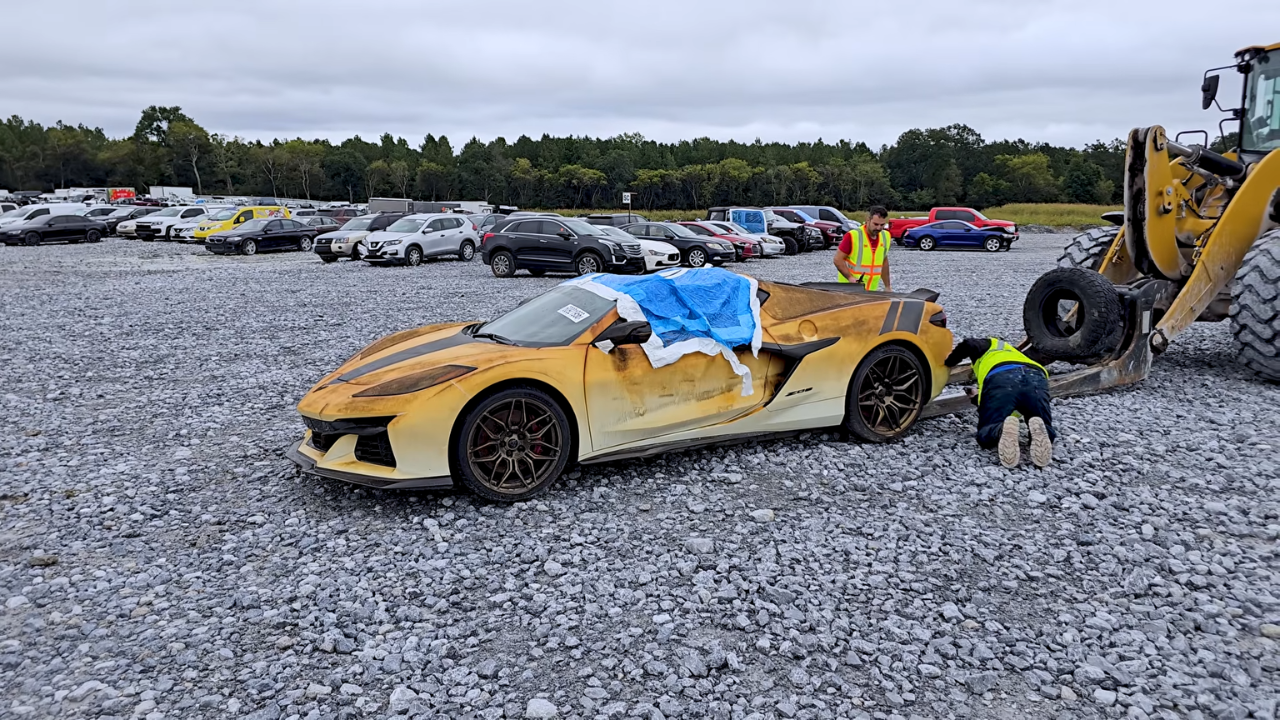
A small patch of white paint helped persuade the Chicago-based host of LegitStreetCars to bid $65,000 on a fire-damaged Corvette. He hoped the car beneath its blackened surface was in much better shape than the auction photos suggested.
His purchase was a 2025 Corvette Z06 3LZ with just 3,000 miles on its dash. In his October 31 video, he puts its original selling price at $155,000, but his own bill topped $70,000 once auction fees were added.
The clue was paint protection film, often called PPF. If the coating had taken much of the visible damage, he thought peeling it away might reveal a white Corvette worth saving.
“This might be the most expensive mistake I’ve ever made or my best car purchase ever,” he says. The auction offered the car as-is, with no engine photos or pictures of the dashboard powered up, leaving him to collect it in Georgia before he could inspect those costly unknowns himself.
Under the Grime
Embedded media follows; please allow a moment for it to load.
At pickup, both mirrors had melted, and the removable roof panel was missing. The tan cabin was coated in dark residue, but the leather still felt soft, and the rubber roof seals remained flexible.
A quick cleaning test cut through the grime on one bronze wheel. Inside, rubbing a finger across some surfaces also removed black soot, giving him a reason to keep testing before buying replacement trim.
Opening the engine compartment brought another useful discovery: the engine was present, with wiring and plastic tubing he found intact. He did not try to start it at the auction.
Once home near Chicago, he raised the Corvette on a lift and found no visible fire damage underneath. He did identify scrapes and damaged plastic panels he attributed to the auction forklift, along with a cracked carbon-fiber trim piece and heat-distorted grilles that would need attention.
Those findings helped narrow the repair list, but they did not establish how the fire happened. His theory that the car had been caught in a garage fire remained a theory throughout the episode.
Back at the Shop
The dashboard had briefly lit up at the auction. Back home, screens went blank or flickered, lights flashed, and his diagnostic scanner reported several lost-communication faults.
While removing interior panels, he found water near a fuse area. Turning on the climate system also sent water out inside the cabin, prompting him to suspect rain had entered through the missing roof and contributed to the electrical trouble.
That remained an unfinished diagnosis. He checked fuses and reset the battery, but the screens and communication problems persisted as he worked toward a first start.
After inspecting the air filters and confirming the engine contained oil, he pressed the start button. The 670-horsepower, 5.5-liter V8, identified in GM TechLink as the LT6, cranked but did not start. After that failed attempt, he lifted the floor mat and found wet material underneath, adding another area to investigate.
Before stopping work, he tested a section of tan door trim with cleaner and a gentle brush. Much of the dark coating came away, and nearby carbon-fiber trim and chrome also cleaned up, while the condition of the buttons still needed more work to assess.