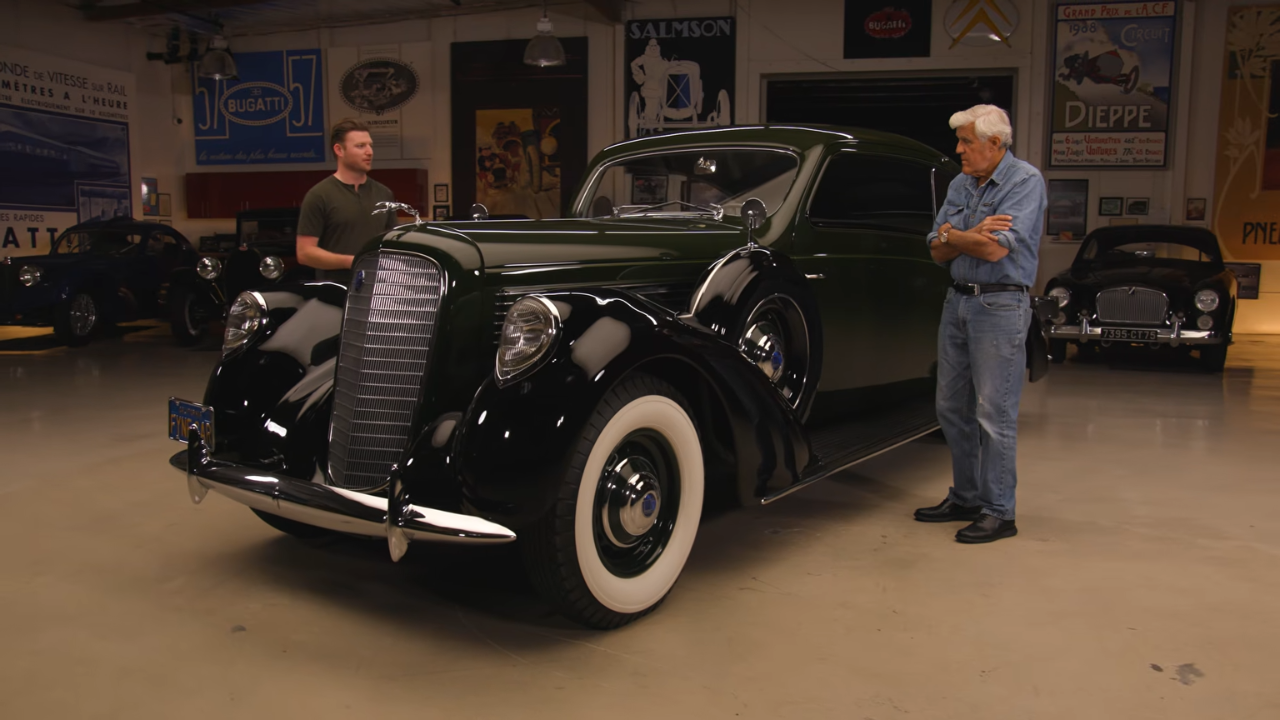
A one-off 1938 Lincoln might seem like a car its owners would save for a short trip across a show field. The family behind California’s Nethercutt Collection has put more than 50,000 miles on this one since acquiring it.
Curator Cameron Richards brings the Model K V12 from the collection in Sylmar, California, to Jay Leno’s Garage. During their walk around and drive, the two explore a touring coupe with a custom body by Judkins, a firm whose work helped wealthy buyers choose how their cars would look.
The coupe comes from an era when a luxury car buyer could order much more than paint and upholstery. An outside company could build the body around a manufacturer’s chassis, giving the car its own shape.
Richards describes this Lincoln as the last car Judkins bodied. Its history includes an intended connection to Edsel Ford, a sale its former owner later reversed, and decades of use by the Nethercutt family.
A Personal Touch
Embedded media follows; please allow a moment for it to load.
The Classic Car Club of America Museum traces Judkins’ relationship with Lincoln to a Boston dealer’s order in 1921. Through 1939, the firm produced 5,904 custom and series-custom Lincoln bodies. Some customers commissioned individual designs, while others chose designs from a catalog.
In Richards’ account, the coupe was supposed to be a gift for Edsel Ford, but Ford’s designers considered it too far ahead of its time. Judkins kept it as a personal car. Its open side-window treatment prompts Leno to compare it with the pillarless hardtops that became familiar in the 1950s.
That personal connection survived a change of ownership. Richards explains that Judkins sold the Lincoln, then tracked it down in Florida and bought it back in the mid-1960s. After his death, his wife contacted Dorothy Nethercutt, knowing that she and J.B. Nethercutt admired the car; they acquired it in 1969.
Room to Swing
Getting into the two-door coupe requires room beside it. Each rear-hinged door measures about five feet long, yet the hand crank moves its large window through its full travel in just two and a half turns. Closing the door takes a firm slam, especially with the windows raised.
Beneath the aluminum body sits a V12 rated at 150 horsepower, paired with a three-speed manual transmission. Reaching it can be awkward: Richards explains that both side-mounted spare tires had to come off for access. Before the visit, the team also fixed a spark plug that was arcing.
Inside, Leno compares the huge gearshift knob to grabbing a bowling ball. A heater serves the passengers, but there is no radio, power steering, or power brakes. Drum brakes handle the stopping, and Richards puts its comfortable cruising range around 40 to 45 mph.
Once they are on the road, Leno notes that they have reached 60 mph and finds the engine less strained than he expected. He also remarks on the limited wind noise and how easily people in front could talk with passengers in the back.
A Few More Miles
The odometer needs some context: Richards explains that it was reset when the family acquired the Lincoln. The reading therefore reflects their use, not the car’s lifetime mileage, and he recalls driving it across the country and back more than once.
“If it gets another rock chip, we’re not going to scream and cry about it,” Richards says. “It’s a car. It’s meant to be driven.”
The Nethercutt Collection records a first-in-class win for the coupe at Amelia Island. It also lists a second-in-class finish at San Marino, where the Lincoln was driven to the show and back.