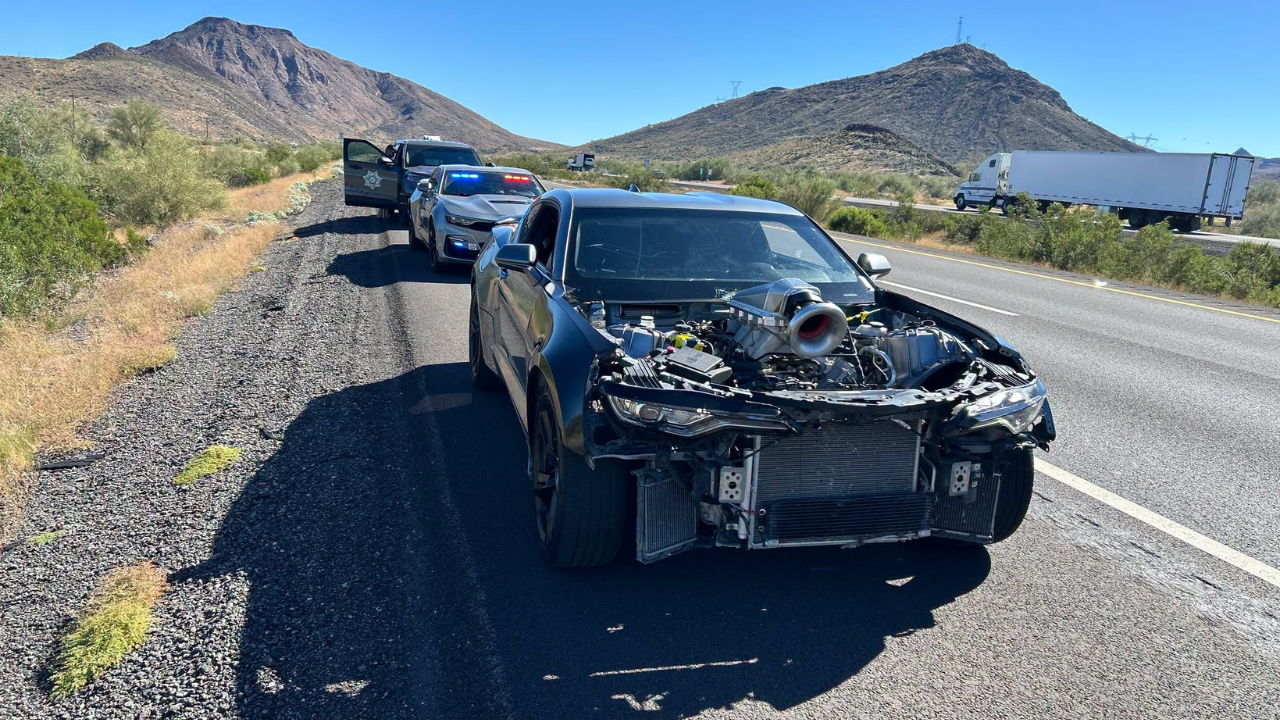
A silver Camaro caught a trooper’s attention on Interstate 10 in Arizona. Once the car stopped, the driver’s license record gave the trooper considerably more to work through.
The stop happened October 25 near Gold Nugget Road in the Quartzsite area, according to AZDPS Highway Patrol. A trooper conducting traffic enforcement spotted the Camaro traveling fast in the left lane.
Dash-mounted radar displayed a steady 105 mph reading where the posted limit was 75. At 30 mph over the limit, the reported speed put the stop into Arizona’s criminal-speeding territory.
Asked whether he had a valid driver’s license, the driver answered yes. The records check that followed contradicted that answer, and a second question about his license brought a different response.
A Second Look
Embedded media follows; please allow a moment for it to load.
His record showed three suspensions during 2026: one in January for financial responsibility, another in March for street racing, and a third in June for failing to appear in court. When the trooper asked whether he knew his license was suspended, the driver said he believed it was. Further checking also showed two earlier contacts this year in which he had been cited for driving on a suspended license. The trooper arrested him for speeding and driving on a suspended license.
Under Arizona’s excessive-speed statute, exceeding the posted limit by more than 20 mph outside business or residential districts is a class 3 misdemeanor. That threshold depends on the speed relative to the posted limit, not a single statewide freeway-speed cutoff.
For drivers dealing with suspensions, the Arizona Department of Transportation provides license-status checks through AZ MVD Now. Its reinstatement guidance directs drivers with court-related suspensions to obtain court clearance and submit the required paperwork to MVD.
AZDPS opened its account of the Camaro stop with a question: “Do you think it whistles at those speeds?” It also declared: “Suspended License + Criminal Speeding = JAIL.”
All parties are presumed innocent unless and until proven guilty in a court of law.