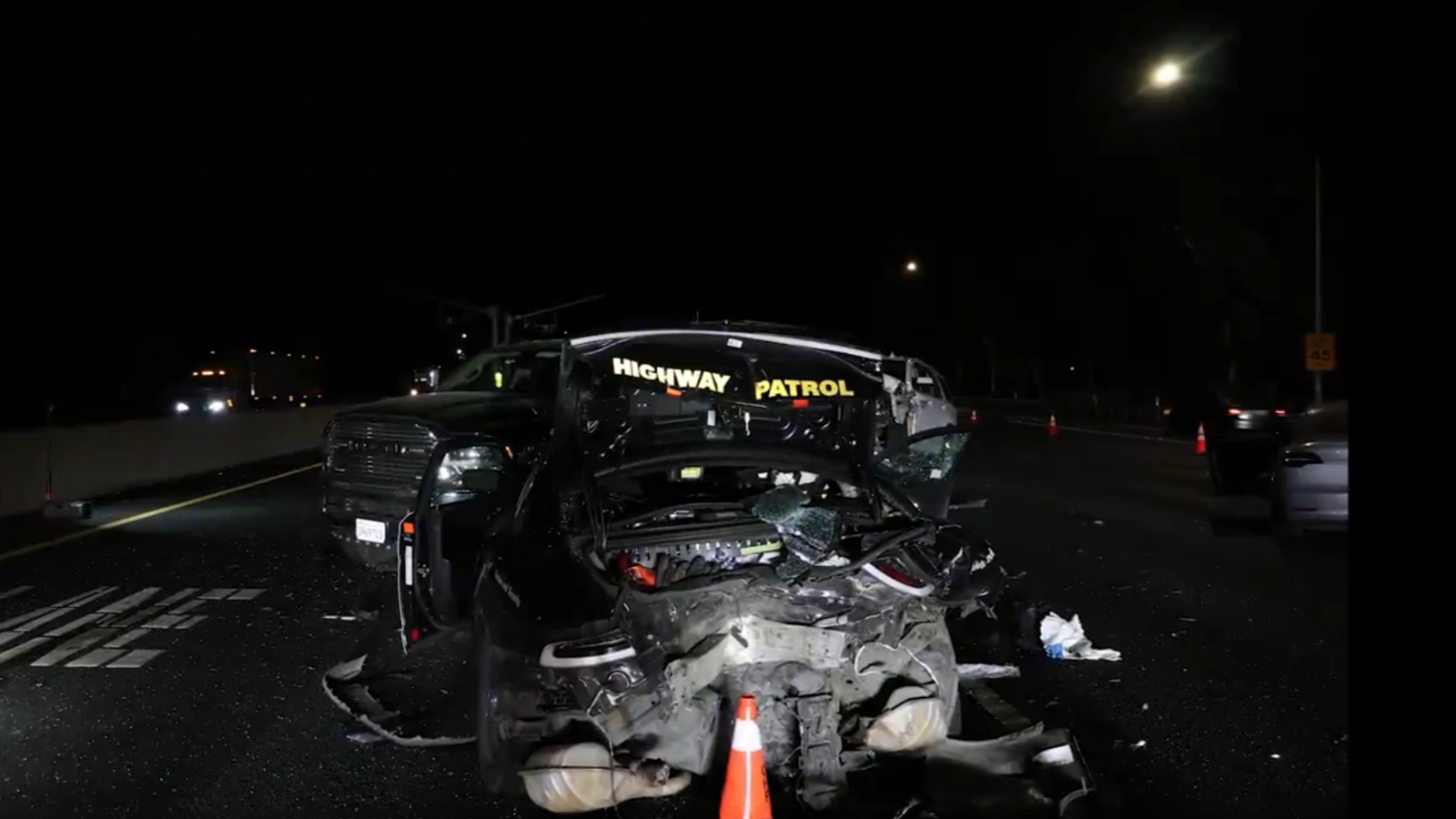
A Tesla slammed into a California Highway Patrol cruiser occupied by two officers on Interstate 80, leaving both seriously injured. According to CHP, the driver claimed he had been asleep while the car was operating in Tesla’s Full Self-Driving mode.
The October 13, 2026, collision occurred near Fairfield, California, where officers were investigating an earlier fatal crash. Several eastbound lanes had been closed with cones and flares, and emergency vehicles were positioned along the roadway with their warning lights flashing.
The Tesla entered the closed lanes at freeway speed and struck the rear of a Dodge Charger patrol car. Both officers were hospitalized, while the 22-year-old Sacramento man driving the Tesla suffered minor injuries.
CHP later released dramatic dashcam footage of the impact, along with a warning about the responsibilities of drivers using automated assistance. The driver’s account has also raised questions about how Tesla’s technology monitors attentiveness, an issue that has figured prominently in previous federal investigations.
A Violent Impact Caught on Camera
The collision happened at approximately 11:45 p.m. on eastbound I-80, west of Air Base Parkway. Four CHP officers were investigating a fatal crash from about an hour earlier, with traffic diverted into the remaining open lane while they worked.
Dashcam cameras captured the approaching Tesla and the force of its impact against the occupied patrol car. The two injured officers were treated at NorthBay Hospital in Fairfield and have since been released.
The earlier incident involved a 19-year-old San Pablo man who lost control of his Honda Civic before it was struck by a Chevrolet Tahoe driven by a 47-year-old Sacramento man. The Civic driver later died at a hospital, according to CBS Sacramento’s reporting based on CHP information.
The Tesla arrived after that fatal collision, while officers were examining the scene. Its driver has not been publicly identified.
A Claim That Raises Technical Questions
In the statement accompanying its video, CHP reported that the Tesla driver claimed he was asleep and that the vehicle was operating in Full Self-Driving mode when the collision occurred.
That account presents an important question about the vehicle’s driver-monitoring safeguards, which are designed to discourage motorists from becoming inattentive while using automated assistance.
Tesla’s Full Self-Driving (Supervised) is classified as a Level 2 driver-assistance system. Although it can handle steering, acceleration, braking, lane changes, and other driving tasks, it requires the person behind the wheel to remain attentive and prepared to intervene throughout the trip.
According to Tesla’s owner’s manual, the system uses a cabin camera to monitor the driver’s attention and can issue escalating warnings when it detects inattentiveness. Repeated failures to respond can result in the assistance being disengaged, with the vehicle potentially activating its hazard lights and attempting to stop.
The safeguards have evolved substantially over time, and their precise operation depends on the vehicle’s equipment and software. CHP has not identified the Tesla model or software version involved in the Fairfield collision, leaving the specific monitoring features available in that vehicle unclear.
Some commenters responding to the agency’s footage questioned how the driver could have fallen asleep without triggering those safeguards, while others blamed Full Self-Driving for failing to avoid the patrol car.
CHP’s statement offers no determination on either point. The agency relayed what the driver said and used the collision to emphasize the continuing need for driver attention, rather than presenting the results of a completed technical examination of the Tesla.
When the Evidence Told a Different Story
The importance of examining vehicle data before drawing conclusions became particularly apparent following a fatal Tesla crash near Houston in April 2021, when early reports raised questions about whether the vehicle had been traveling without anyone behind the wheel.
The National Transportation Safety Board’s subsequent investigation established that the driver had entered the driver’s seat before the trip and that Autopilot could not have been engaged on the residential roadway because the necessary lane markings were absent.
Recorded data revealed that the Tesla had accelerated rapidly before leaving the road, with substantial accelerator-pedal application and no braking during the final five seconds. The findings contradicted the early suggestion that the vehicle had been operating autonomously without a driver.
That crash involved an earlier Autopilot system rather than today’s Full Self-Driving technology, but it illustrates how physical evidence and recorded vehicle information can substantially change the understanding of an accident.
Federal investigators have also documented circumstances in which Tesla’s driver-engagement safeguards proved inadequate, particularly when motorists became complacent or used the assistance in ways it was not designed to support.
In a 2024 investigation, the National Highway Traffic Safety Administration concluded that earlier Autopilot controls did not sufficiently ensure driver attention and appropriate use. Investigators identified at least 13 crashes involving fatalities in which foreseeable driver misuse apparently played a role, raising concerns about the gap between the system’s driving capabilities and its ability to keep motorists appropriately engaged.
Tesla issued a recall intended to strengthen warnings and controls, and federal regulators subsequently began examining the effectiveness of those changes.
The company has continued developing its driver-monitoring technology, including greater reliance on cabin cameras rather than steering-wheel interaction alone. Nevertheless, the earlier investigations demonstrate that automated assistance and the safeguards intended to supervise its use have not always operated as drivers or observers might expect.
What the Fairfield Investigation May Reveal
Those previous cases provide context for the questions surrounding the latest collision, particularly because the Fairfield driver’s explanation involves both the claimed operation of Full Self-Driving and an extended lapse in attention.
Vehicle records may help determine whether the system was engaged as the Tesla approached the emergency closure, whether its monitoring equipment detected inattention, and whether the driver received warnings or attempted to intervene before impact.
The distinction matters because inattentive driving, misuse of assistance, and technological shortcomings can overlap in a collision investigation. Previous findings have documented both motorists overriding or misusing automated features and monitoring safeguards that failed to ensure adequate supervision.
In Fairfield, CHP has reported the driver’s claim without publicly establishing how the technology operated during the moments leading up to the crash. The agency’s video instead illustrates the danger that prompted its warning: even when a vehicle can perform much of the driving, its operator must remain alert enough to recognize and respond to changing road conditions.
The officers had established a closure using cones, flares, and flashing emergency lights while investigating a fatal collision. Determining how the Tesla passed those precautions and reached their patrol car will require evidence beyond the driver’s initial explanation.
All parties are presumed innocent unless and until proven guilty in a court of law.