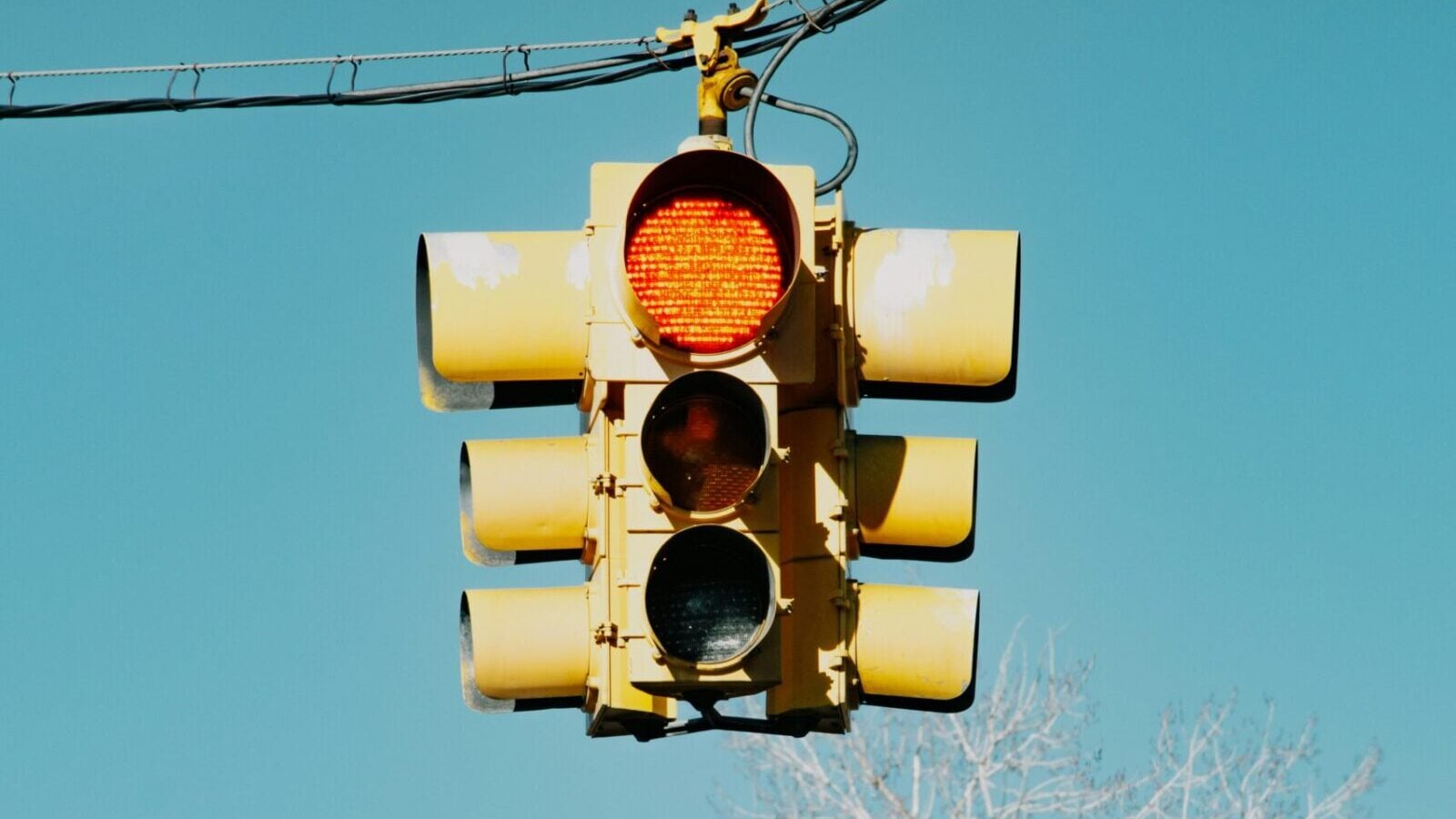
Speeding to catch the next green light can now have exactly the opposite effect on certain streets in Albuquerque and Portland. Drive too quickly toward one of their specially equipped intersections, and the traffic signal may leave you sitting at red instead.
Drivers who stick to the posted limit get the better deal, as sensors monitor approaching vehicles and can provide an earlier green light when motorists arrive at an appropriate speed, effectively rewarding slower driving with a smoother trip.
The Associated Press reports that Albuquerque, New Mexico, and Portland, Oregon, are using versions of a traffic-control strategy commonly called “rest in red.” The basic concept isn’t new, although these cities have added speed detection to give drivers another reason to obey the limit.
Early results suggest the idea could have an impact. Portland says average speeds at its first test intersection fell from 39 mph to the road’s 30-mph limit, while Albuquerque credits its broader strategy with helping reduce crashes and injuries along a troublesome corridor.
Speeders Get Stuck At Red
Traditional rest-in-red systems leave a traffic signal red when no vehicles are present, switching to green once an approaching vehicle is detected. Albuquerque and Portland have taken that concept further by factoring vehicle speed into how quickly the signal changes.
Someone approaching at or below the limit can therefore receive a green earlier. A speeding driver doesn’t receive the same benefit and may be forced to stop, removing one of the incentives to race toward the next intersection.
Portland traffic officials have described the system as a “virtual speed bump.” The city recently introduced it during overnight hours on Southeast Powell Boulevard, a major road with a history of serious crashes.
Albuquerque Says Drivers Are Learning Quickly
Albuquerque is using the technology along Lead and Coal avenues, a pair of parallel one-way streets where speeding had caused years of problems for nearby residents. City officials say motorists quickly discover that excessive speed simply results in another red light.
The system works alongside other measures, including automated speed cameras and traffic signals coordinated around the 30-mph limit. That makes it difficult to isolate exactly how much of Albuquerque’s reported safety improvement comes from rest in red alone.
Local resident Isaac Romero told AP that the difference has nevertheless been noticeable. He said crashes and late-night racing had previously been common enough that one collision sent a vehicle into a neighbor’s yard, while another impact against a tree shook his house.
Researchers Still Want More Data
There is evidence that the rest-in-red concept can improve safety elsewhere. A 2023 study involving five roads in North Carolina found total crashes declined by 43 percent after a simpler version of the system was introduced, although those signals did not use speed sensors to reward compliant drivers.
Researchers studying Portland’s system are being more cautious about drawing conclusions this early. Oregon State University transportation engineering professor David Hurwitz told AP that the initial results appear promising, but researchers still need to determine whether the system creates unintended effects such as additional red-light running.
If enough drivers learn that holding 30 mph delivers a string of green lights while speeding earns them a stop, following the limit suddenly becomes the faster option.