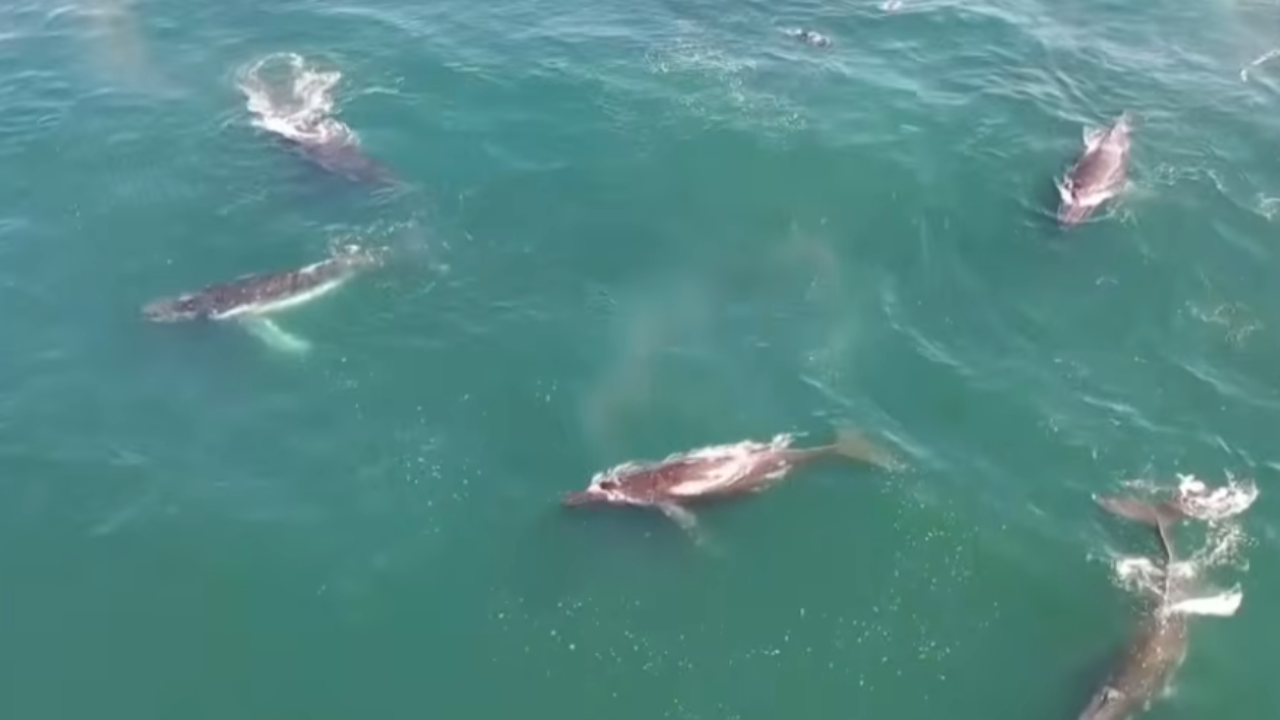
If you’ve ever been out on the water and thought you saw a lot of fish jumping, or a decent pod of dolphins showing off, hold that thought. It’s nothing compared to what one South African couple ran into off the coast near Cape Town. Chris and Monique Fallows, a husband and wife team who spend their working lives on boats studying and photographing marine life, found themselves surrounded by nearly 300 humpback whales gathered in a single patch of ocean. Not passing through. Not migrating single file. Just hanging out together, feeding, in what scientists call a “supergroup.”
For context, this isn’t a couple of whales that happened to be in the same zip code. Chris and Monique documented 299 humpback whales in the group, counting them by photographing each whale’s tail, known as a fluke. That’s essentially a small town’s worth of animals that can each weigh as much as a loaded semi truck, all converging on the same stretch of water off South Africa’s west coast, according to 2 News Nevada.
The timeline of how this built up is almost as interesting as the sighting itself. Chris Fallows said that late last year, he noticed whale numbers steadily increasing, with initial groups of 20 or 50 individuals growing to around 100 by the middle of December.
Then, on one particular morning, things went from impressive to almost unbelievable. Chris Fallows described the scene using a comparison that instantly makes sense to anyone who has seen a big city skyline: plumes of whale breath rising into the air one after another, like skyscrapers.
We’ll admit, we’ve heard plenty of fish stories in our time covering this beat, the kind where the catch gets bigger every time it’s retold. This one doesn’t need any embellishing. A man who has spent 35 years photographing marine animals professionally called it extraordinary. That’s not a word career wildlife photographers throw around lightly.
Why This Is Actually Happening More Often
Supergroups sound like something out of a nature documentary narrator’s wildest dreams, but they’re a documented and increasingly studied phenomenon.
Researchers have been tracking these gatherings off South Africa’s west coast for over a decade now, and the numbers keep climbing as the years go on.
The Whaling Comeback Story
Here’s the part that ties it all together. Scientists say the supergroups are an indication of how some whale species have strongly rebounded in southern hemisphere oceans decades after an international whaling ban took effect in 1986. In plain terms, humpbacks were hunted to dangerously low numbers for generations.
As the population has slowly clawed its way back, the conditions for these massive feeding gatherings have returned along with it.
This isn’t just whales randomly bumping into each other. Researchers studying the area have found that a higher than normal phytoplankton bloom in October, combined with reduced water flow along the Cape Peninsula current, creates the ideal conditions for these gatherings to form roughly a month later.
Essentially, the ocean sets the table, and the whales show up for the feast. It’s the same rich upwelling system, known as the Benguela system, that has made this stretch of coastline a magnet for marine life for as long as people have been watching.
A Success Story With Some Fine Print
As encouraging as this rebound is, it’s not without complications. More whales in busy waters means more overlap with shipping traffic, and researchers have flagged a real increase in vessel activity along this same coastline in recent years. It’s the kind of thing that comes with any comeback story: more of a good thing in a space that hasn’t necessarily grown to match it.
Still, for anyone who loves being out on the water, watching engines idle while nature does something you’ve genuinely never seen before, this one’s hard to beat. Sometimes the best encounters aren’t the ones you plan for.