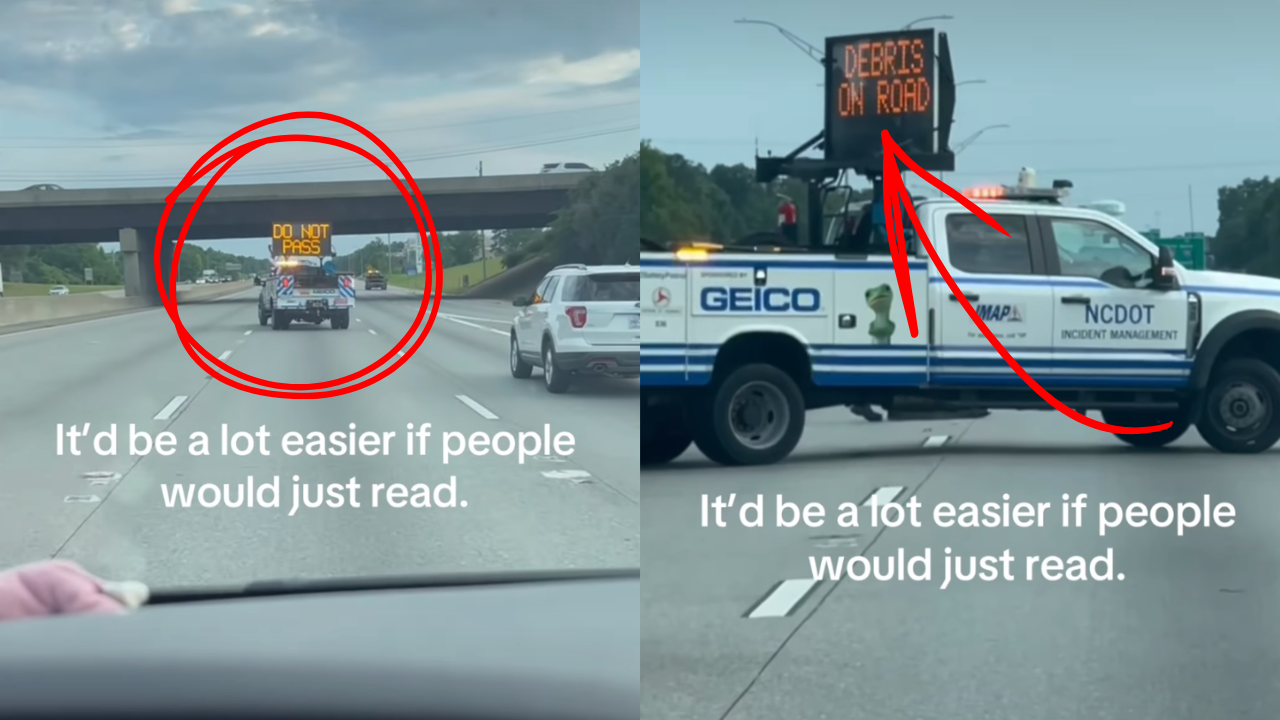
Some road signs are open to interpretation. A giant electronic board flashing “DO NOT PASS” from the back of a truck is not one of them. That didn’t stop Charlotte drivers from trying to slip past an NCDOT safety truck anyway, because apparently, it seemed more like a suggestion than a command. Or perhaps the drivers couldn’t read.
Either way, it wasn’t exactly a display of high intelligence.
The video, posted by Instagram user feliciathegreatt, follows an NCDOT Incident Management truck heading down the highway. It has a massive sign raised over the bed that’s visible from quite a ways away. It reads “DEBRIS ON ROAD,” while a white SUV rides close behind. The caption added by feliciathegreatt sums up her annoyance well. As she puts it, “It’d be a lot easier if people would just read.”
Soon, we see debris on the road, including one larger piece in a travel lane. The truck is right in front of traffic to keep cars from plowing into it so workers can fix the hazard. Then the sign switches to “DO NOT PASS” and it as subtle as a heart attack.
Still, people keep on driving.
So at that point, the driver stops, just starts blocking, swinging the truck across the lanes until it’s nearly sideways, with “DO NOT PASS” still flashing overhead. It seems to work, but barely. And the drivers keep on doing what they do best: ignoring the hazard in front of them.
What an NCDOT Safety Truck Is Actually Doing
View this post on Instagram
NCDOT runs a free Safety Service Patrol, also known as the Incident Management Assistance Patrol. Over 100 responders work across roads in North Carolina. They help stranded drivers, clear wrecks and debris and set up emergency traffic control so a hazard doesn’t turn into a pile-up. Of course, if people don’t read, that tends to happen anyway.
So the truck turning sideways looks dangerous too, right? It’s nothing to worry about. It’s just the truck trying to take control of traffic. Drivers are expected to obey it the same way they would a flagger or an officer waving them down. Slipping past doesn’t just ignore that, it undercuts the one thing keeping the scene orderly.
Why Blowing Past One Is a Worse Idea Than It Looks
Ignoring a road crew isn’t just rude. It can be dangerous, and North Carolina takes it seriously enough to put it in the law. The state’s Move Over Law requires drivers to slow way down or change lanes for emergency and highway vehicles stopped with amber lights flashing. The point is to treat the people working those scenes as lives to protect, not obstacles to beat. Ignore it and the base penalty is a $250 fine, and it climbs from there if someone gets hurt.
Those escalations are not hypothetical. Under the law, striking one of these responders can bring a misdemeanor, and causing serious injury or death can rise to a felony. The risk is real for the people doing this work. One NCDOT patrol driver was struck by a car going more than 80 miles per hour while helping on the road, and the crash changed his life.
So if you’re driving along and you see this right in front of your face, it’s a good idea to, well, we don’t know, read it? Maybe you should think about someone other than yourself for once?
So going around or placing cones for merge to one lane wasnt an idea?
We’re just gonna cause a traffic jam telling all lanes to not pass?
Placing cones for a piece of debris in the roadway is more dangerous and counterproductive. Let’s put into action your suggestion. The responder would have to to “Slow Roll” the left two lanes at least which would cause another traffic jam as you suggested. This is true but if two lanes are slowing down to very slow speeds and the next two lanes are flowing at highway speeds then I would suggest that is a recipe for diasater. People will people and find the faster lane and in doing so likely cause a high kinetic crash!
So, let’s now deploy cones for this two lane minimum closures. At highway speeds a minimum of 18 cones would have to be placed to be MUTCD compliant. This would take a skilled worker about ten minutes to do. Now he’s free to collect the debris which would take all of five seconds. But we’re not done here yet. Those 18 cones now have to be collected. There’s another ten minutes to get those up!
I would ask you, what is better for the worker and the traveling public? Twenty minutes of a two lane closure to spend five seconds removing the debris? Or maybe a quick and safe slow down of all lanes to perform a five second clearing of debris?