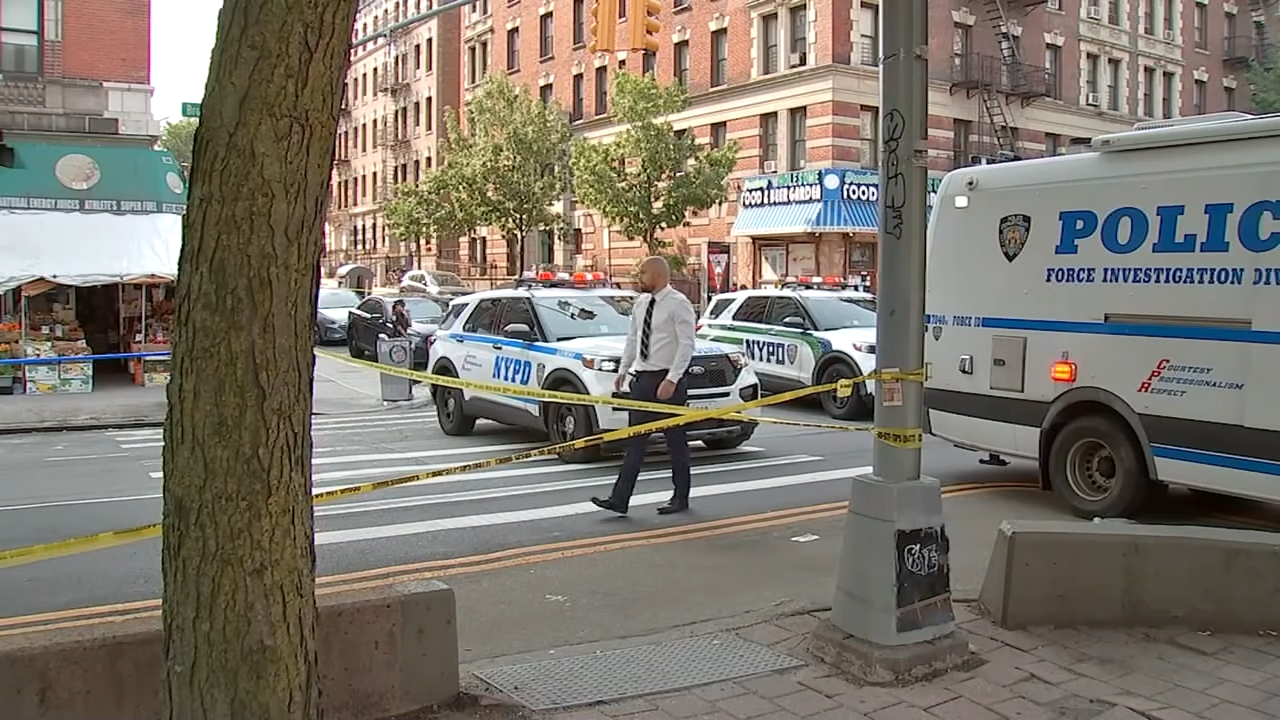
If you’ve ever wondered what it takes to finally interrupt a catalytic converter theft in progress, apparently the answer is: an off-duty cop, a minivan, and absolutely no patience for brazen criminals. Early Tuesday morning in Hamilton Heights, Upper Manhattan, a 31-year-old NYPD officer on her way to work found herself at the center of an incident that’s equal parts remarkable and grimly familiar.
The officer was heading out to start her shift when a neighbor flagged her down to report that three men were actively stealing a catalytic converter from a nearby parked vehicle. Most of us would have called 911 and kept driving. She didn’t. She drove to the scene and began recording the three suspects in the act — at which point the group noticed her and approached her vehicle, apparently trying to box her in. That’s when things escalated quickly.
Two of the men reached into their waistbands in what the officer described as an intimidating manner. She drew her weapon and fired one round from inside her car. The shot went through her minivan’s windshield. The three suspects scattered and, as of this writing, remain at large. No injuries have been confirmed.
Surveillance footage shows the theft began in the pre-dawn hours, with the men arriving in a black BMW before going to work on a black Toyota Corolla parked on the street. They operated in the open, apparently unconcerned about being seen. As one local news reporter noted on the scene, they did it “with absolutely no shame.” That detail might sting a little, but it’s worth sitting with — because this is precisely what catalytic converter theft looks like in practice: organized, fast, and conducted in full public view.
What They Were After and Why It Keeps Happening
The car these men targeted was a Toyota Corolla, which might seem like an odd choice if you’re unfamiliar with how catalytic converter theft works. But it makes complete sense once you understand the economics. Catalytic converters contain precious metals including platinum, palladium, and rhodium — and rhodium hit more than $11,000 an ounce in March 2026, before settling back to around $8,500 by May. Even a fraction of a gram adds up fast when you’re moving volume.
A skilled thief can duck under a vehicle, saw through the connections, and drive away with your converter in under five minutes. No special equipment required. No significant noise. You might be asleep forty feet away and never know until your car sounds like a dragster in the morning. Forbes
The Numbers Behind the Comeback
For a while, it genuinely looked like the worst of this was behind us. Roughly 14,000 converters were stolen in 2024 according to the National Insurance Crime Bureau — a 68% decrease from 2023. Law enforcement crackdowns, new state-level legislation requiring scrap dealers to document purchases, and falling metal prices all contributed to a welcome lull.
That lull appears to be ending. In St. Paul, Minnesota — a city with some of the nation’s strictest anti-theft laws — catalytic converter thefts nearly tripled in 2025, rising from 172 incidents to 504. Researchers have found that theft rates track precious metal prices almost mechanically: a 10% increase in the value of metals like rhodium produces roughly a 20% increase in theft incidents. With rhodium climbing again, the math isn’t encouraging.
What This Incident Actually Tells Us
The Hamilton Heights shooting is unusual in its specifics but completely ordinary in its context. Catalytic converter theft has always been a crime of opportunity and economics, carried out by people who have calculated — often correctly — that the risk-reward ratio is favorable. Three men in broad daylight on a residential street were apparently confident enough to not just steal a converter, but to then approach and confront a witness who was recording them. That’s not recklessness; that’s a pattern of behavior that’s worked before.
New York is consistently among the top states for catalytic converter theft claims, alongside California, Illinois, Texas, and Florida. The problem isn’t going away on its own. If you park on the street, particularly in a high-clearance vehicle or a hybrid, a converter shield is worth every penny — and considerably less dramatic than what unfolded on West 148th Street Tuesday morning.