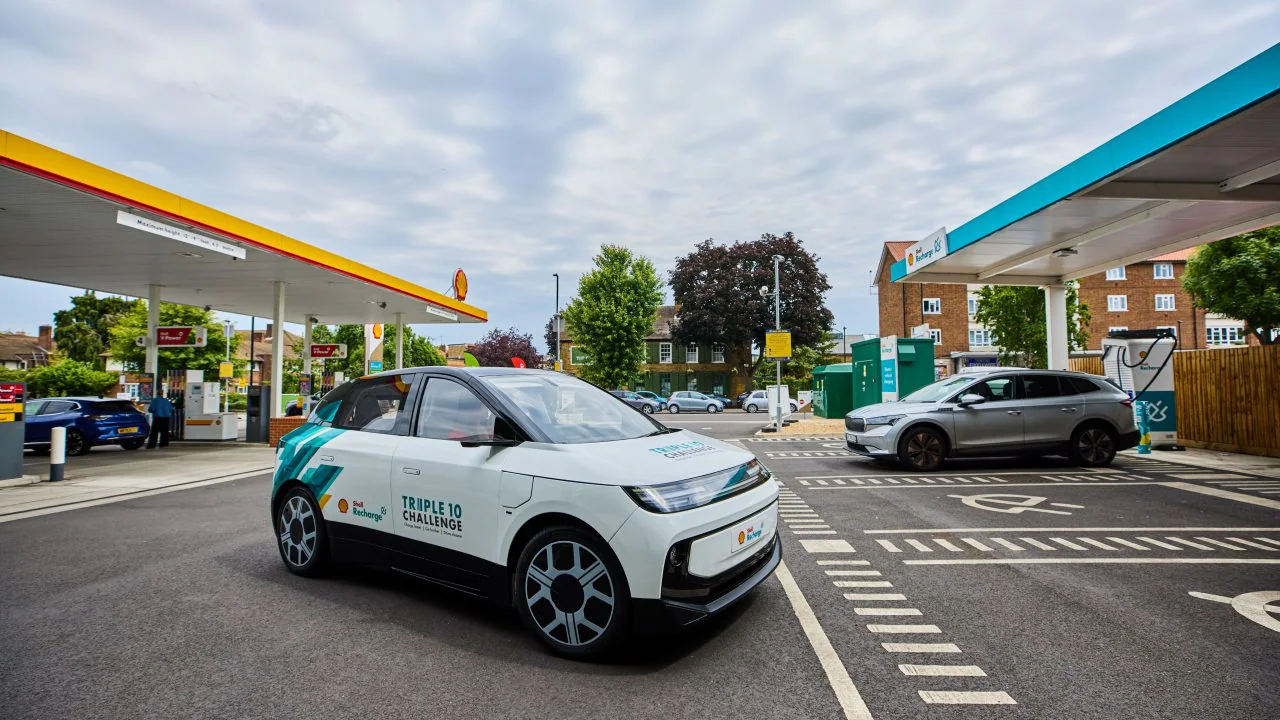
Shell has pulled the wraps off an unusual electric hatchback concept, although the company isn’t planning to become the next automaker. Instead, the compact prototype serves as a rolling demonstration of a new battery cooling system that could make future EVs lighter, more efficient, and significantly quicker to charge.
Called the Triple 10 Challenge Concept, the one-off vehicle was developed alongside British engineering firms RML, Empel Systems, and HORIBA MIRA. The project focuses on proving that better thermal management can deliver major performance gains without relying on ever-larger battery packs.
Shell says the concept achieves three ambitious targets. It can charge from 10% to 80% in less than 10 minutes, deliver an efficiency of 10 km/kWh (6.2 miles/kWh), and reduce lifecycle carbon emissions to approximately 10 metric tons of CO₂e.
While the hatchback itself is unlikely to reach production, the technology hidden underneath could eventually find its way into future electric vehicles from established manufacturers.
A Different Way To Cool An EV Battery
The biggest innovation isn’t the car itself but the fluid circulating through it. Unlike conventional EVs that rely on water-glycol coolant flowing around battery modules, Shell uses a dielectric fluid that can safely come into direct contact with battery cells and other high-voltage components.
That direct immersion cooling removes heat much more efficiently than traditional systems. Better thermal control allows the battery to maintain higher charging speeds for longer without overheating or reducing performance.
Shell also designed the concept with a simplified single-circuit cooling system. The same thermal fluid helps manage temperatures for the battery, electric motor, and power electronics, reducing complexity and lowering overall vehicle weight.
Faster Charging Without Massive Chargers
One of the concept’s headline figures is its charging performance. Shell says the battery can recharge from 10% to 80% in 9 minutes and 54 seconds.
Unlike some production EVs that require charging stations delivering well over 300 kW to achieve similar times, the Triple 10 concept reaches that benchmark using a more common 175-kW DC fast charger. According to Shell, the vehicle can add approximately 24 kilometers of driving range per minute of charging, compared with an average of around 13 kilometers for many current battery-electric vehicles using the same charging power.
The improved thermal management helps keep battery temperatures under control during rapid charging sessions. That reduces the need for aggressive power throttling, allowing charging performance to remain consistently high.
Efficiency Is Just As Important
Shell says the concept demonstrates that smarter engineering can improve efficiency without simply installing a larger battery pack. The company claims the hatchback consumes just 10 km/kWh, representing roughly a 30% improvement over many current-generation electric vehicles.
The simplified cooling system also contributes to a lighter battery pack with fewer components. According to Shell, the redesigned battery architecture could reduce overall battery pack costs by roughly 25% compared with conventional EV designs.
The company also estimates the concept’s total lifecycle carbon footprint at approximately 10 metric tons of CO₂e. Shell attributes that reduction to its lightweight design, optimized battery size, recyclable materials, and charging powered by renewable electricity.
The Real Product Isn’t The Car
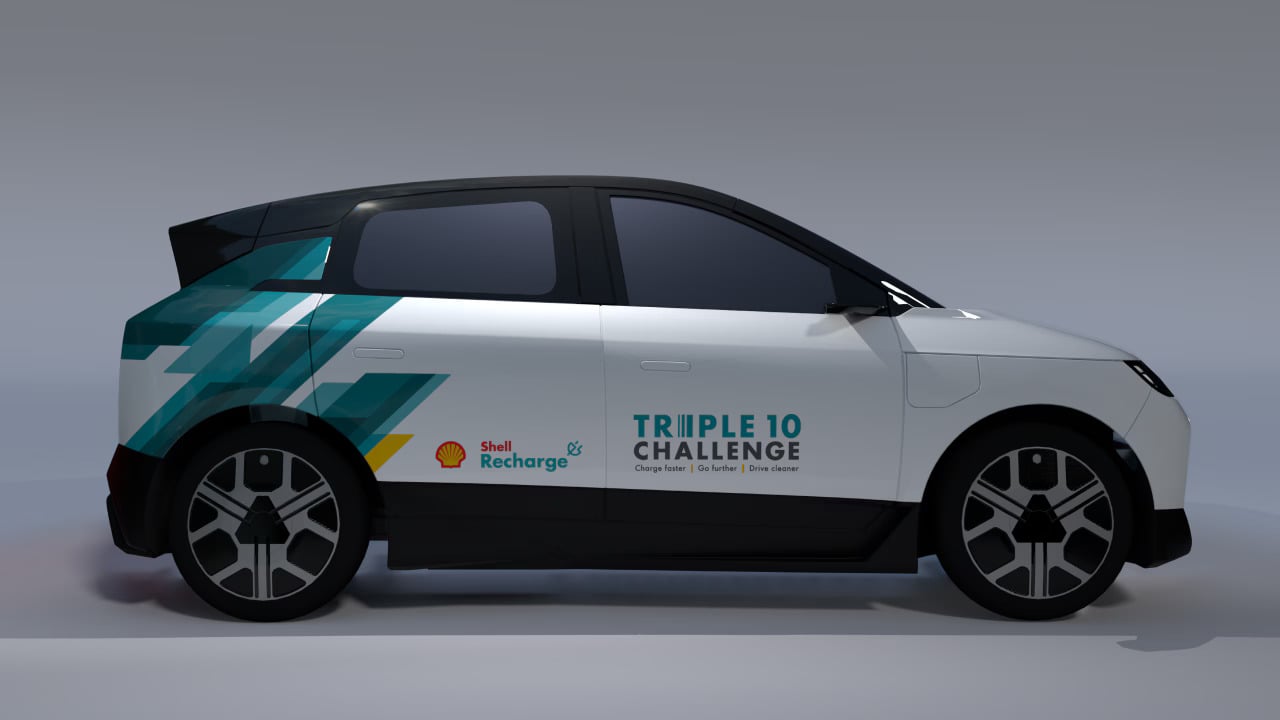
Despite the futuristic hatchback attracting attention, Shell has made it clear that the concept is not intended for production. The company’s primary goal is to demonstrate its thermal management technology to automakers looking to improve future EV designs.
If manufacturers adopt the cooling system, Shell would supply the specialized dielectric fluid required for immersion cooling. That would allow the energy company to expand its presence in the electric vehicle market through charging infrastructure, battery technologies, and advanced thermal fluids rather than by building vehicles itself.
The Triple 10 Challenge ultimately serves as a technology showcase rather than a preview of a future Shell-branded EV. Whether the compact hatchback ever reaches the road is uncertain, but the cooling system it was built to demonstrate could influence the next generation of electric vehicles.