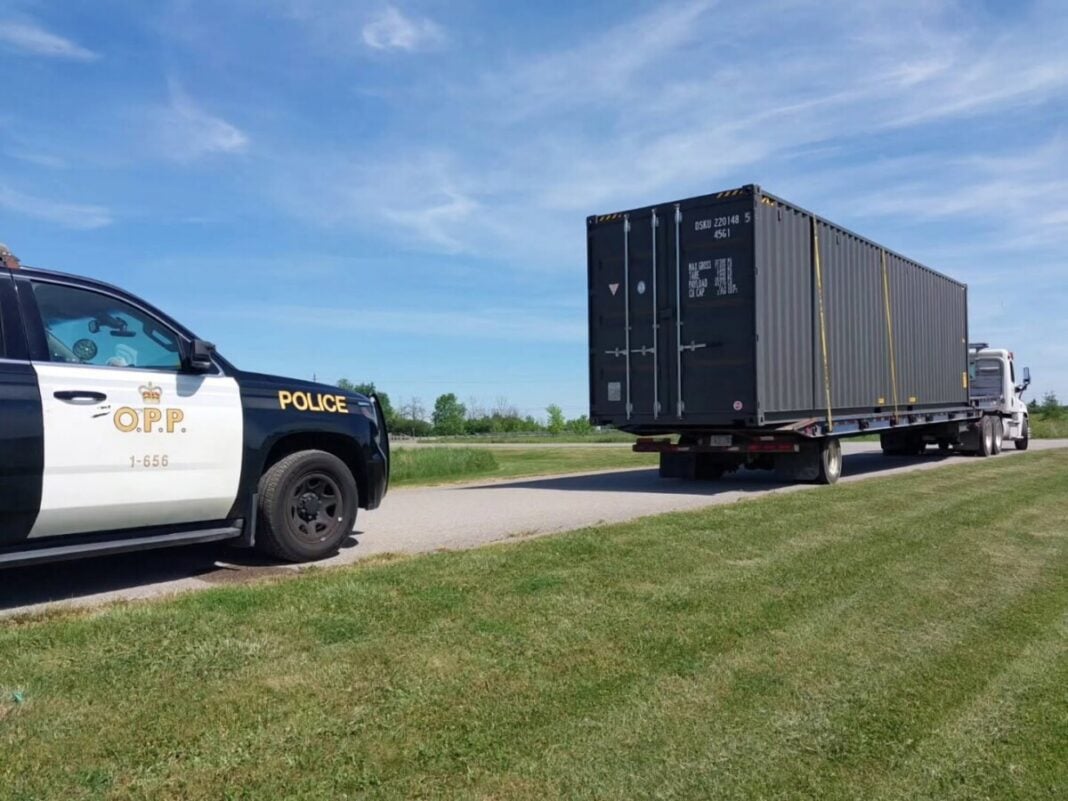
If there is one thing that tends to irritate both professional drivers and everyday motorists equally, it is the knowledge that some operators treat federal and provincial safety standards less like enforceable law and more like a loose set of suggestions. A story out of Ontario this week is a textbook example of exactly that attitude, and it ended about as well as you would expect. A commercial truck driver and the trucking company behind the wheel are now staring down 17 charges after Ontario Provincial Police caught the same defective truck back on the road, wearing a fresh set of plates and a bogus certification, just days after being ordered off of it.
The incident unfolded on Monday, June 8, when OPP officers stopped a commercial truck on King Street in Caledon, Ontario. What officers discovered during that inspection was not just a non-compliant vehicle. It was a vehicle that had already been flagged, pulled, and formally ordered out of service the week prior for multiple serious equipment defects. Rather than repair any of those defects, someone in this operation took a decidedly creative approach: swap the plates, obtain a fresh certification, and put the truck right back into service as though the original stop never happened.
It did not work. Officers identified the same major defects that had prompted the original out-of-service order, none of which had been properly repaired in the intervening days. The OPP put it plainly in their statement: “The good news, no new defects. The bad news, none of the original defects were fixed.” The new plates were seized on the spot, the truck was pulled from service a second time, and the driver and the company collectively walked away with 17 charges between them.
What makes this case particularly notable is not just the brazenness of driving a flagged truck back onto public roads. It is that someone, somewhere in this chain, certified that vehicle as roadworthy. That certification either failed completely or was obtained improperly, and either scenario raises uncomfortable questions about how this truck cleared the paperwork hurdle at all.
What an Out-of-Service Order Actually Means
For anyone unfamiliar with how commercial vehicle enforcement works, an out-of-service order is not a warning. It is a legally binding directive that prohibits a vehicle from operating on public roads until identified defects are corrected and the vehicle passes a formal re-inspection. In Canada, these orders are governed under the National Safety Code, the framework that all provinces including Ontario use to regulate commercial carrier safety standards.
Operating a vehicle under an active out-of-service order is a serious violation on its own. Obtaining new plates in an apparent effort to circumvent that order adds a layer of deliberate evasion that enforcement officers and the courts tend to take a dim view of.
How the Plate Swap Scheme Unraveled
OPP noted that the operator had somehow received new plates and a certification to return the vehicle to service, despite the underlying defects never having been addressed. The details of how that certification was obtained have not been publicly disclosed, but it is the kind of detail that tends to surface during the legal process that follows 17 charges.
Commercial vehicle certifications in Ontario are issued through licensed inspection facilities, and any certification issued for a vehicle with known, unrepaired defects would represent a serious breakdown in that oversight process. Whether the facility involved was unaware of the prior order, misled about the repairs, or something else entirely remains to be seen.
Why Defective Commercial Trucks Are a Public Safety Issue
This is not a story about a cracked taillight or an overdue oil change. Out-of-service orders for commercial trucks are issued when inspectors find defects serious enough to pose a direct risk to the driver, other motorists, or both. Common grounds include brake system failures, steering defects, tire conditions, coupling device issues, and lighting failures, any of which on a fully loaded commercial vehicle traveling highway speeds can have catastrophic consequences.
The sheer mass and momentum of a commercial truck means that a brake failure or a steering defect is not a recoverable situation in most real-world scenarios. Enforcement crackdowns like this one exist precisely because the stakes are not theoretical.
The Charges and What Comes Next
The driver and the trucking company between them are facing 17 charges stemming from the June 8 stop. OPP has not specified which provincial statutes each charge falls under, though Ontario’s Highway Traffic Act provides a wide range of offenses applicable to situations involving out-of-service violations, plate misuse, and operating an unsafe commercial vehicle.
The OPP Central Region closed their public statement on the matter without much ambiguity: “Safety standards are not suggestions, they are the law.” Given the circumstances, it is hard to argue with that framing. Courts in Ontario have broad discretion in sentencing for commercial vehicle offenses, including fines, license suspensions, and in egregious cases, criminal charges under federal statutes.
For the trucking industry at large, cases like this one are a reminder that enforcement agencies are not simply running rote inspections. They remember the vehicles they pull. They compare plates. And when something does not add up, they look harder.