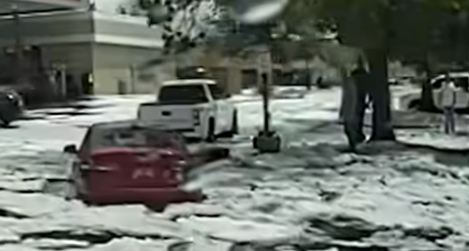
A Colorado woman’s ordinary morning commute became anything but after a fast-moving hail storm and flash flooding turned city streets into something resembling a river, and the officers who waded in to get her out are now getting well-deserved attention for it.
It happened near 6th Avenue and Sable Boulevard in Aurora, Colorado, where the driver made a mistake that thousands of motorists make every single year: she didn’t realize how deep the water on the road ahead actually was, and she drove into it. What looked like a passable stretch of flooded street was enough to swallow her vehicle and strand her inside. Fortunately, Aurora Police Department officers were already in the area responding to storm-related emergencies when the situation unfolded.
Photos shared by the Aurora PD on Facebook show officers wading through the murky, fast-moving water to physically carry the woman out of her car. She was unharmed. Officers then went a step further and gave her a ride home, a small but decent touch after what had already been a rough morning. The department posted the images with a straightforward message about floodwater safety, and the story quickly gained traction online.
It’s an easy moment to scroll past, but there’s a real and important lesson buried in the photos: floodwaters are one of the most consistently underestimated hazards on the road. The National Weather Service has long pushed its “Turn Around, Don’t Drown” campaign for a reason. Drivers who misjudge water depth on roadways account for a significant number of flood-related fatalities every year across the country, and the problem tends to spike precisely in areas where sudden, severe storms are common, like Colorado’s Front Range.
Why Flooded Roads Are So Deceptive
The core problem isn’t recklessness. Most drivers who end up in flooded roadways weren’t being careless on purpose. The issue is that standing or moving water on pavement is genuinely hard to judge from behind the windshield. A road that appears to have a few inches of water covering it can easily have a foot or more in the lowest point of a dip, and just 12 inches of moving water is enough to carry away a small car. Two feet can float most full-size trucks and SUVs. Even experienced drivers frequently misjudge this because there’s almost no visible reference point from a driver’s seat.
Add in the conditions Aurora dealt with that day, including hail and rapidly changing weather, and it gets harder still. Hail can obscure visibility, gutters overflow faster than drivers expect, and in urban environments water tends to pool and funnel in ways that aren’t intuitive unless you know the area extremely well. The intersection at 6th and Sable is no backwoods two-track. It’s a regular city street that became hazardous in a matter of minutes.
“Turn Around, Don’t Drown” Is Worth Taking Seriously
The advice has been around long enough that it almost starts to sound like background noise, but the numbers behind it are not trivial. According to the National Weather Service, more than half of all flood-related drowning deaths in the United States involve vehicles. The campaign exists specifically because the human instinct to push through rather than backtrack has repeatedly proven fatal.
The rule of thumb is straightforward: if water is covering a road and you cannot clearly see the pavement surface beneath it, find another route. It doesn’t matter if the car in front of you made it through. Road surfaces in flood conditions can be washed out entirely without any visible sign from above the water. Bridges and low-water crossings fail. Drainage covers get swept away. The road you’re about to drive onto may not be structurally what it was twenty minutes ago.
Aurora PD’s Response Reflects Well on the Department
It’s worth noting that beyond the rescue itself, the Aurora Police Department’s handling of this moment, both in real time and in how they communicated about it publicly, was measured and professional. The post wasn’t self-congratulatory. It didn’t oversell what happened. Officers got a woman out of a dangerous situation, made sure she was okay, drove her home, and then used the moment to pass along a practical safety reminder to the community they serve. That’s exactly how public safety communication should work.
The image of uniformed officers knee-deep in floodwater carrying someone to safety is also a useful corrective to the kind of cynicism that tends to dominate online conversations about law enforcement. Whatever anyone’s broader opinions are on that subject, this is what good, basic police work looks like.
What Drivers Should Know Before Storm Season Peaks
Summer storm season on the Front Range is far from over. Colorado’s Front Range sits in a geography that makes it prone to fast-moving afternoon and evening thunderstorms, some of which can drop substantial rain in a very short window. Urban and suburban streets in the Denver metro area, including Aurora, can flood quickly because of how drainage infrastructure handles those rapid surges.
If you’re driving during or after a significant storm, slow down around underpasses, low-lying intersections, and any area near drainage channels or retention infrastructure. Water can reach those areas well before it becomes visible from a distance. Keep an eye on local alerts, and if a road is closed due to flooding, it’s closed for a reason. The detour adds minutes. Driving into floodwater can cost significantly more than that.