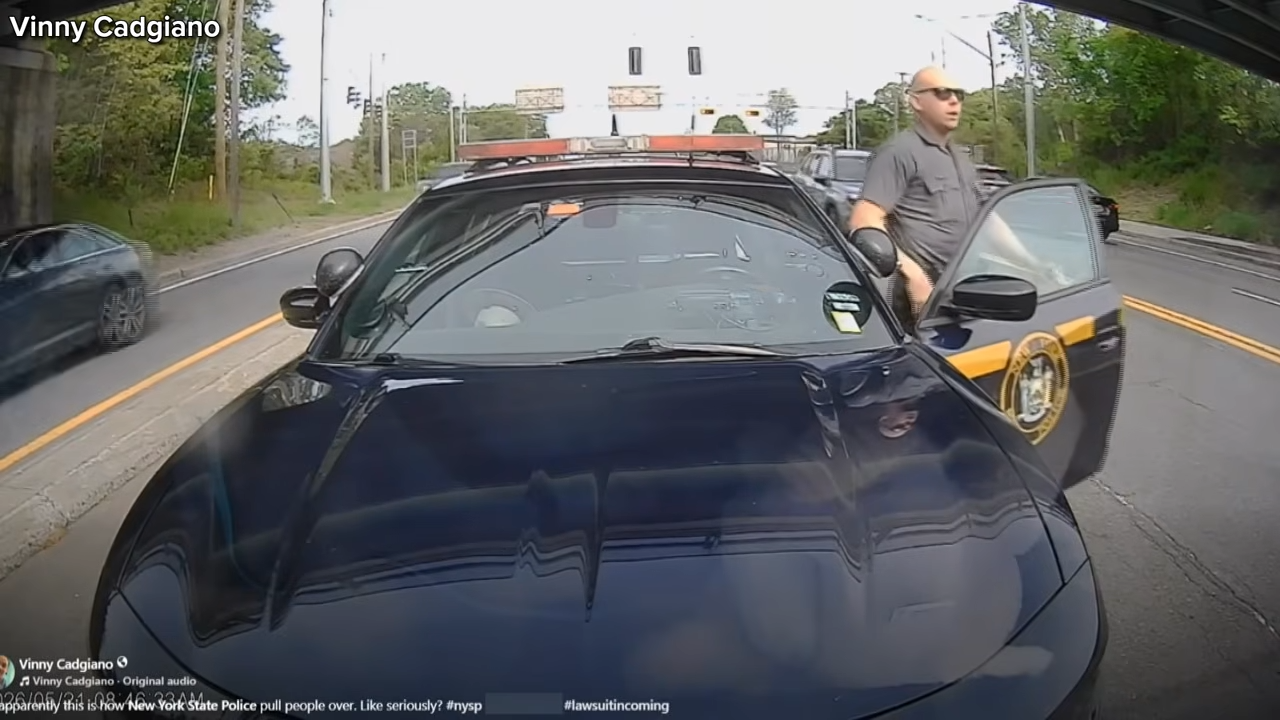
A New York State Police trooper found himself on the wrong end of a fender bender on May 21, 2026, when dashcam footage captured the moment he rear-ended a civilian vehicle in Guilderland. The video, obtained by CBS6, shows the collision playing out in the kind of awkward slow-motion irony that practically writes its own punchline. The officer had reportedly been attempting to pull the driver over when traffic came to a stop, and the trooper’s cruiser made contact with the car ahead. Nobody was hurt, no tickets were handed out, and now the whole thing is on the internet.
The incident happened around 8:45 a.m. as both vehicles were exiting the Northway (I-87) onto Western Avenue, heading eastbound. Traffic stopped, the trooper did not stop quite fast enough, and the result was a collision caught on camera by the very driver who was about to get pulled over. After the crash, the trooper reportedly walked up to the driver and told him he had been about to issue him a traffic stop. That is one way to break the ice.
For most people, getting rear-ended is already a frustrating experience. Getting rear-ended by the cop who was trying to pull you over adds a layer of disbelief that even the best screenwriters might have trouble pitching with a straight face. To be clear, both parties walked away from this without injury, which takes the edge off the absurdity and makes it easier to appreciate just how unusual this situation really was.
New York State Police confirmed the basic facts of the incident. The crash occurred, no injuries were reported, and no citations were issued. What happens next, particularly whether there are any internal consequences for the trooper, remains to be seen. But the footage is out there, and the questions it raises about accountability, protocol, and what exactly happens when a law enforcement officer causes a crash, are worth taking seriously.
What the Dashcam Footage Shows
The video, shot from inside the civilian vehicle, captures the aftermath of the collision. Both cars had just made the turn from the Northway onto Western Avenue in Guilderland when traffic backed up. The trooper’s patrol vehicle failed to brake in time and struck the car in front. The trooper then approached the driver and, in a moment that is hard to forget, explained that the whole encounter had started because he was about to initiate a traffic stop.
Dashcam footage has become an increasingly powerful tool for documenting roadway incidents, and this case is a solid example of why that technology matters. Without the recording, this incident might have been little more than a police report buried in a filing cabinet. With it, the public gets a clear view of exactly what happened and the ability to ask informed questions.
What Happens When a Police Officer Causes a Car Accident
When a civilian rear-ends another driver, the process is pretty straightforward: exchange insurance information, file a report, potentially receive a citation, and let the insurance companies sort out the rest. When the at-fault driver is a law enforcement officer operating a government vehicle, the process gets considerably more complicated.
In New York, crashes involving state police vehicles are typically investigated internally by the agency. The officer may face a departmental review, and depending on the findings, disciplinary action is possible. Civil liability generally falls to the government entity, in this case the state of New York, rather than to the individual officer. Victims of crashes caused by government employees can file claims against the state, though the process involves specific procedures and deadlines under New York law.
The fact that no injuries occurred and no tickets were issued in the Guilderland incident likely simplifies things considerably. But the dashcam footage does create a public record that did not exist before, and that matters both for transparency and for any future proceedings.
No Tickets Issued, But Questions Remain
One detail that caught attention in the original report is that no citations were handed out following the crash. That is not necessarily unusual. Police officers are sometimes given discretion in low-speed, no-injury accidents, and the circumstances here, a minor rear-end collision with no apparent damage serious enough to require emergency response, may not have warranted a ticket under standard protocols.
That said, the optics are complicated. If a civilian rear-ended a cop car under similar circumstances, a ticket would be a very realistic outcome. The perceived double standard is something that communities have long flagged as a concern, and incidents like this one tend to reignite that conversation quickly. New York State Police has not issued any statement beyond confirming the basic facts of the crash.
A Reminder That Everyone on the Road Is Human
Crashes happen. Rear-end collisions are among the most common types of traffic accidents in the United States, and they occur for a range of reasons including distraction, following too closely, and unexpected stops in traffic. Officers are not immune to the same driving challenges that every motorist faces, and in fairness, patrol work involves constant distractions including radio communication, navigation, and active surveillance of surrounding traffic.
None of that excuses a preventable collision, but it does put the incident in a broader context. What makes this case stand out is not just that a trooper hit another car, but that it happened in the middle of an attempted traffic stop, and that the whole thing was captured on video by the driver who was the intended target of that stop. The footage is a good reminder that accountability on the road applies to everyone behind the wheel, badge or not.
Not really an attempted traffic stop. His lights weren’t even on. It happened before an attempted traffic stop, if he was even telling the truth.