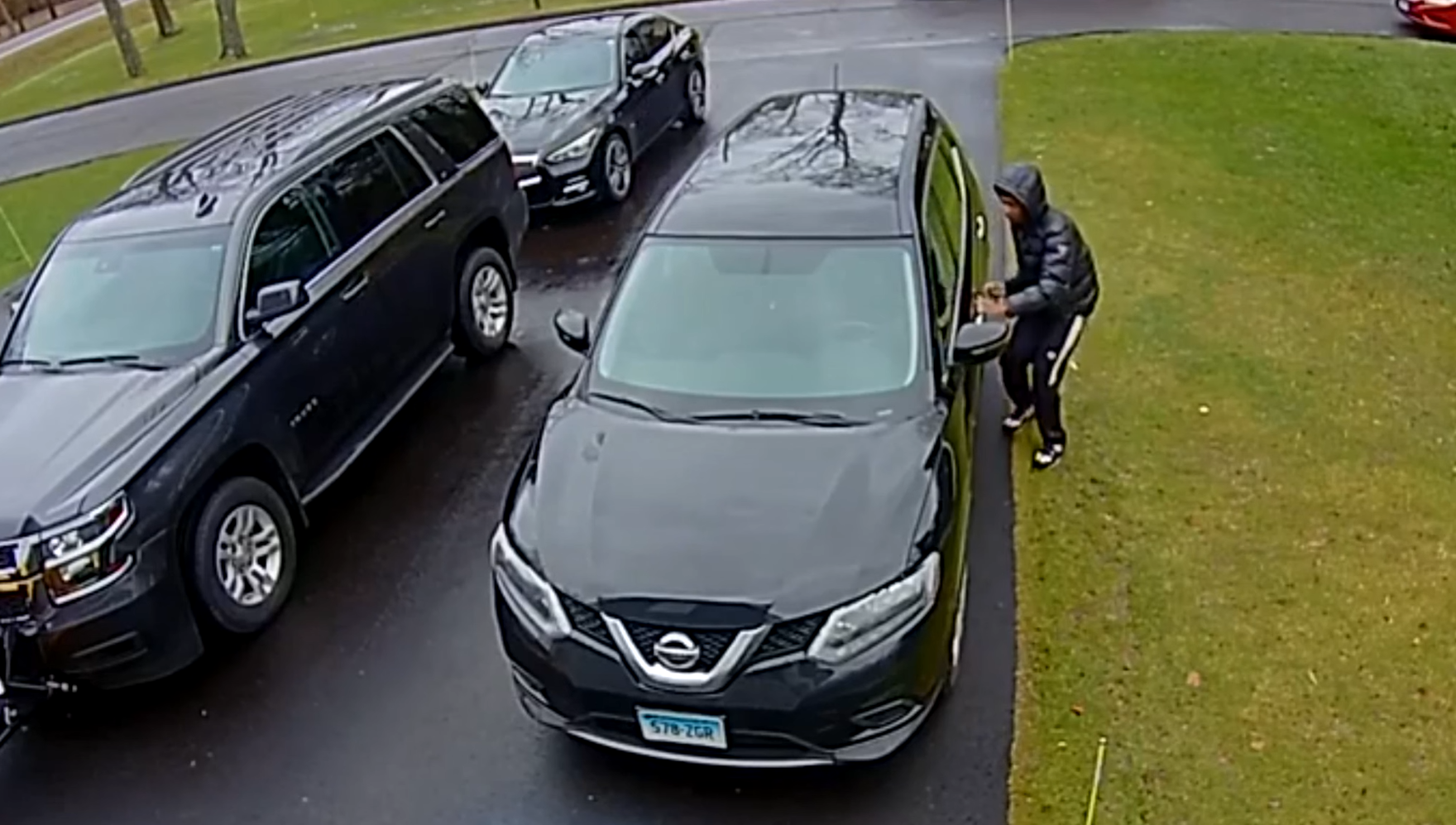
A surveillance video out of Connecticut has gone viral for all the wrong reasons, and if it does not make you think twice about your habits, nothing will. Captured on Christmas Day in Woodbridge, the footage shows a masked man casually jogging up a residential driveway, trying a few door handles, and driving off in someone’s car before most people would have even noticed a stranger outside. The whole thing was over in half a minute.
Fox 61 shared the clip on Facebook with a simple but pointed warning: lock your car and take your fob with you. The post resonated with thousands of people, partly because the theft was so effortless. There were no tools, no tricks, no broken windows. Just an unlocked door and a key fob sitting right there waiting to be used.
What made the video hit differently was the location. Woodbridge is a quiet, suburban town in New Haven County, the kind of place where many residents still feel comfortable leaving doors unlocked. That comfort, it turns out, is exactly what criminals count on. Opportunistic car theft does not discriminate by zip code, income level, or how safe a neighborhood feels on a Tuesday afternoon.
The comments on the post were about as divided as you would expect. Some viewers expressed genuine sympathy for the family whose holiday took a hard left turn. Others were significantly less charitable, pointing out that leaving a running vehicle or a fob unattended is an open invitation. The debate itself is worth having, because buried inside it is a real conversation about personal responsibility, crime prevention, and how quickly things can go wrong.
How Car Theft Really Happens: It Is Simpler Than You Think
Most people picture car theft as a complex operation involving slim jims, hotwiring, and some kind of cinematic chase sequence. The reality is far more mundane. The National Highway Traffic Safety Administration (NHTSA) has long reported that a significant percentage of stolen vehicles had the keys left inside them. Criminals are not always sophisticated. Frequently, they are just walking down a street, pulling on door handles, and waiting for someone to have made their job easy.
Keyless entry and push-button start technology, while convenient, has added a new layer of vulnerability. Modern key fobs communicate with vehicles using radio signals, and thieves have developed relay attack devices that amplify that signal from inside a home, tricking a car into thinking the fob is right next to it. In those cases, the vehicle does not even need to be unlocked manually. Experts from AAA and the Insurance Information Institute have both flagged relay theft as a growing concern, particularly for newer vehicles parked in driveways close to front doors.
What We Can Learn From a 30-Second Theft on Christmas Day
There is a reason this video traveled so fast online. It strips away every excuse. The thief did not case the home for days. He did not bring specialized equipment. He simply ran up, tried a few doors, and left with a car. The lesson is uncomfortable but clear: passive security habits are not security at all.
Locking your doors every single time, regardless of how long you plan to be inside, is the most basic line of defense. The NHTSA and law enforcement agencies consistently recommend never leaving a fob, spare key, or any key-adjacent device inside a vehicle, even briefly. For keyless entry vehicles, signal-blocking pouches, often called Faraday bags, are an inexpensive option that prevents relay attacks by blocking the fob’s radio frequency from being detected or amplified. Many auto security experts suggest storing fobs away from exterior walls and doors overnight for the same reason.
The “It Won’t Happen Here” Mentality Is the Real Vulnerability
Rural and suburban residents are statistically more likely to leave vehicles unlocked than urban dwellers, largely because of a deeply ingrained sense of community safety. That assumption has always carried some risk, but it is increasingly disconnected from reality. The FBI’s Uniform Crime Reports have historically shown that property crime, including motor vehicle theft, spans every type of community. In recent years, organized theft rings have deliberately targeted quieter neighborhoods precisely because residents let their guard down.
Insurance companies are paying attention too. Comprehensive auto coverage will generally cover a stolen vehicle, but deductibles, rental car gaps, and premium increases afterward make prevention the smarter financial play. Some insurers have begun asking about vehicle security features during underwriting, and a pattern of avoidable claims can absolutely affect your rates over time.
Simple Habits That Could Save You a Very Bad Day
The fix here is not complicated or expensive. Locking your car every time you park it, including in your own driveway, takes about two seconds. Taking the fob or key inside with you takes another two. For keyless vehicles, a Faraday pouch costs less than ten dollars on most retail sites. A steering wheel club, while old-fashioned, remains a visible deterrent that makes opportunistic thieves move on to easier targets. A dashcam with exterior coverage will not prevent a theft but can provide useful footage for law enforcement and insurance purposes, much like the video that surfaced from Woodbridge.
The family who lost their car on Christmas Day likely knows all of this now. The goal is to learn it before the lesson comes at that kind of cost.
Sources: Fox 61 Facebook, NHTSA, AAA, Insurance Information Institute, FBI Uniform Crime Reports