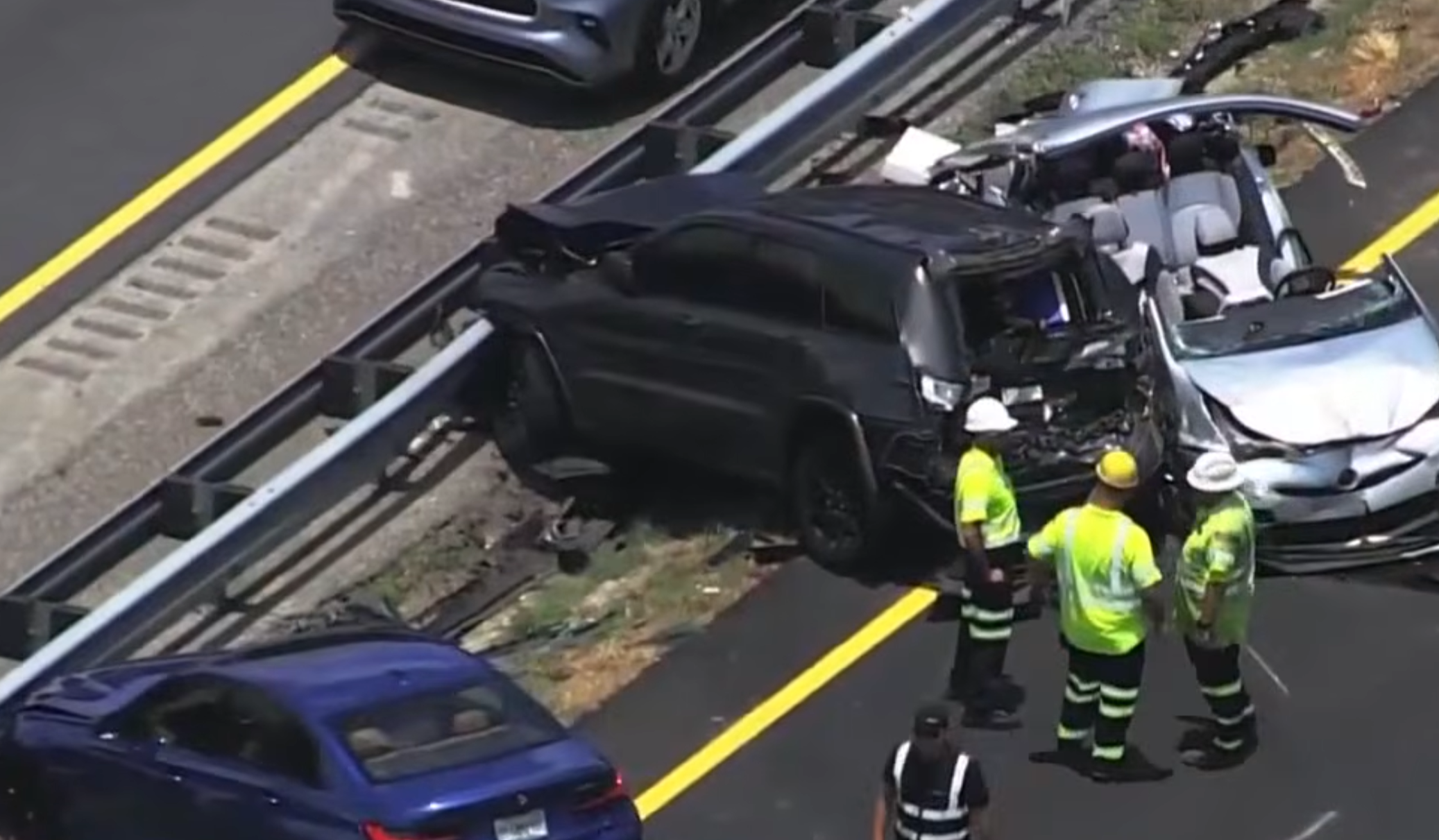
A chaotic midmorning crash on one of Central Florida’s busiest stretches of highway turned the Florida Turnpike into a parking lot Tuesday, after a dump truck collided with a string of passenger vehicles in Osceola County. The crash happened around 11:20 a.m. in the northbound lanes near mile marker 248, drawing a swift response from Florida Highway Patrol, fire crews, and paramedics. What followed was hours of gridlock, crunched metal, and a scene dramatic enough to pull news helicopters overhead for an aerial look, according to WFTV.
The collision involved a dump truck and six to eight other vehicles, and several people were taken to area hospitals, including at least one person with serious injuries. Florida Highway Patrol confirmed that no fatalities occurred, which given the scale of the wreck, was something of a relief. The cause of the crash remained under investigation as of Tuesday afternoon, with troopers working to piece together exactly how things unraveled so quickly on such a heavily traveled corridor.
WESH 2’s news chopper was first on the scene from the air, capturing exclusive aerial footage that showed the sheer scope of the damage below. Firefighters, an ambulance, and tow trucks were all visible clustered along the northbound lanes, while backed-up traffic stretched well behind the crash site. It took crews roughly two hours to get a shoulder lane moving, and all northbound lanes were back open by later in the afternoon as troopers continued their investigation.
This is not the first time the Florida Turnpike in Osceola County has made headlines for a serious wreck. The stretch near Kissimmee has seen multiple major incidents in recent years, from overturned semis to fatal multi-vehicle crashes, making Tuesday’s pileup part of a concerning pattern on this corridor. Whether the cause turns out to be distracted driving, a mechanical failure, or something else entirely, the crash is a stark reminder of what can happen in an instant when large commercial vehicles share the road with everyday drivers at highway speeds.
What We Know About the Crash
The crash happened just before 11:30 a.m. near Osceola Parkway, involving a dump truck and six to eight other vehicles. Emergency responders arrived quickly, and at least four people were transported to area hospitals, with one person sustaining serious injuries. FHP confirmed no one was killed. Aerial footage from WESH’s Chopper 2 showed visible, significant damage to several of the cars involved in the chain-reaction wreck.
Traffic on the northbound side slowed to a crawl almost immediately, and FHP worked to establish a shoulder workaround before ultimately clearing the roadblock and restoring normal flow later that afternoon. The agency has not yet announced a cause, which is standard in multi-vehicle crashes that require a more thorough on-scene and potentially post-scene investigation.
Why Dump Truck Crashes Are Especially Dangerous
When a dump truck is involved in a highway pileup, the consequences tend to be far worse than your average fender-bender, and the numbers back that up. Trucks often weigh 20 to 30 times as much as passenger cars and sit higher off the ground, which can cause smaller vehicles to slide underneath them in a crash. That size and weight disparity means even a relatively low-speed collision can cause catastrophic damage to smaller vehicles.
In 2022, roughly 81 percent of large trucks involved in fatal traffic crashes were in multi-vehicle crashes, compared to 63 percent for passenger vehicles. And stopping distance is a persistent issue: loaded tractor-trailers need 20 to 40 percent more distance than a standard car to stop, a gap that widens further on wet or slippery roads or when brakes are not well maintained. On a high-speed highway like the Turnpike, that margin for error shrinks fast.
A Pattern on Florida’s Turnpike
Tuesday’s crash did not happen in a vacuum. The Florida Turnpike in and around Osceola County has been the site of several significant crashes in recent years. In December 2025, a semitrailer driver was killed after his rig failed to slow for slowing traffic in the southbound lanes near Osceola Parkway, triggering a fiery chain-reaction crash that injured a second driver. Before that, overturned semis in Kissimmee caused lane closures and major delays on more than one occasion.
The Turnpike is a critical artery for commuters, tourists heading to theme parks, and commercial freight moving through Central Florida. That combination of high traffic volume, large commercial vehicles, and high speeds creates conditions where crashes can escalate quickly into something much larger than a single-vehicle incident.
What We Can Learn From This Incident
Multi-vehicle pileups involving large trucks on busy highways often share a few common threads, and Tuesday’s wreck offers some useful lessons whether or not you were stuck in that backup.
First, following distance matters more than most drivers realize. At 70 mph, a passenger vehicle needs several hundred feet to stop safely. A dump truck needs considerably more. When drivers tailgate large commercial vehicles or cut in front of them without leaving a generous buffer, the margin for error becomes razor-thin.
Second, when you see brake lights ahead on a highway, treat it seriously. Chain-reaction crashes typically start because one or two vehicles react too slowly to slowing traffic ahead of them, and each subsequent vehicle has even less time to respond. According to NHTSA research, vehicles equipped with center high-mounted stop lamps showed meaningfully lower risk of being involved in chain-reaction collisions, pointing to how even small visibility improvements can make a difference in these situations.
Finally, incidents like this are a good reminder to check traffic before you get on the highway, leave extra time on major corridors, and know your alternate routes. For drivers in the Kissimmee area, Osceola Parkway is a frequently cited alternate when the Turnpike backs up. FHP will continue to update the public as the investigation into Tuesday’s crash moves forward.