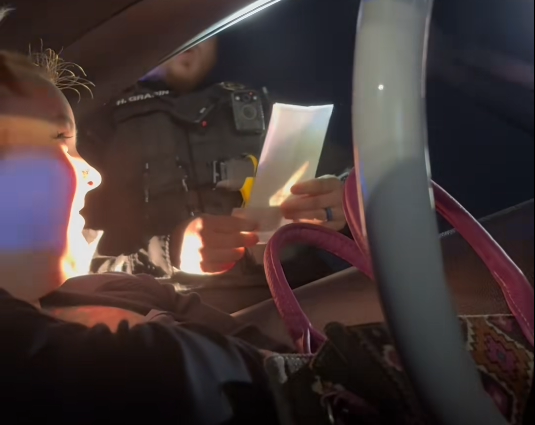
An Oklahoma traffic stop went sideways fast when a police officer decided he could diagnose a modified exhaust without crawling under the car, pulling out a sound meter, or doing much of anything beyond listening and feeling confident about it. The driver, a Mustang owner who goes by Cheyanne on TikTok, had her phone rolling the entire time, and the footage quickly made its way around the internet, racking up over 222,000 views. The officer wrote her two tickets: one for defective equipment, and one for a modified exhaust. Both were eventually dismissed.
What makes this stop so interesting is not just that the tickets got tossed, but how the officer tried to justify them in real time. When Cheyanne asked him directly how he could know the exhaust was modified without getting underneath the vehicle, he told her he could identify it “by the decibels it’s displaying” and by his “observation and experience.” No meter. No inspection. Just vibes and a notepad.
The video spread largely because of how confidently wrong the officer seemed in the moment, and how calmly Cheyanne held her ground. She pushed back at every turn, asking for the equipment to be tested on the spot. The officer declined, told her to take it up in court, and walked away. She signed off the clip with a colorful farewell that the internet found very relatable.
What the video did not reveal, at least until a follow-up post, was whether the exhaust was actually modified. A commenter asked outright. Cheyanne posted a seven-second reply featuring the Mustang’s very loud engine note and captioned it: “I’m just the queen at gaslighting cops.” So yes, it was modified.
What Oklahoma Law Actually Says About Exhaust Noise
@tcheyanne The judge and clerk rolled their eyes and dismissed both btw and I haven’t seen that cop since 🤣 #police #ticket #fyp #comedy ♬ Jackass – Ivč
Oklahoma’s muffler statute prohibits any exhaust modification that increases noise beyond the vehicle manufacturer’s original design. Here is the catch though: there is no specific decibel number written into the law. No threshold. No hard limit.
That means enforcement comes down almost entirely to officer discretion. If a cop thinks it sounds too loud, that is technically enough to write a ticket. There is no requirement for a sound meter, and there is no legal benchmark a meter reading would even be compared against. This gives officers a lot of room to write tickets based on gut feeling, but it also gives drivers a lot of room to fight them.
Without any objective measurement on record, the entire case rests on the officer’s testimony alone. That is admissible evidence, but it is weak evidence, especially when the officer cannot point to any specific standard that was violated.
Why Decibel Meters Actually Matter in Court
One commenter on the video identified himself as a professional audio engineer, and his breakdown of the legal vulnerability here is worth understanding. If an officer does use a sound meter to build a case, that meter has to meet certain requirements to be taken seriously in court.
The device needs to be properly calibrated on a regular maintenance schedule. It needs to be set to the “C” weighting mode, which is the standard used for low-frequency noise measurement like engine exhaust. And the officer operating it needs to be trained on how to use it correctly.
If any of those boxes go unchecked, a defense attorney can argue the reading is inadmissible, and the case falls apart. This is not a technicality most people would think to raise, but it is a legitimate and well-established defense strategy in traffic court.
Several commenters on the video shared similar experiences. One described her husband being pulled over for the same reason, only for the officer to inspect the truck, find nothing worth ticketing, and leave frustrated. Another described a stop where the officer’s own meter showed the patrol car was louder than the vehicle being cited.
What Happened When the Case Got to Court
Cheyanne buried the update in a reply to a commenter who asked for follow-up. She showed up to court. The officer did not. A clerk made her way around the room asking why people were there, took Cheyanne’s ticket to the judge, and both charges were dismissed with an eye roll from the bench.
It is tempting to chalk this up to the well-known belief that traffic tickets disappear automatically when officers skip court. That is mostly a myth, though. Virginia traffic defense attorney Andrew Flusche has written that the “officer no-show equals automatic dismissal” idea is one of the most common misconceptions in traffic law. Judges have discretion, and cases can be rescheduled rather than dropped.
What the eye roll likely signals in this case is that the judge took one look at the underlying evidence and was not impressed. Two tickets written with no inspection and no measurement, for a violation with no specific legal threshold. The officer’s absence may have sped things along, but the case was probably not going anywhere regardless.
What Drivers Can Learn From This Traffic Stop
This situation highlights a few practical things worth keeping in mind if you drive a modified vehicle, especially one with a loud exhaust.
Know your local laws before you modify anything. Oklahoma’s statute is intentionally vague, which gives officers room to write tickets but also gives drivers room to challenge them. States vary widely on this, and some do have specific decibel limits with defined testing procedures.
If you get pulled over, you are allowed to ask questions. Cheyanne asked how the officer knew the exhaust was modified, and that question ended up being the foundation of her entire court defense. Officers are generally required to be able to articulate the basis for a citation.
Document what you can. The video recording did not just go viral. It preserved exactly what the officer said and did not say, which matters in court. If an officer cannot point to a measurement, an inspection, or a specific standard that was violated, that is worth noting.
Finally, showing up to court matters. Many people pay tickets to avoid the hassle. Cheyanne showed up, and both charges disappeared. Even a weak case requires you to actually contest it.