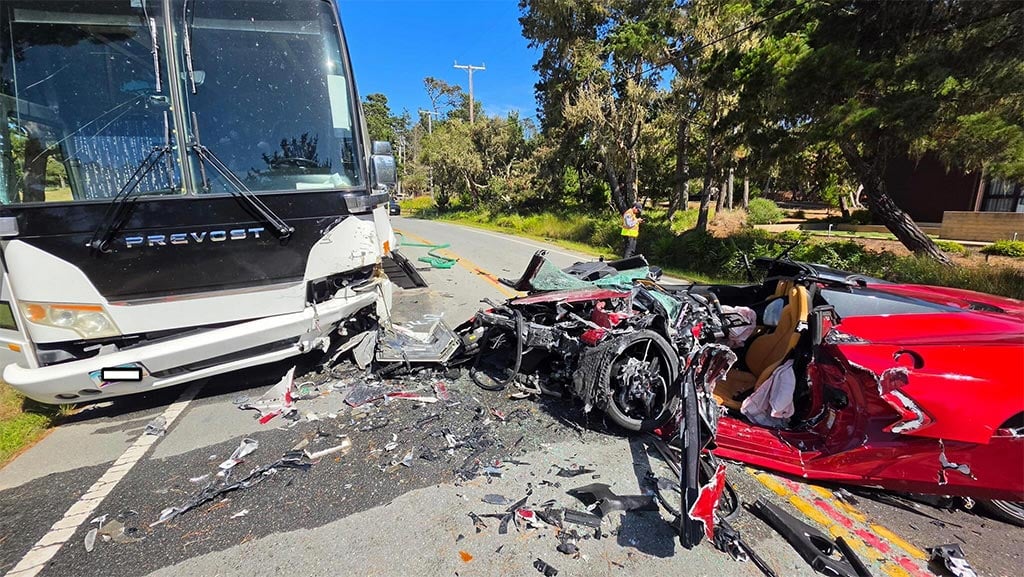
When people think about what a C8 Corvette can do, they usually imagine track days, canyon runs, or the satisfying growl of a flat-plane V8 at a stoplight. Nobody pictures the front half of one crumpled beyond recognition against the nose of a tour bus on one of California’s most scenic coastal roads. That is exactly what happened last Saturday on 17 Mile Drive in Monterey County, and it is every bit as bad as it sounds.
California Highway Patrol officers responded to a head-on collision on 17 Mile Drive west of Majella Road, where a tour bus carrying 48 passengers was traveling westbound when an eastbound Torch Red C8 Corvette convertible reportedly crossed the double yellow line at a high rate of speed and drove directly into it. The physics were not kind to the Corvette. Its entire front section was obliterated in the impact, leaving behind what looked less like a car and more like a cautionary tale that somehow still had a rear bumper attached.
The Corvette driver was transported to a local hospital and later placed under arrest on suspicion of driving under the influence. Remarkably, given the sheer violence of the collision, only one bus passenger reported any injury, and that injury was described as minor. The other 47 passengers walked away unhurt, which under the circumstances qualifies as nothing short of extraordinary.
CHP officials did not let the moment pass quietly. They used the crash as an opportunity to remind drivers, yet again, that impaired driving and reckless speeds are not just personal risks. Every bad decision behind the wheel carries the potential to seriously hurt or kill people who never made that choice themselves. It is a message that never gets old, even if some drivers seem determined not to hear it.
What Makes 17 Mile Drive a Particularly Dangerous Place for This Kind of Crash
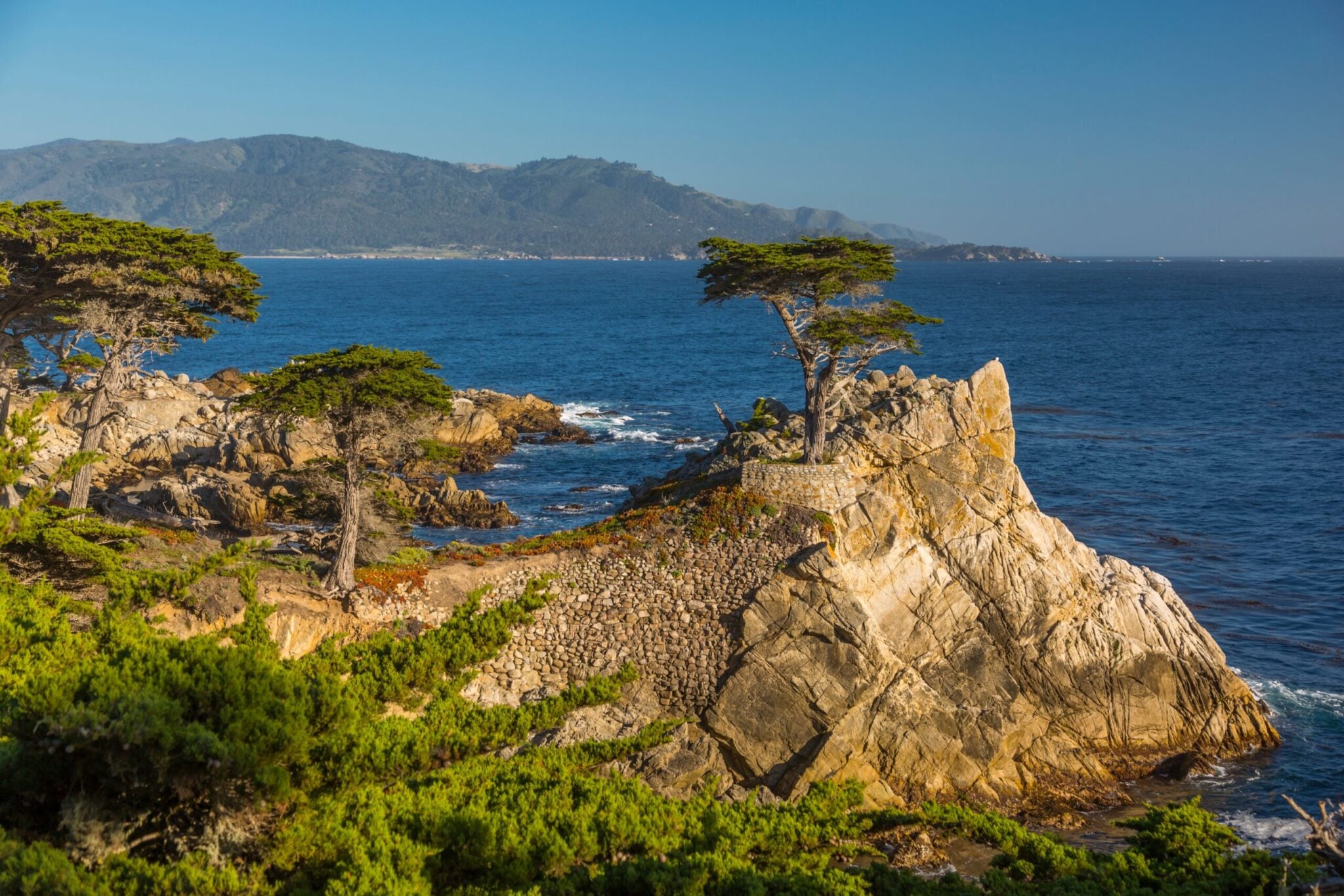
17 Mile Drive is one of the most famous scenic routes in the United States. Winding through the Del Monte Forest and along the Monterey Peninsula coastline between Pacific Grove and Pebble Beach, it draws tourists, cyclists, and car enthusiasts year-round. The road is narrow, curvy, and flanked by everything from golf courses to cypress forests, which makes it beautiful and simultaneously unforgiving.
Tour buses are a regular presence on the route, transporting visitors who want to take in the views of Pebble Beach, Seal Rock, and the Lone Cypress without worrying about parking. The combination of large commercial vehicles, tourist traffic, and a road that demands full attention creates exactly the kind of environment where speed and impairment become exponentially more dangerous.
A C8 Corvette Is Not the Car You Want to Drive Recklessly
The eighth-generation Corvette is widely regarded as one of the most impressive performance bargains in modern automotive history. With a mid-engine layout, available Z51 performance package, and a base price that undercuts nearly every comparable European sports car, it democratized supercar performance in a way that genuinely surprised the industry when it launched.
But high performance cuts both ways. A car capable of reaching 60 mph in under three seconds is also capable of generating catastrophic forces in a collision. The C8’s aluminum-intensive structure is engineered for crash protection, but no amount of engineering fully compensates for crossing a double yellow line into oncoming traffic at high speed. The wreckage photos that circulated following the Monterey County crash make that point more vividly than any safety brochure ever could.
What This Crash Can Teach Us Beyond the Obvious Warning Label
The CHP’s reminder about impaired driving is important, but it is worth digging into what incidents like this one reveal on a broader level. First, the outcome here was about as lucky as a head-on collision between a sports car and a fully loaded tour bus can possibly be. One minor injury out of 49 people involved is a statistical miracle, not a template anyone should rely on.
Second, crashes involving suspected DUI on scenic or tourist routes often share a common thread: the driver is somewhere unfamiliar, potentially celebrating something, and operating a vehicle they may not drive every day. Rental cars and borrowed performance vehicles show up in these incidents with troubling regularity. The novelty of the vehicle and the novelty of the road are a combination worth treating with serious respect.
Third, the presence of a commercial vehicle changes the legal and human stakes considerably. Had the driver on that bus not been skilled enough to react, or had the Corvette struck at a slightly different angle, the casualty count could have been devastating. Tour bus passengers tend to be seated and unbelted, which is legal in most configurations but means they are more vulnerable to sudden lateral or frontal forces than occupants of a standard passenger vehicle.
What Happens Next for the Driver
Under California law, a DUI arrest following a collision that results in injury can be charged as either a misdemeanor or a felony, depending on the severity of harm caused and the driver’s prior record. Because one passenger did sustain an injury, prosecutors will have the option to pursue the more serious felony route if the facts support it. The Corvette driver will also likely face civil liability from any injured parties and potentially from the bus company itself.
Beyond the legal consequences, the financial toll of a collision like this is staggering. A new C8 Corvette convertible carries a starting price in the mid-$70,000 range, and depending on options, can climb significantly higher. Insurance, if it applies at all in a DUI situation, will be a complicated conversation. The car itself is almost certainly a total loss. None of that begins to account for the human cost of what could have been an unthinkable tragedy on one of California’s most beloved roads.