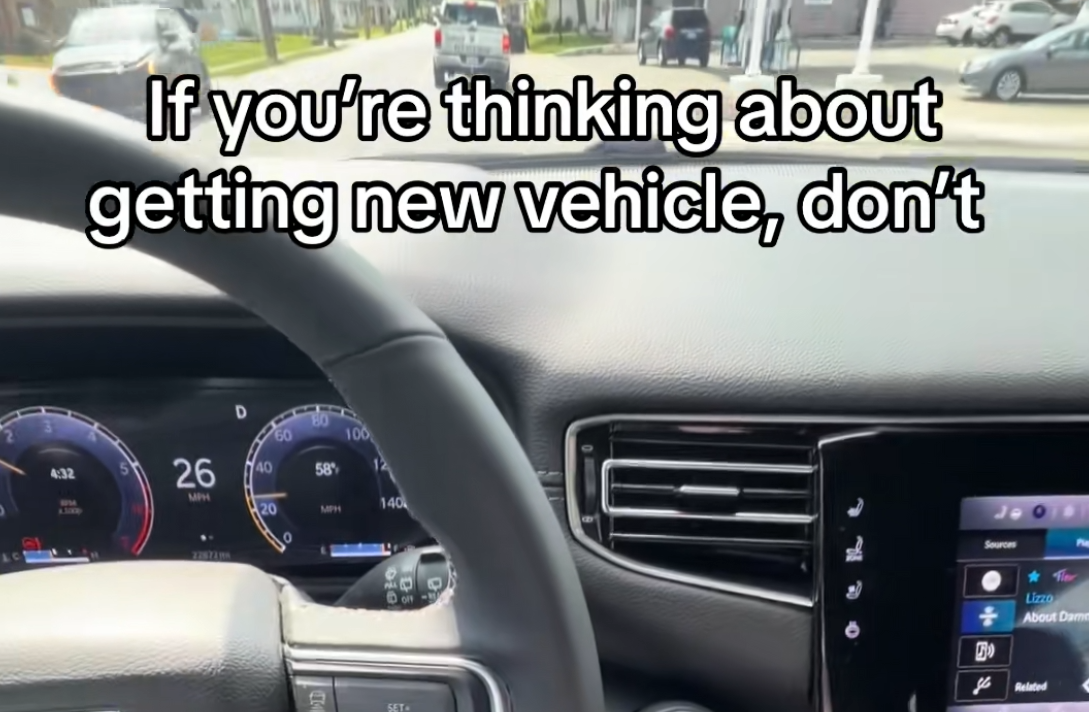
A 29-second clip filmed from the driver’s seat of a brand-new SUV has turned into one of the most relatable automotive meltdowns on the internet this year. Addison Stanley, a home-care nurse and mother who goes by @addierain on TikTok, was simply driving her 2025 Jeep Wagoneer to a stop sign when the unthinkable happened: the vehicle completely shut off. No warning. No gradual stutter. Just a full, dead-silent shutdown, mid-drive, while still in gear.
The video has now crossed 2.7 million views, and it is not hard to see why. Stanley narrates the whole thing in real time, calm and almost resigned, like someone who has been through this before because, as it turns out, she has. The clip ends with her asking if anyone knows what is going on, and the replies came fast, loud, and with a lot of shared frustration from people who said they knew exactly what was happening.
What followed in the comments section read less like a social media thread and more like a support group for Wagoneer owners. Jeep dealership employees, current and former service techs, and owners from across the country piled in with diagnoses, advice, and more than a few “your first mistake was buying a Jeep” remarks. The incident touched a nerve that clearly runs a lot deeper than one bad afternoon at a stop sign.
Stanley’s Wagoneer is not a cheap vehicle. The 2025 model starts at just under $60,000 after Stellantis cut prices by as much as $7,000 for the model year. It is a full-size SUV positioned as a near-luxury family hauler, and for that kind of money, most buyers reasonably expect the car to stay on when they press the brake. That expectation, it seems, is where things get complicated.
What Actually Happens When the Wagoneer Dies at a Stop
@addierain These new vehicles get on my nerves…. The tiniest thing will malfunction and make the entire car not start 🙄 #wagoneer #newvehicle #jeep ♬ original sound – Addison Stanley
The shutdown Stanley filmed is not random, and it is not a mystery to people in the service industry. The vehicle rolled to the stop sign, her foot hit the brake, and the engine cut out completely while the transmission was still in drive. On restart, the dashboard threw a power steering warning, which then cleared as the system came back online.
It looks terrifying, and in a car that costs the better part of $60,000 to $76,000 depending on trim, it absolutely should not be happening. But according to commenters with service department experience, the culprit is almost always the auxiliary stop-start battery, a smaller secondary 12-volt unit that works alongside the main battery to support the vehicle’s stop-start system and keep all the electronics running during brief engine-off moments at idle.
When that auxiliary battery weakens or fails, the stop-start system can behave erratically. The engine drops out, the electrically assisted power steering briefly loses power, and warnings start flashing at restart. It looks like a catastrophic failure, but it is, mechanically speaking, a battery problem. That said, a battery problem in a vehicle you just bought is still a problem worth being angry about.
“This Will Be Our 2nd Battery”
The most telling detail in the entire thread was not a comment from a mechanic or a dealership employee. It was Stanley’s own reply when someone suggested she get the auxiliary battery tested under warranty. “This will be our 2nd battery,” she wrote.
That one sentence tells the whole story. A brand-new vehicle, already on its second battery, still dying at stop signs.
Multiple commenters who identified themselves as Jeep dealership workers backed up what she was experiencing, with one noting that she had replaced more batteries in six months working at a Jeep store than she had in six years at Nissan and Hyundai dealerships combined. The explanation offered was that modern Wagoneers run so many systems simultaneously in the background that they place unusual strain on both batteries, accelerating wear in the auxiliary unit.
There is also a wrinkle that makes a quick trip to the auto parts store useless here. The replacement battery has to be coded to the vehicle’s body control module by a trained technician. Swapping one in yourself without that step will leave the car still throwing the same fault codes, which means every repair requires a dealer visit, not exactly ideal when the vehicle keeps letting you down.
The Wagoneer’s Longer History of Recalls and Complaints

The battery issue does not exist in a vacuum. The Wagoneer platform has accumulated a notable list of recalls and customer satisfaction campaigns since it launched, and while none of those are directly related to what Stanley filmed, they paint a picture of a vehicle line that has been dealing with growing pains at scale.
Among the issues on record: improperly installed B-pillar trim on around 44,000 vehicles that could prevent side-curtain airbags from deploying in a crash, third-row seatbelt damage or accessibility concerns affecting more than 97,000 SUVs, and a 2025 campaign covering rear-window trim that can detach from more than 123,000 vehicles. The phrases “lemon law” and “take it back to the dealer” showed up in dozens of replies under Stanley’s video, which suggests that for some owners, the battery problem is just the latest item on a longer list.
For context, the standard Wagoneer starts at $59,945 and tops out around $76,040 for the Series III. The Grand Wagoneer, the longer and more premium variant, pushes into the high $90,000s and beyond. These are not budget vehicles, and the expectations that come with that price point are entirely reasonable.
What Drivers Can Learn From This Viral Moment
Stanley’s video is a good reminder that documenting vehicle issues, even casually on social media, has real practical value. By filming the fault as it happened, she created a timestamped, visual record of the problem that could prove useful if she ever needs to pursue a warranty claim or, in a worst-case scenario, a lemon law buyback.
Most states have lemon law protections that kick in after three unsuccessful repair attempts for the same defect within a defined period, or after a vehicle has been out of service for a cumulative number of days. The exact thresholds vary, but the general principle is consistent: document everything in writing at the dealer, keep copies of every service visit, and do not assume the problem is resolved just because the battery gets swapped again.
The broader takeaway is worth stating plainly. Modern vehicles are extraordinarily complex, and even a component as simple as a secondary battery can cascade into what looks and feels like a total electrical failure. If your newer vehicle is dying at stops, throwing unexpected warning lights, or behaving erratically after what should be a routine fix, push for a written diagnosis, get everything documented, and know that you have options beyond just hoping the next repair sticks.