General Motors CEO Mary Barra had plenty to talk about on the company’s first quarter earnings call, from new trucks to geopolitical headaches, but one number she dropped landed differently than the rest. According to Barra, nearly 90% of the code being produced by GM’s autonomy team is now generated by artificial intelligence. Not reviewed by AI. Not assisted by AI. Generated by it.
That figure is striking on its own, but the context makes it even more interesting. GM is not some startup experimenting with autonomous driving on a shoestring budget and a lot of optimism. This is one of the largest automakers in the world, and it is building the next chapter of its Super Cruise technology, a system that is already on public roads, with code that a human did not write.
Barra framed the development as a feature, not a concern. She described it as a direct reflection of how seriously the company is taking AI adoption across every part of the business. In her view, this is GM moving fast and moving smart, using every tool at its disposal to stay competitive in a technology race that shows no signs of slowing down.
Whether consumers share that enthusiasm is a different story entirely. Trust in autonomous driving technology has been hard to build and easy to lose, and a headline about AI writing the code for self-driving cars is the kind of thing that sends a particular segment of the driving public straight to the comments section. Buckle up.
What Super Cruise Is Actually Becoming

For those who have not been following GM’s driver assistance roadmap, Super Cruise is the company’s hands-free highway driving system. It already exists, it already works on approved roads, and millions of miles have been logged with it. But the next generation is a significant step up from what is currently available.
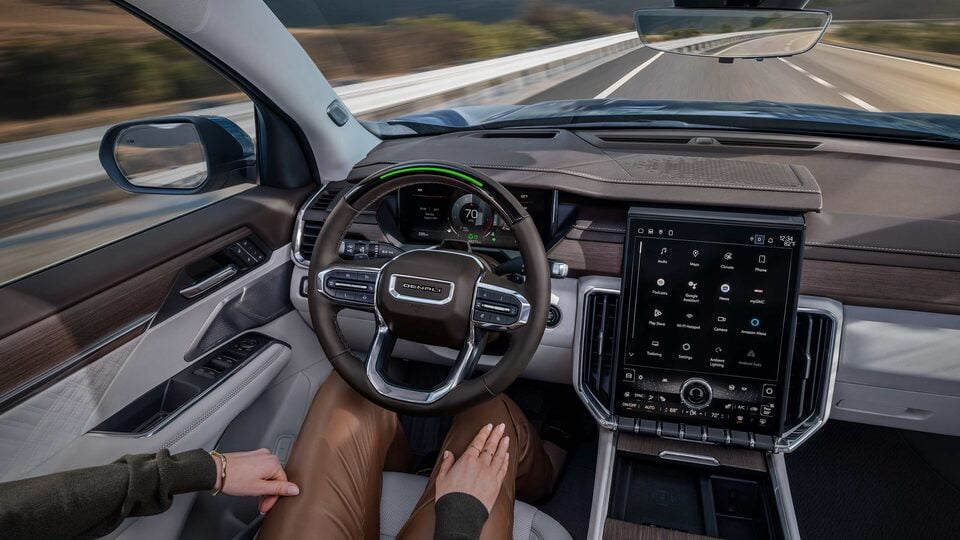
The updated system, set to launch in 2028 on the Cadillac Escalade IQ, is being designed for what the industry calls “eyes-off, hands-off” operation. That means the driver is not expected to monitor the road the way they are with current semi-autonomous systems. The car handles it, and to make that crystal clear to everyone nearby, the vehicle will signal its autonomous mode with a series of turquoise lights visible both inside the cabin and to other drivers on the road.
The technology behind it is more layered than what Super Cruise uses today. Lidar will be added alongside the existing radar and camera setup, giving the system a richer, three-dimensional picture of the environment around the vehicle. Think of it as upgrading from a photograph to a topographic map. The more data the system has, the better its decisions. At least in theory.
What We Can Learn From the “AI-Written Code” Revelation
The 90% figure is going to make a lot of people uncomfortable, and that reaction is worth taking seriously rather than dismissing. Here is the nuance that tends to get lost in the panic: AI-generated code is not the same as unreviewed code. Engineers do not simply prompt a model, copy-paste the output, and ship it to production in a safety-critical vehicle system. The code still gets tested, validated, and scrutinized by human engineers. The AI is the drafter, not the decision-maker.
That said, this moment does raise legitimate questions about accountability and transparency. When something goes wrong in a system this complex, and in complex systems something eventually does, understanding who or what made which decision matters. If the foundational logic was generated by a model, tracing the reasoning behind a specific output becomes significantly harder than reading through human-authored code line by line.
What the industry can take from this: the conversation around AI-generated safety-critical code needs to move faster than the technology itself. Standards for testing, auditing, and certifying AI-generated software in vehicles do not yet exist in a comprehensive way. GM’s disclosure is a good opening for that conversation, even if it was not framed as one.
For consumers, the lesson is simpler. Ask questions, read the fine print on what “autonomous” actually means in any given system, and remember that hands-free does not mean risk-free. The technology is genuinely impressive. It is also genuinely new.
Meanwhile, There Are Trucks, and There Is a War
Not everything from GM’s earnings call was about the philosophical implications of machine-written code. Barra also signaled excitement about new full-size trucks arriving before the end of the year, referring to the redesigned Chevrolet Silverado and GMC Sierra. Given that the electric versions of those trucks have struggled to find traction with buyers, the return to a refreshed traditional lineup is welcome news for dealers and for GM’s bottom line.
On the international front, GM acknowledged real-world disruption from the conflict in Iran. The company rerouted approximately 7,500 full-size SUVs that had been earmarked for the Middle East market, redirecting them to the United States instead. The reallocation helped offset some inventory shortfalls domestically, turning a logistical problem into an accidental solution. GM noted it expects some softness in international operations as long as the situation continues, a reminder that geopolitics has a way of showing up in the most unexpected places, including a car company’s quarterly earnings report.