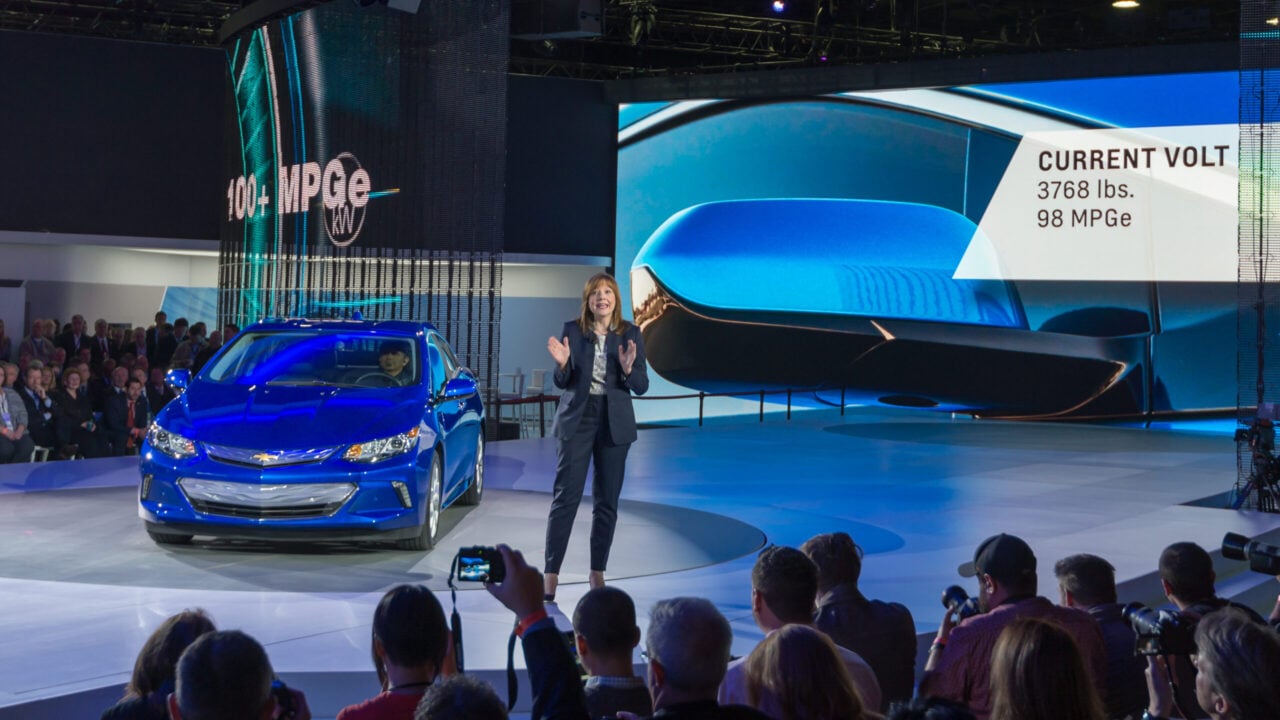
Mary Barra has once again taken the top spot as the highest-paid executive among Detroit’s Big Three automakers, pulling in just under $30 million in total compensation for 2025. That figure, confirmed in a regulatory filing submitted to the SEC on April 20, marks her 12th year running General Motors and pushes her career earnings from the role past the $300 million threshold. Not bad for a job that comes with an awful lot of tariff headaches.
The announcement comes at a complicated time for GM. The company posted a full-year net income of $2.7 billion in 2025, which sounds solid until you realize that figure represents a 55 percent decline from the prior year. Tariffs imposed by the Trump administration hit the automaker to the tune of $3.1 billion, and additional charges related to scaling back its electric vehicle ambitions added more than $7 billion in hits against earnings. In short, GM has had better years.
Still, Barra’s pay package grew modestly, up about 1.4 percent year over year. Her base salary of $2.1 million has remained unchanged for several years, so the movement came largely from stock awards, which climbed 11 percent to $21.6 million. Her performance-based cash compensation, on the other hand, dipped 26 percent as the company’s adjusted pretax earnings fell short of prior peaks.
What makes the story even more interesting is not just what Barra earned, but who is sitting beside her in the executive suite and what GM paid to get them there.
GM’s Newest Exec Got a Welcome Package Worth $40 Million
Sterling Anderson, GM’s chief product officer, joined the company last May after co-founding Aurora Innovation, a self-driving trucking company. To pull him away from that role, GM’s board put together a compensation package valued at $40.3 million, though most of that figure consists of one-time hiring incentives he has not yet fully received.
The breakdown is striking. Anderson received a $3 million performance cash award that already vested in December, along with $10 million in restricted stock units set to vest in phases through 2027, and another $11 million in performance-based awards tied to specific benchmarks. His base salary for the portion of 2025 he actually worked came out to roughly $583,000.
The board’s justification was straightforward: Anderson held significant equity in his prior company, and recruiting him required making up for what he walked away from.
How Does Barra Stack Up Against Ford and Stellantis?
The Detroit CEO pay comparisons are always worth examining. Barra reclaimed the top spot in 2025 after briefly losing it in 2023 to former Stellantis CEO Carlos Tavares. Ford’s Jim Farley saw his own compensation climb nearly 11 percent last year to $27.5 million, reflecting progress the company made on quality improvement targets. New Stellantis CEO Antonio Filosa, who stepped into the role in June, received $6.37 million for the partial year, a figure that will likely look different once he completes a full year in the seat.
The gap between Farley and Barra is narrower than it looks when you consider the headwinds each company faced. Both automakers grappled with tariff exposure and a shifting EV landscape. That Barra’s package grew at all, even by a modest 1.4 percent, reflects GM’s board standing by its leadership team even during a tough stretch.
What This Tells Us About Executive Pay and Corporate Accountability
The bigger lesson buried in these SEC filings is the tension between executive compensation and broader company performance. GM’s UAW-represented hourly workers saw their profit-sharing checks shrink to a maximum of $10,500, the result of a 28 percent drop in North American pretax profit. Meanwhile, the executives overseeing the company that produced those results are still pulling in eight-figure packages.
That is not necessarily a scandal. Executive compensation at large public companies is tied to long-term stock performance, retention needs, and competitive market pressures, and GM’s board did reduce Barra’s performance cash payout as profits fell. But the contrast is a useful reminder that pay structures in corporate America are built to insulate top leadership from short-term pain in ways that regular employees simply are not. When the numbers are good, everyone shares in the upside. When they are not, the math works out very differently depending on where you sit.
What Comes Next for GM and Its Leadership Team
GM heads into 2026 with a lot to prove. The company is still recalibrating its EV strategy after pulling back on some earlier ambitions, and trade policy uncertainty has not disappeared. Anderson’s arrival signals a meaningful investment in product development talent, which suggests GM is betting that what it builds over the next few years will matter more than near-term cost-cutting.
Barra’s compensation committee put it plainly in the SEC filing, saying the 2025 program was designed to push management to navigate uncertainty and focus on profitability and products customers actually want. Whether $300 million over 12 years has produced the results GM shareholders expected is a question the next few model years will start to answer.