

There is a new cat-and-mouse phase unfolding in the Tesla ecosystem, and this time it is not about range anxiety or phantom braking. It is about Full Self-Driving access being forced through hardware and software doors that were never meant to open outside approved regions.
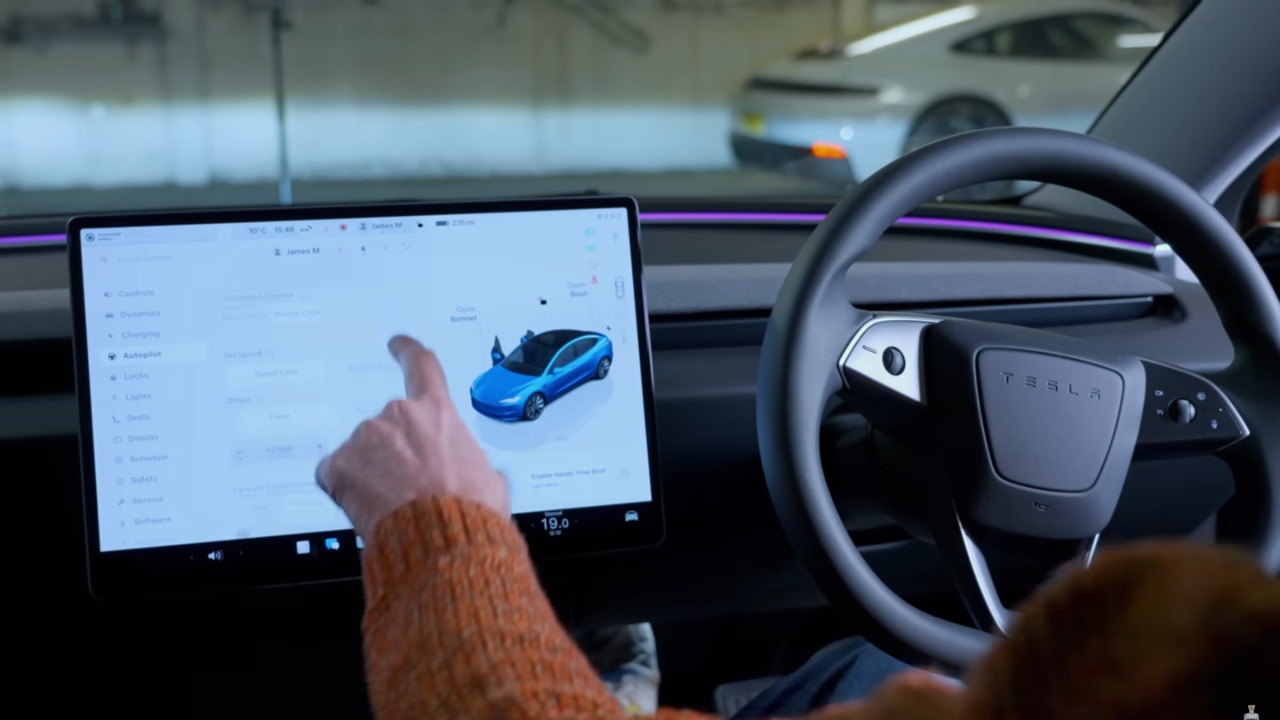
Reports circulating among owners and independent technicians describe a wave of “FSD jailbreaks” that rely on inexpensive third-party CAN bus devices. These small modules plug into a vehicle’s controller area network and attempt to intercept or spoof signals that normally flow between core vehicle systems, including the Autopilot computer, gateway module, and body control units.
In plain terms, they try to convince the car that it is something it is not.
The technique varies, but most setups appear to inject or modify CAN frames tied to configuration flags, region codes, or feature entitlements. In some cases, enthusiasts attempt to mimic the presence of a valid software package license by replaying stored communication sequences.
In others, they try to interfere with the handshake that validates whether Full Self-Driving capability is enabled for a specific VIN and geographic region. If all this sounds like Latin, here’s the gist of it in simpler terms.
Think of a car’s computer system like a group chat where all the parts (engine, brakes, sensors) are constantly talking to each other. That “chat” happens over something called the CAN bus, a network that carries signals telling the car what features are active.
So, a “FSD jailbreak” is when someone plugs in a cheap device that pretends to be part of that chat. Instead of just listening, it sends fake messages—like saying, “Yes, this car has Full Self-Driving enabled” even if it doesn’t.
Sometimes it replays old messages, other times it interrupts the handshake that verifies whether the car is licensed for advanced features. In simple terms, it tricks the car into believing it has software or capabilities it wasn’t actually given.
It’s like showing a fake ticket at a concert: the scanner thinks you belong, but you don’t. That’s why automakers see it as risky and illegal.
Tesla Fights Back
Tesla, however, is no passive observer in this ecosystem.
According to owner reports and telemetry behavior patterns, the company’s backend infrastructure continuously audits vehicle logs that are uploaded during connectivity events. These logs are not just error reports or crash summaries. They include detailed state snapshots of feature activation, firmware integrity checks, and configuration consistency between on-board modules and cloud assigned entitlements.
When something does not match, the system flags it.
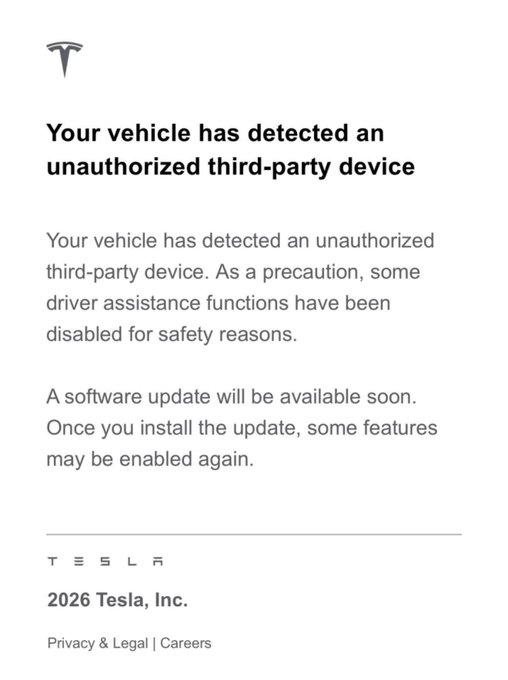
In the newest wave of enforcement, vehicles suspected of unauthorized modifications reportedly receive a server-side instruction that forces a configuration rollback. Owners describe seeing a message along the lines of “Unauthorized third-party device detected.”
Once triggered, Autopilot and Full Self-Driving revert to their original factory or region compliant settings. In some cases, the system disables FSD entirely until the anomaly is resolved.
What makes this enforcement notable is not just the deactivation itself, but the absence of prior notice in some instances. Instead of a gradual warning chain, the backend appears capable of executing immediate entitlement revocation when the risk score crosses a threshold.
How Tesla’s Cloud Architecture Enforces Compliance
Under the hood, Tesla’s architecture supports this kind of control through a tightly coupled OTA ecosystem. Each vehicle maintains a cryptographically signed configuration profile tied to its VIN. Feature access is not simply stored locally; it is validated against Tesla’s servers, which act as the authoritative source of truth.
If a CAN bus device attempts to spoof state changes, it risks creating a mismatch between local telemetry and backend expectations.
Once that mismatch is detected, the system can enforce compliance by pushing a revised feature flag set during the next connectivity handshake, or in some cases by forcing an immediate wake event that re-evaluates system integrity.
What does this all mean? Imagine Tesla’s system like a teacher constantly checking homework against the answer key. Every time your car connects to Tesla’s servers, it uploads logs, that is, snapshots of what features are active, whether the software looks intact, and if the car’s settings match what Tesla says you’re entitled to.
So, if someone plugs in a device that tries to trick the car into thinking it has Full Self-Driving when it doesn’t, those logs stop matching. Tesla’s backend spots the mismatch and flags it.
Word on the street is that instead of sending a warning, Tesla can immediately push a correction: the car gets a message and the fancy features switch back to factory defaults. That works because each car’s configuration is cryptographically tied to its VIN and validated against Tesla’s servers.
In other words, Tesla holds the master key, and if your car’s local story doesn’t line up, the system rewrites it to enforce compliance.
Regulation, Impatience, and the Server Always Wins
The timing of this enforcement wave has raised eyebrows. It coincides with growing anticipation around a decision from the Dutch RDW, the regulatory authority expected to weigh expanded approval for Tesla’s Full Self-Driving capabilities in parts of Europe. Enthusiasts in restricted regions have long viewed gray-market activation methods as a workaround while waiting for formal rollout.
That impatience is exactly what third party CAN devices exploit. They are cheap, widely available, and marketed in online communities as harmless “configuration tools.” In reality, they sit in a legally and technically sensitive space, altering safety critical signals in ways that manufacturers explicitly prohibit.
Tesla’s firm stance on the matter is not surprising. Unauthorized modification of vehicle control systems violates terms of service, may void warranty coverage, and introduces unpredictability into systems designed with strict safety constraints. More importantly, it undermines the regulatory pathway that determines where and how advanced driver assistance systems can operate.
There is also a technical irony in the situation. The same cloud connected architecture that enables seamless over-the-air updates and feature expansion is what allows remote detection and disabling of tampered configurations. The vehicle is no longer a closed machine but a continuously verified node in a distributed software network.
🚨 Tesla is cracking down on FSD jailbreaks.
Owners using cheap third party CAN bus devices to unlock Full Self-Driving in unsupported regions (like parts of Europe) are getting their FSD remotely disabled.
Notification: “Unauthorized third party device detected”, so… pic.twitter.com/zUzPRZ1gHt
— Rustavi (@Rustavi) April 9, 2026
In the meantime, Tesla’s message to the jailbreakers is that if FSD access arrives in your region, it will arrive through official channels, not through improvised wiring tricks and signal impersonation. And if those tricks are detected, the system is capable of snapping back to baseline without much negotiation.
The age of offline modification meets the age of server governed driving logic, and the server tends to win.