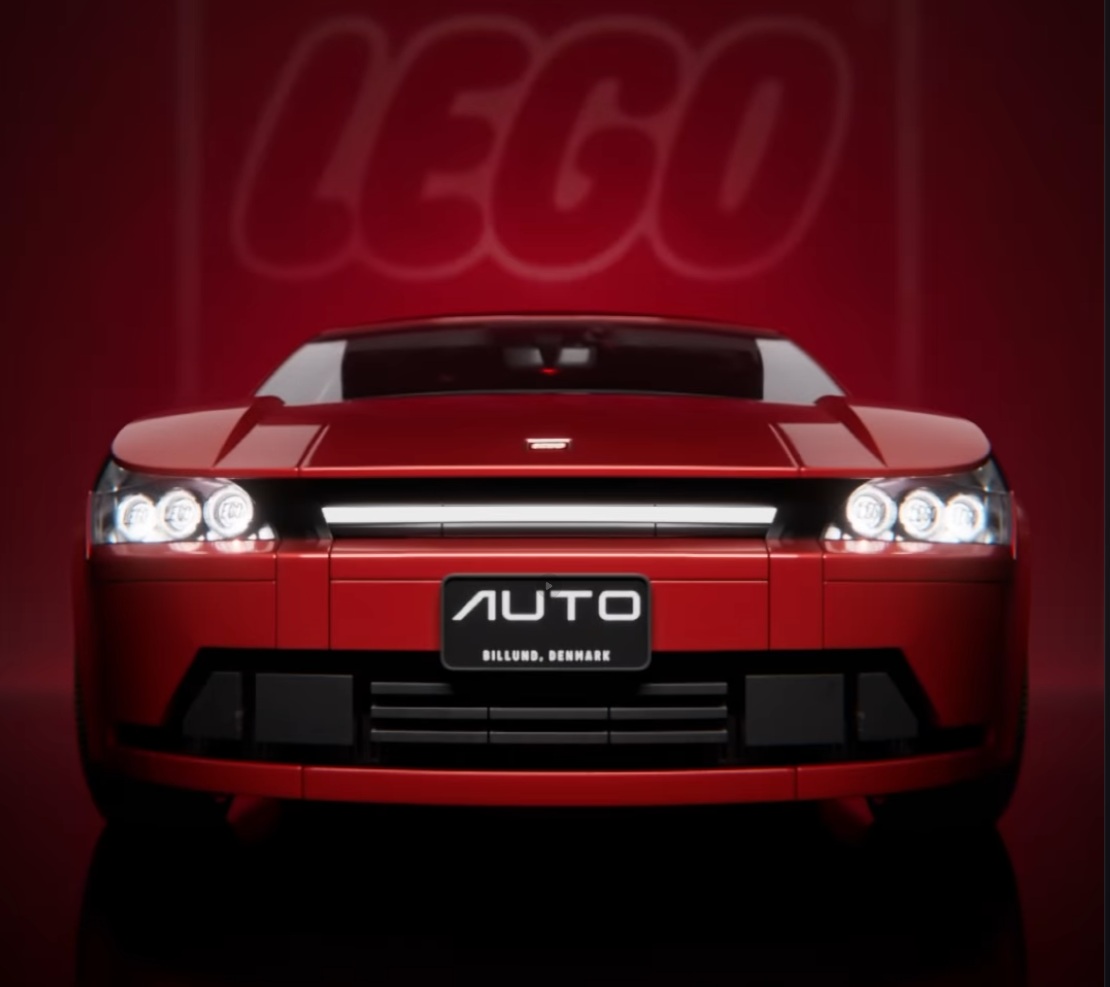
April Fools’ Day usually delivers the same thing every year: a flood of cringey, half-baked automotive “announcements” that waste everyone’s time and rarely land the joke. Most of them are forgotten before lunch, and for good reason. The line between clever and pointless gets crossed more often than not.
This one is different.
When you hear that Lego “designed a real car,” your brain probably goes somewhere ridiculous. Something cartoonish. Something closer to the infamous car dreamed up by Homer Simpson that nearly bankrupted his brother’s company than anything you would actually want to drive. But that is not what Lego showed here. Instead of going full gimmick, the concept leans surprisingly grounded, with Lego DNA worked in as clever, subtle Easter eggs rather than the entire identity.
And that is exactly why it works. If a plastic brick company can make people feel something about a car in 30 seconds, what exactly has the rest of the industry been doing for the last couple of decades?
Make Everything Awesome, Just Not Obvious
The details are what sell it. A frog-inspired gear shifter that feels playful without being obnoxious, and honestly would not feel out of place in something like a Jeep, which is probably a sign that a few designers in Auburn Hills might want to ask themselves if they have been playing things a little too safe. Brick-patterned pedals paired with a “Step On It” floor mat lean into the joke just enough. Subtle Lego logos are worked into lighting elements instead of screaming for attention. Even the idea of a minifigure-style puddle light manages to feel more clever than gimmicky.
That balance is the entire point. Most attempts at “fun” cars either go too far and feel like toys, or they play it so safe that the personality disappears entirely. This threads the needle. It feels like a real car first, with Lego layered in as personality rather than the whole identity.
And that is where real automakers keep missing.
The Internet Got the Joke—And Still Wants the Car
If this was meant to be a throwaway April Fools’ gag, the reaction suggests Lego may have accidentally done some market research instead. The comments are full of people who clearly understood the joke—and immediately started asking where they could buy one.
“I know it’s a joke, but I would actually drive this.” “April fools joke? Yes. Do I want one anyway? Also yes.” That theme shows up over and over, along with people calling out specific details they would genuinely want in their own cars.
The frog shifter, in particular, completely took over the conversation. “I kind of want a frog shifter for my car now.” “Honestly wouldn’t be mad having a frog as a shifter.” “You got me at the frog gear lever.” Out of everything shown, that is what stuck.
There is also a steady stream of people asking the same question in slightly different ways: do we have to build it ourselves? “Does it come with instructions?” “How big is the instruction book?” “Do you need to build it or does it come preassembled?” That is part of the joke, but it is also part of the appeal.
And maybe the most telling reaction shows up again and again in different forms: people know it is fake—and still want it to be real.
Lego Already Understands Car Culture Better Than It Should
This is not coming out of nowhere. Lego has spent years quietly building credibility with car enthusiasts through its Technic and licensed sets. From hypercars to classic icons, Lego has managed to translate what makes these vehicles special into something people can actually build, display, and connect with.
That matters, because it shows Lego understands something deeper than just styling. It understands why people care about cars in the first place.
There is a reason these sets sell so well. People are not just buying plastic bricks. They are buying a connection to cars they love, or cars they wish they could own. Lego has figured out how to capture that emotion in a way a lot of modern vehicles struggle to.
This Is the Part That Should Bother the Industry
The real takeaway here is not the frog shifter, as great as it is. It is the reaction. People saw this and immediately started wishing it was real.
That says more about the current state of the auto industry than any press release ever could.
We are in an era of shared platforms, overlapping designs, and vehicles that feel increasingly interchangeable. Scroll through a lineup today and it is easy to lose track of what brand you are even looking at. Screens got bigger, interfaces got more complicated, and somewhere along the way, a lot of the personality got engineered out.
Automakers have tried to inject character back into their vehicles. Volvo gave us an Orrefors crystal shifter. Genesis introduced a glowing rotating orb. Those are nice touches, but they feel like isolated ideas, not part of a bigger identity.
What Lego did here, even as a joke, feels cohesive. It feels intentional. And most importantly, it feels like something people actually connect with.
If the industry keeps sanding everything down into the same safe, focus-grouped shape, the idea of a Lego-branded car stops sounding ridiculous and starts sounding like an opportunity.
PS: If anyone at Jeep is reading this, how exactly did Lego beat you to a retractable duck hood ornament?