
Let’s be honest for a second: if you lined up a dozen Porsches from different decades, you’d probably struggle to tell some of them apart at first glance. The brand has built its reputation on evolutionary design rather than revolutionary changes, which means that classic 911 silhouette has remained remarkably consistent since the 1960s.
But every now and then, Porsche breaks from tradition and creates something that makes you do a double-take.
Porsche 928 (1977-1995)

The 928 was Porsche’s bold attempt to replace the 911 with something completely different, and boy, did it look the part. With its pop-up headlights, sleek fastback profile, and integrated bumpers, it looked more like a spaceship than a traditional Porsche.
The design was so ahead of its time that it still looks futuristic today, even though the last one rolled off the production line nearly 30 years ago.
Porsche 914 (1969-1976)

This mid-engine oddball was born from a partnership with Volkswagen, and it shows. There’s a reason it’s also known as the VW-Porsche, writes Porsche. The 914’s angular, wedge-shaped body and distinctive “Targa bar” gave it a completely unique look that stood apart from both Porsche’s rear-engine sports cars and VW’s people-movers.
Love it or hate it, you definitely can’t mistake it for any other car on the road.
Porsche Panamera (First Generation, 2009-2016)

When Porsche announced they were making a four-door fastback sedan, purists were skeptical, but nobody expected it to look quite like this. The first-generation Panamera’s controversial rear end, with its high deck and unusual proportions, sparked countless debates about whether it was brilliant or bizarre.
It was definitely polarizing, but there’s no denying it was instantly recognizable as something different from Stuttgart.
Porsche 959 (1986-1993)

The 959 took the basic 911 formula and turned it into something that looked like it belonged in a sci-fi movie. With its wide fender flares, distinctive air intakes, and that massive rear spoiler, it managed to be both unmistakably Porsche and completely revolutionary at the same time.
Only 337 were ever made, which makes spotting one in the wild feel like finding automotive treasure.
Porsche Cayenne (First Generation, 2002-2010)

Porsche’s first SUV was about as controversial as automotive launches get, and its chunky, upright proportions were a far cry from the low-slung sports cars the brand was known for.
The original Cayenne’s bold, almost brutalist design language made it impossible to ignore, whether you loved it or thought it was automotive sacrilege. Either way, it proved that Porsche could successfully venture into completely new territory.
Porsche 911 Turbo (930 Generation, 1975-1989)
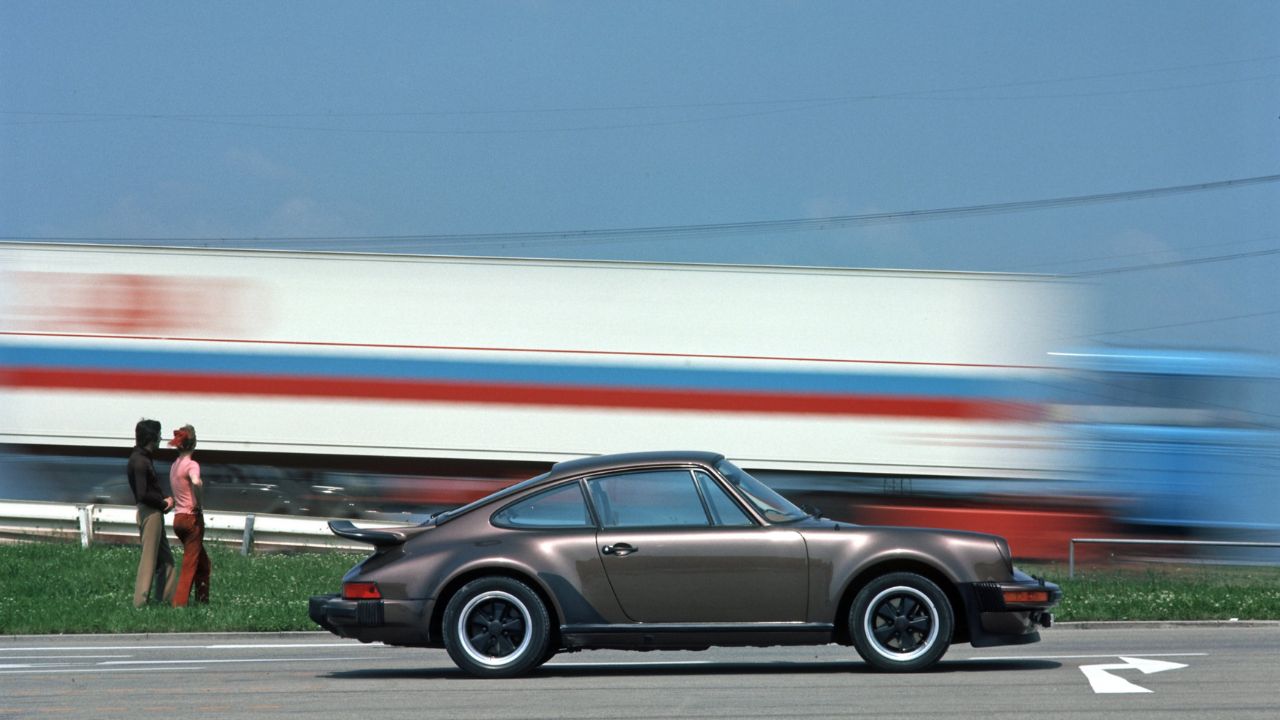
While most 911s blend together in memory, the original Turbo stands out thanks to its dramatic “whale tail” spoiler and massively flared rear fenders. While striking, these were functional additions needed to handle the extra power and wider tires.
The result was a 911 that looked properly menacing and gave birth to the “widebody” aesthetic that still influences Porsche design today.
Porsche Boxster (First Generation, 1996-2004)

The original Boxster proved that Porsche could create something entirely new while still looking undeniably like a Porsche. Its flowing, organic curves and distinctive side air intakes created a fresh design language that was both modern and timeless.
More importantly, it showed that a “budget” Porsche could still be beautiful and didn’t need to look like a watered-down version of something else.
Porsche Carrera GT (2004-2006)

The Carrera GT was Porsche’s attempt at building the ultimate analog supercar, and its dramatic styling matched its racing-derived mechanical bits. With its prominent roll hoops, aggressive front splitter, and that distinctive rear deck engine cover, it looked like nothing else in the Porsche lineup.
The carbon fiber body and track-focused aerodynamics gave it an almost alien appearance that still turns heads nearly two decades later.
Conclusion

These standout Porsches prove that even the most conservative automotive brands can surprise us when they’re willing to take risks. Whether they were born from necessity, experimentation, or pure ambition, each of these cars managed to break the mold while still maintaining that essential Porsche DNA.
They remind us that sometimes the most memorable designs come from companies brave enough to color outside their own lines, even if it means dealing with a few raised eyebrows along the way.