When you think about Lamborghini, “subtle” probably isn’t the first word that comes to mind. For over 60 years, the Italian marque has built a reputation on creating cars that make sensible automotive engineers clutch their clipboards in disbelief.
From single-seat fighter jet cockpits to V12-powered off-road monsters, Lamborghini has consistently asked “why not?” when everyone else says “you shouldn’t.” What’s fascinating is how the company has turned excess into an art form, creating machines that are equal parts engineering marvel and automotive theater.
These aren’t just cars, they’re dreams made real, and sometimes wonderfully impractical solutions to problems nobody asked about. Let’s explore 12 of the most outrageous creations to ever wear the raging bull badge.
Lamborghini Revuelto (2024)
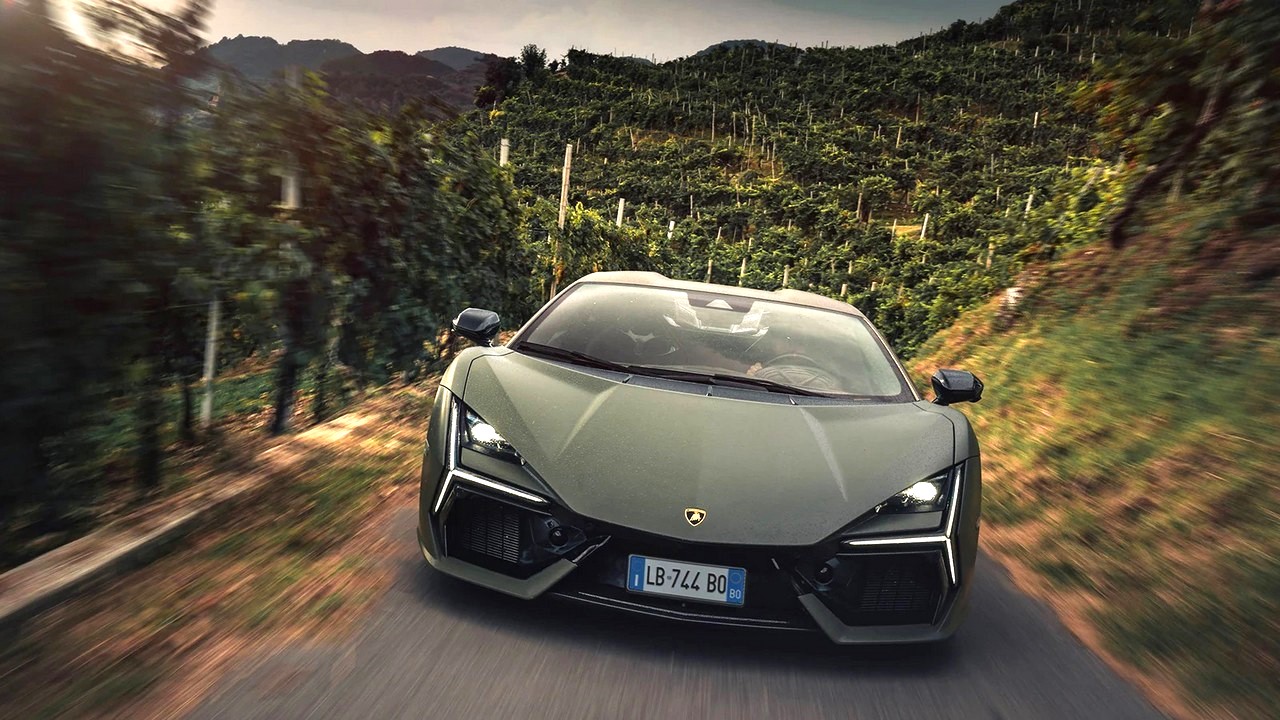
The Revuelto represents Lamborghini’s leap into electrified performance, and they didn’t hold back. This plug-in hybrid combines a naturally aspirated 6.5-liter V12 with three electric motors to produce a combined 1,001 horsepower, making it one of the most powerful production Lamborghinis ever built.
The V12 spins to over 9,000 rpm while the electric motors provide instant torque, and Lamborghini quotes 0 to 62 mph in 2.5 seconds. What makes it particularly wild is that Lamborghini added hybrid tech not for efficiency, but purely for more performance. It can travel about eight miles on electric power alone, which is just enough to sneak out of your neighborhood before waking up with that glorious V12 symphony.
Starting at about $608,000 in the U.S., it proves that going green doesn’t mean going boring.
Lamborghini Veneno (2013)

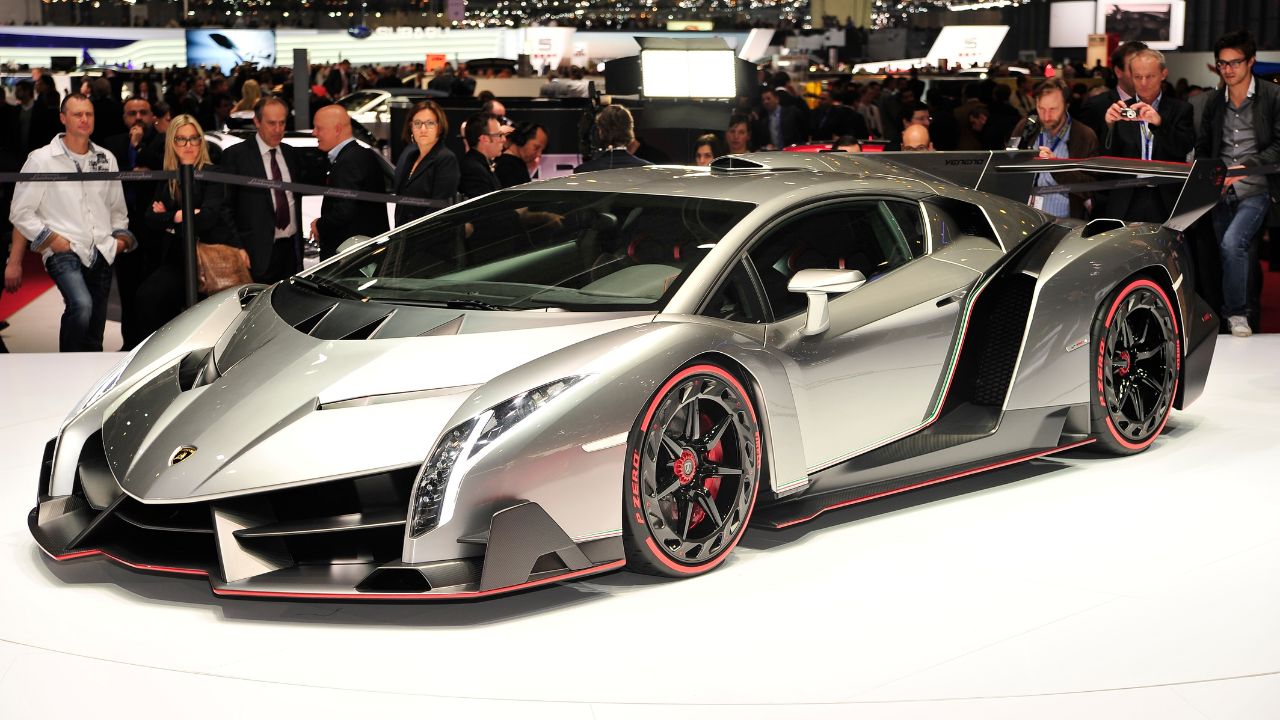
Built to celebrate Lamborghini’s 50th anniversary, the Veneno looked like it crash-landed from a distant galaxy where aerodynamics trump all earthly concerns. With 3 customer coupes plus 1 factory museum coupe and 9 roadsters built, this 740-horsepower rocket featured origami-inspired bodywork that was extreme even by Lamborghini’s already dramatic standards.
The name means “poison” in Spanish, which seems appropriate for a car that could induce heart palpitations just sitting still in your driveway. The three customer coupes were painted in Grigio Metalluro with red, green, or white accents, and the car commanded a price around $4 million. With a top speed of 221 mph and 0 to 62 mph in 2.8 seconds, the Veneno proved that sometimes more really is more.
Its angular design divided opinions, but nobody could ignore it.
Lamborghini Sesto Elemento (2010)

The name translates to “sixth element”, carbon, and that tells you everything about this stripped-down track weapon. Lamborghini obsessed over weight reduction so intensely they didn’t even paint the car, leaving the exposed carbon fiber to speak for itself.
Weighing just 2,202 pounds, the Sesto Elemento paired a 570-horsepower V10 with an almost religious devotion to lightness. The seats were mounted directly to the carbon fiber chassis, there was virtually no sound insulation, and creature comforts were treated as unnecessary ballast. Lamborghini announced a run of 20 track-only cars priced at about $2.92 million each.
Lamborghini Egoista (2013)

Nothing says “over-the-top” quite like a single-seat supercar with a fighter jet canopy and anti-radar bodywork. The Egoista, Italian for “selfish”, was Lamborghini’s gift to itself for the company’s 50th anniversary.
With its removable cockpit inspired by Apache helicopters and a design that required removing the steering wheel just to get in or out, this 600-horsepower concept took dramatic flair to absurd heights. The canopy featured orange-tinted anti-glare windows, and the LED lighting system mimicked aircraft positioning lights. Designer Walter de Silva called it “hedonism taken to the extreme,” which might be the understatement of the century.
The car now resides in Lamborghini’s museum, a one-off testament to what happens when designers are told to forget practicality entirely.
Lamborghini Countach LP 400 (1974)

The original poster car that launched a thousand bedroom wall decorations, the Countach LP 400 (nicknamed “Periscopio” for its periscope-style rear-view mirror) defined what a supercar should look like for an entire generation. Those scissor doors weren’t just for show, they were necessary because the car was so wide and visibility so limited that regular doors would’ve been impractical.
The wedge-shaped design was so radical that it still looks futuristic today, nearly 50 years later. Powered by a 4.0-liter V12 producing around 375 horsepower, it could hit 180 mph at a time when most cars struggled to reach highway speeds gracefully. The interior was famously cramped and hot, visibility was terrible, and parking it was an exercise in faith.
None of that mattered: it looked like it was going 200 mph while sitting still.
Lamborghini Miura P400 Jota (1970)

Built by Lamborghini’s test driver Bob Wallace, the Jota (pronounced “Hota,” the Spanish name for the letter J) was created to meet FIA’s Appendix J racing regulations. This one-off prototype took the already stunning Miura and dialed everything to 11.
Weight was stripped out, the suspension was stiffened, the 4.0-liter V12 was tuned to produce about 418 to 440 horsepower, and the body received unique aerodynamic modifications. The Jota was so extreme that it inspired a small run of customer “SVJ” replicas, though the original was tragically destroyed.
The Miura may have been the world’s first true supercar, but the Jota showed what happened when you took that masterpiece and asked how much more extreme it could get. The answer: a lot.
Lamborghini LM002 (1986-1993)

Before luxury SUVs became commonplace, Lamborghini built the “Rambo Lambo”, a Countach-powered off-road beast with a curb weight around 5,720 pounds and a leather-lined interior that would make a drug lord blush. The LM002 packed a 5.2-liter V12 producing 444 horsepower, mated to a five-speed manual transmission with a dual-range transfer case.
It could hit 60 mph in 7.7 seconds despite a curb weight around 5,720 pounds, and topped out at 118 mph while getting about 8 mpg from its massive 76-gallon fuel tank. With specially designed Pirelli Scorpion run-flat tires and full leather everything, it was simultaneously a military-grade off-roader and a rolling luxury lounge.
Only 301 were built, and today they command prices around $250,000 to $400,000. It proved Lamborghini could make anything excessive.
Lamborghini Aventador SVJ (2018)

The SVJ (SuperVeloce Jota) represented the ultimate expression of Lamborghini’s V12 Aventador platform, and it went out swinging. With 770 horsepower from its naturally aspirated 6.5-liter V12, it became the most powerful V12 production Lamborghini at the time.
The car featured Lamborghini’s ALA 2.0 active aerodynamics system, four-wheel steering, and could lap the Nürburgring Nordschleife faster than nearly anything else with license plates. Zero to 60 took just 2.8 seconds, and it would keep accelerating to a top speed of 217 mph. With only 900 coupes produced and a starting price around $500,000, the SVJ was Lamborghini’s way of saying goodbye to the Aventador generation.
The thunderous exhaust note and razor-sharp handling made it clear that even in an era of turbocharging and hybridization, nothing quite matches a screaming naturally aspirated V12.
Lamborghini Centenario (2016)

Built to honor company founder Ferruccio Lamborghini’s 100th birthday, the Centenario took the already wild Aventador platform and dressed it in utterly bonkers bodywork. Only 40 were made, 20 coupes and 20 roadsters, each with a 759-horsepower version of the 6.5-liter V12.
The aggressive styling featured active aerodynamics, distinctive Y-shaped lighting elements, and enough carbon fiber to build a small aircraft. At $1.9 million, it was one of the most expensive Lamborghinis ever, and every single one sold before the public reveal. The 0-60 time of 2.8 seconds and top speed of 217 mph were impressive, but the real draw was the dramatic design that looked like it belonged in a science fiction movie.
The Centenario proved that Lamborghini’s design language could be pushed even further into the stratosphere.
Lamborghini Murciélago LP 670-4 SuperVeloce (2009)

When Lamborghini decided to give the Murciélago a final send-off, they created the SV — a car that stripped away 220 pounds while adding 30 horsepower to the 6.5-liter V12. The result was 661 horsepower channeled through all four wheels, propelling the car to 60 mph in 3.2 seconds and on to a top speed of 212 mph.
The exterior received aggressive aerodynamic updates, including a massive rear wing and revised front fascia. Only 350 were built, making it one of the rarer modern Lamborghinis. What made the SV special was how it refined the Murciélago’s already impressive performance into something truly track-focused while maintaining street usability.
It represented the peak of Lamborghini’s pre-Aventador V12 engineering, and remains highly sought after by collectors today.
Lamborghini Diablo GT1 Stradale (1998)

The Diablo GT1 Stradale was essentially a race-focused Diablo built by French specialist Signes Advanced Technology, with two examples widely reported.
The 6.0-liter naturally aspirated V12 is commonly reported at about 655 horsepower, making it one of the most powerful Diablo-based machines ever built. Weight reduction was extreme, lightweight materials were used throughout, the interior was stripped down to racing seats and a bare-bones dashboard, and even the windows were made from lightweight materials. The aerodynamic package included race-style bodywork with a large rear wing and enlarged air intakes.
When it surfaced publicly, it was treated as an ultra-rare collector piece rather than a normal market-priced production model. Today, it’s one of the most coveted Lamborghinis among serious collectors.
Lamborghini Countach Turbo S (1983)

If the regular Countach wasn’t wild enough, Swiss distributor Max Bobnar had tuner Franz Albert add twin turbochargers to a Countach V12, complete with a driver-adjustable boost control.
At maximum boost, output was reported at roughly 750 horsepower with 646 lb-ft of torque, from a 4,754 cc V12. Depending on gearing and aero, reporting for the Bobnar Albert Turbo S quotes 0 to 62 mph in about 3.7 seconds and a top speed a little over 200 mph. The project never made it to production, likely because it was simply too extreme even for Lamborghini’s adventurous customers.
Those two prototypes remain some of the most valuable and historically significant Lamborghinis ever created, representing the brand’s willingness to push boundaries regardless of practicality.
Conclusion

These twelve Lamborghinis represent more than just automotive engineering, they’re mechanical expressions of pure passion and the refusal to accept conventional limits. From single-seat concepts to V12-powered SUVs, each vehicle in this list pushed boundaries in ways that often seemed unnecessary, sometimes impractical, and always spectacular.
What’s remarkable is that Lamborghini has maintained this philosophy throughout its 60-year history, whether creating million-dollar limited editions or production models. While other manufacturers might ask “should we,” Lamborghini consistently asks “how far can we take this?” These cars prove that sometimes the most memorable machines are the ones that ignore reason in favor of emotion.
They’re automotive excess at its finest, but we somehow want even more!