
Think electric vehicles are a modern invention? Think again. While today’s EVs dominate headlines with their cutting-edge technology and impressive range, the truth is that electric cars have been cruising our streets for well over a century.
In fact, at the dawn of the automotive age, in the late 1890s, electric vehicles were outselling gasoline cars in the U.S. market overall in some years, though steam was often the largest share. These early pioneers of electric transportation offered quiet operation, easy starting, and none of the hand-cranking drama that came with early internal combustion engines.
Before gas stations dotted every corner and before the electric starter made gasoline cars more user-friendly, EVs were the sophisticated choice for urban drivers who valued reliability and refinement.
Flocken Elektrowagen (1888)

Germany’s Andreas Flocken created what many historians consider the world’s first true electric car, and it looked exactly like what you’d expect from the 1880s — essentially a fancy carriage that traded horses for electricity.
This four-wheeled pioneer is said to have reached about 15 km/h (around 9 mph), which doesn’t sound impressive until you remember that most people were still traveling by actual horse at the time. The Elektrowagen featured a small electric motor and battery system mounted beneath a carriage-style body, proving that the fundamental concept of battery-powered transportation was viable.
While only one was ever built, Flocken’s creation demonstrated that personal electric transportation wasn’t just a pipe dream but an achievable reality.
Morrison Electric (1890-1891)

Iowa’s own William Morrison built America’s first successful electric vehicle in Des Moines, and it made quite the impression when it debuted. Morrison’s six-passenger wagon could hit a top speed of 14 mph and had a range often cited at up to about 50 miles on a charge (figures vary by account) — numbers that would remain competitive for decades to come.
The vehicle featured 24 battery cells hidden under the front seats and could be recharged overnight, establishing a pattern that modern EV owners would find remarkably familiar. Morrison never mass-produced his creation, but he demonstrated it at the 1893 World’s Columbian Exposition in Chicago, where it sparked genuine public interest in electric transportation.
Electrobat (1894-1896)

Philadelphia’s Morris and Salom didn’t just build an electric car — they created what might be America’s first electric taxi service with their Electrobat vehicles.
These purpose-built EVs featured a clever design with the heavy batteries mounted low in the chassis for better stability, a lesson that Tesla and other modern manufacturers would rediscover over a century later. The Electrobat could travel about 25 miles per charge at speeds up to 20 mph, making it practical for short urban trips.
While the taxi service eventually switched to a battery-swapping system similar to today’s battery-swap concepts, the Electrobat proved that electric vehicles could serve commercial purposes beyond just personal transportation.
Riker Electric Tricycle (1896)

Andrew Riker took a different approach with his electric tricycle, creating something that was part motorcycle, part car, and entirely ahead of its time.
This lightweight three-wheeler was reported to reach very high speeds for the era in demonstrations/competition (claims approach 40 mph in some accounts), making it one of the fastest vehicles of any kind on American roads in the 1890s. Riker went on to race his electric creations, even defeating some gasoline-powered vehicles in competitions and proving that electric motors could deliver serious performance.
The success of his tricycles and later four-wheeled models helped establish the idea that electric vehicles weren’t just for gentle city driving — they could be genuinely exciting machines.
Columbia Electric (1897)

The Pope Manufacturing Company’s Columbia Electric became one of the first mass-produced electric vehicles in America, and they sold them by the hundreds.
These elegant vehicles came in various body styles, from simple runabouts to fancy enclosed models that appealed to wealthy urban customers. Columbia Electrics typically featured speeds around 15 mph and ranges of 40 miles, and some operators experimented with centralized charging and battery service facilities, rather than every owner charging at home.
Pope’s vehicles were reliable enough that many stayed on the road for years, with some even serving as taxicabs in major cities well into the early 1900s.
Lohner-Porsche (1898)

Yes, that Porsche — Ferdinand Porsche designed his first car as an electric vehicle for the Viennese coach-builder Lohner, and it was revolutionary.
The Lohner-Porsche featured electric motors mounted directly in the front wheel hubs, eliminating the need for transmissions and complex drivetrains decades before this concept would become common. The early Lohner-Porsche is documented at a top speed of about 32 km/h (around 20 mph) and impressed crowds at the 1900 Paris World’s Fair.
Porsche later created an all-wheel-drive version with motors in all four wheels, and even developed a hybrid model called the Mixte that used a gasoline engine to charge the batteries — proving that even in 1900, engineers understood the potential benefits of combining power sources.
Baker Electric (1899-1914)
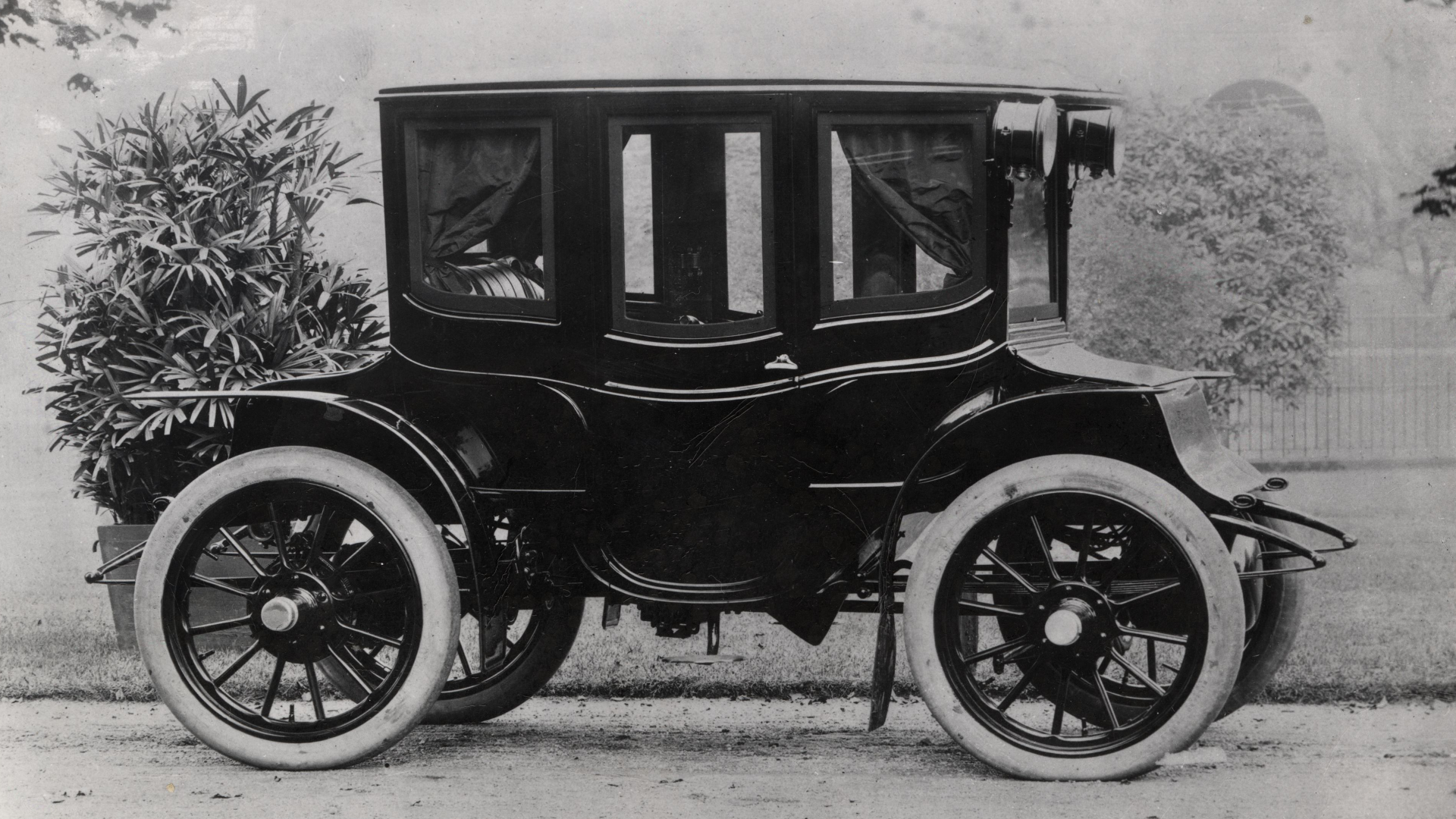
Cleveland’s Baker Motor Vehicle Company built some of the most refined and popular electric cars of the early automotive era, with production lasting over 15 years. These weren’t stripped-down experiments — Baker Electrics were beautiful, well-appointed vehicles that competed directly with the best gasoline cars of their time.
The company offered various models including roadsters and enclosed coupes, with ranges often cited around 50 miles (varying by model, battery type, and driving conditions) and top speeds of about 25 mph. Baker Electrics became particularly popular with women drivers because they didn’t require dangerous hand-cranking to start, and the company’s marketing wisely emphasized this safety advantage at a time when gasoline cars could literally break your arm if the crank kicked back.
Woods Electric (1899-1918)

The Woods Motor Vehicle Company of Chicago produced electric cars that were known for their quality and innovation, including some genuinely creative hybrid models.
Their Dual Power model from 1916 could run on either electric power for city driving or switch to a gasoline engine for longer trips, allowing significantly extended range compared with pure electric operation by switching to gasoline power at higher speeds. Standard Woods Electrics typically featured speeds up to 18 mph and came in various body styles, from sporty roadsters to enclosed broughams.
The company survived longer than many electric vehicle manufacturers, finally succumbing to the rising dominance of affordable gasoline cars after nearly two decades of production.
Detroit Electric (1907-1939)

When it comes to longevity, Detroit Electric takes the crown among early EV manufacturers with an incredible 32-year production run.
These vehicles became the electric car of choice for countless affluent Americans, including Thomas Edison and Clara Ford, who preferred her Detroit Electric to her husband Henry’s gasoline-powered creations. The cars typically offered ranges between 80 and 100 miles per charge and could reach speeds of about 20 mph, which was perfectly adequate for urban driving.
Detroit Electric’s success came from understanding their market; they built refined, reliable vehicles for people who valued smooth, quiet operation over maximum speed, and they stuck to that formula even as the rest of the industry shifted decisively toward gasoline power.
Milburn Light Electric (1914-1922)

The Milburn Wagon Company transitioned from making horse-drawn carriages to electric cars with impressive success, producing thousands of vehicles in the 1910s and early 1920s.
Their Light Electric was exactly what the name suggested — a lightweight, efficient design that made the most of limited battery capacity. These vehicles featured clean, modern styling for their era and could travel about 60 miles on a charge at speeds up to 20 mph.
Milburn focused on making electric cars affordable, with period prices commonly in the $1,485 to $1,885 range depending on model and year, though they still couldn’t compete with the Model T’s dramatically falling prices over the 1910s and 1920s that eventually dominated the market.
Rauch & Lang (1905-1928)

Cleveland’s Rauch & Lang built some of the most luxurious electric vehicles ever made, with interiors that rivaled fine furniture and attention to detail that would make modern luxury car makers jealous.
These weren’t cars for speed enthusiasts — they were rolling parlors for wealthy urbanites who valued comfort and status above all else. The company’s vehicles typically featured ranges around 50 miles and modest top speeds, but they made up for it with exquisite craftsmanship and exclusive appeal.
Rauch & Lang survived into the late 1920s through brand evolution and reorganization, including continued electric production and later related operations, but eventually even wealthy customers couldn’t resist the improved gasoline cars that offered so much more range and performance.
Detroit Electric (Anderson Electric Car Company) (1907–1939)

Detroit Electric was produced by the Anderson Electric Car Company of Detroit, which built electric vehicles from 1907 through 1939. The brand became one of the most successful and long-lived electric car manufacturers of the early automotive era, serving wealthy urban buyers who valued quiet operation and reliability over speed.
While most passenger-car production effectively ended in the early 1930s, a small number of Detroit Electrics continued to be built to order in the later years. The companys longevity demonstrated that electric vehicles could remain viable for specific use cases even as gasoline cars came to dominate the mass market.
Conclusion

Looking back at these pioneering electric vehicles, it’s striking how many of the same challenges and advantages existed over a century ago. Early EV manufacturers understood that electric motors offered smooth, quiet operation and worked perfectly well for urban transportation needs.
What ultimately pushed electric vehicles to the margins wasn’t a lack of technical merit but rather the explosive growth of oil infrastructure, the dramatic improvements in gasoline engine technology, and the rock-bottom prices that mass production brought to gas-powered cars.
Today’s electric vehicle renaissance isn’t really inventing something new — it’s reviving and perfecting a concept that was already proven viable back when your great-great-grandparents were young, now enhanced with modern battery technology and charging infrastructure that those early pioneers could only dream about.