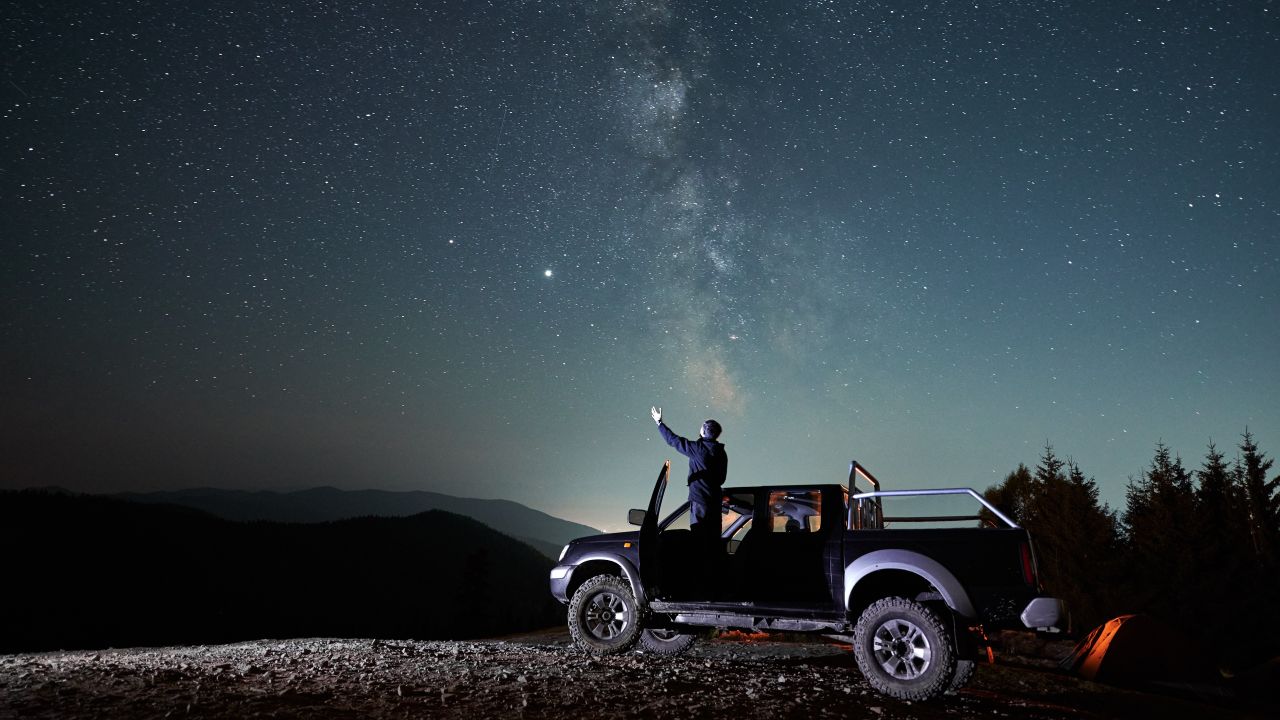
There’s nothing quite like pulling off at a quiet campsite after a long drive, shutting down the engine, and stepping out under a sky full of stars. Away from the city lights, you can sometimes catch the faint, cloudy ribbon of the Milky Way stretching overhead, a reminder that the road trip we’re on here on Earth is just a tiny part of something much bigger.
That glow is our galaxy, packed with billions of stars, planets, and mysteries still waiting to be uncovered. It’s the ultimate backdrop for any late-night campfire conversation, whether you’re swapping car stories or just soaking in the quiet. You don’t have to be an astronomer to feel that sense of awe; just looking up connects the drive we’re on with the journey of the universe itself.
Scientists are still piecing together the Milky Way’s story, from its ancient past to where it’s headed next. Here are 14 facts that might make you look up at the night sky with a fresh sense of wonder the next time you’re parked under the stars.
1. The Milky Way Is a Barred Spiral Galaxy

The Milky Way is what astronomers refer to as a barred spiral galaxy. This means it has a central bar-shaped structure with spiral arms wrapping around it. Scientists estimate that about two-thirds of spiral galaxies have this bar feature, so we’re in pretty good company.
This central bar is full of stars and acts like a giant conveyor belt, channeling gas and dust into the galaxy’s core. That activity fuels star formation, giving the Milky Way its unique and dynamic character compared to other galaxies.
2. It’s Moving at Mind-Blowing Speeds

Our galaxy is traveling through space at approximately 1.3 million miles per hour, propelled by gravitational forces from nearby galaxies and the mysterious “Great Attractor,” a region of space that has scientists perplexed.
Not only is the Milky Way itself moving, but our solar system is orbiting the galactic center at a speed of 828,000 kilometers per hour. It’s wild to think about all this motion, even though we don’t feel a thing.
3. The Sun Takes 230 Million Years to Orbit the Galaxy

Our solar system orbits the center of the Milky Way, a journey that takes roughly 230 million years to complete. The last time we were in our current position, dinosaurs were getting their start here on Earth.
This orbit is called a “galactic year,” and our solar system has only made about 20 trips around the galaxy’s center. It’s a mind-bending reminder of just how ancient the Milky Way really is.
4. Dark Matter Holds It All Together

Only about 10% of the Milky Way’s mass is visible. The other 90%? Dark matter. This mysterious stuff doesn’t emit, absorb, or reflect light, making it invisible. Yet, it’s essential; its gravitational pull holds the galaxy together.
Scientists continue to study the nature of dark matter and its underlying mechanisms. For now, it’s enough to know that without it, the Milky Way wouldn’t look anything like it does today.
5. A Supermassive Black Hole Sits at the Center

In the middle of our galaxy lies a supermassive black hole called Sagittarius A*. It’s about 4 million times more massive than the Sun and has a gravitational pull that influences the orbits of nearby stars.
While we can’t see Sagittarius A directly, we can observe how it affects the stars around it. Its presence helps scientists learn more about the role black holes play in the life and evolution of galaxies.
6. We’re Part of the Local Group

The Milky Way is part of a family of galaxies known as the Local Group, which comprises over 50 galaxies. Among them are the Andromeda Galaxy, the Triangulum Galaxy, and a bunch of smaller, dwarf galaxies.
This group is bound together by gravity, and all the galaxies in it orbit around a shared center. The Local Group itself belongs to an even larger structure known as the Virgo Supercluster. It’s a reminder that galaxies don’t exist alone; they’re part of a much larger cosmic web.
7. It’s on a Collision Course With Andromeda

Our galaxy and the Andromeda Galaxy are destined to collide in about 4.5 billion years. When they finally meet, they’ll merge to create a new galaxy, which some scientists are calling “Milkomeda.”
Despite what you might imagine, galaxy collisions don’t typically involve stars crashing into each other. The vast distances between stars mean they’ll mostly pass by one another, but the gravitational interactions will reshape both galaxies.
8. The Milky Way Is Full of Old Star Clusters

The Milky Way contains over 150 globular clusters, which are dense groups of ancient stars orbiting the galaxy. These clusters are among the oldest objects in the galaxy, dating back billions of years to their formation in the early universe.
Studying globular clusters helps astronomers learn more about the Milky Way’s formation and evolution. They’re like living time capsules, offering a glimpse into the galaxy’s distant past.
9. Spiral Arms Are Star Nurseries

The Milky Way’s spiral arms are where new stars are born. These regions are rich in gas and dust, the raw materials needed for star formation. However, not all stars live in the arms; our Sun, for example, orbits in a relatively quiet area called the galactic disk.
The spiral arms are constantly changing as stars form and drift away from each other. They’re dynamic, bustling areas that give the Milky Way its classic spiral shape, even though most of the galaxy’s mass lies in the quieter regions between them.
10. It Consumes Smaller Galaxies

The Milky Way has a habit of absorbing smaller galaxies that wander too close to it. Over time, our galaxy has swallowed dozens of smaller galaxies, including the ongoing merger with the Sagittarius Dwarf Galaxy. Remnants of past mergers can still be seen today as streams of stars arcing through our galaxy.
These mergers help fuel the Milky Way’s growth, adding new stars, gas, and dark matter to the mix. It’s a natural process that continuously helps shape the galaxy we live in today.
11. Its Rotation Puzzles Scientists

You’d expect the outer regions of the Milky Way to rotate more slowly than the inner ones, but that’s not the case. Instead, the outer areas move almost as quickly as the core, a phenomenon that defies simple physics. This is known as the “galaxy rotation problem,” and it’s one of the main reasons scientists believe dark matter exists.
Dark matter’s gravitational pull is what keeps the galaxy rotating as a cohesive unit. Without it, the stars in the outer regions would likely drift away, proving that the Milky Way is full of mysteries that we’re only beginning to understand.
12. Cosmic Dust Obscures Our View

If you’ve ever looked up at the Milky Way, you might notice that parts of it look dim or obscured. That’s due to cosmic dust, which absorbs and scatters light, blocking our view of some regions. To overcome this, scientists utilize telescopes that detect infrared or radio waves, which can penetrate the dust and reveal what lies beyond.
Although it presents an obstacle, cosmic dust is also the material from which stars and planets are formed. So, while it may block our view, it’s a key ingredient in the galaxy’s ongoing evolution.
13. Seven New Stars Form Each Year

The Milky Way isn’t static; it’s constantly changing, creating new stars at a rate of about seven per year. These new stars are primarily born in the spiral arms, where there’s plenty of gas and dust to fuel the star-forming process.
While seven might not sound like a lot, over millions of years, it adds up. This slow, steady creation of new stars keeps the galaxy fresh, replenishing it with youthful stars even as older ones fade away.
14. Nebulae Are Scattered Throughout the Galaxy

The Milky Way is home to countless nebulae, which are enormous clouds of gas and dust. Some nebulae, like the famous Orion Nebula, are active star-forming regions, while others are the remnants of exploded stars. Nebulae come in all shapes and sizes, and they’re some of the most colorful and captivating structures in the galaxy.
These nebulae aren’t just beautiful to look at; they’re essential to the galaxy’s life cycle, serving as birthplaces for new stars. By studying nebulae, scientists gain valuable insights into the forces that shape the Milky Way.