
Even though the French have tried to make sports cars several times, with varying degrees of success, they haven’t really tackled the supercar market all that much. Sure, for a short while there was Venturi, a company that Chris Chilton of Carscoops reported on, but there wasn’t really anything to rival the best that Italy, Germany, and even the UK had to offer.
While the French auto industry won’t be tackling this corner of the market anytime soon, back in the 2000s, we got a glimpse of what a front-engine, V12 super GT from Peugeot, of all companies, might be like. Peugeot has some awesome concept cars, and this one is definitely up there.
Our Methodology

These facts about the Peugeot 907 concept come from respected automotive publications, such as Top Gear, Evo, and others that reported on it when it was first shown at the Paris Motor Show back in 2004, or in retrospective articles and videos.
Wherever possible, we also make it a point to include some more interesting facts that you might have missed, and include information directly from the automaker, from a press release or similar. Let’s delve into a world where Peugeot had a rival for the Ferrari 575 and the Mercedes SLR.
The V12 Engine

One of the Peugeot 907’s signature features was its V12 engine. Peugeot was so proud of this powertrain that it chose to prominently display the intake trumpets — all twelve of them — on the hood. Naturally, they were enclosed in glass, but they looked so cool.
The way the V12 was built was similar to how Aston Martin did it. For those who don’t know, as Alex Reid of Driving.ca reports, Aston Martin’s old V12 was created from two 3.0-liter Duratec V6 engines from Ford. It’s a similar story with the 907, the V12 was created by fusing two 3.0-liter V6 engines together. According to Peugeot, the 3.0-liter V6 that was used in the fusion also powered the 607 luxury sedan. Total output, according to Ollie Kew of Top Gear, was 493 horsepower and 443 pound-feet of torque.
A Transmission Relic

So, how did the 907 go about sending power to the rear wheels? Through a six-speed sequential manual transmission, of course! It’s a relic because the 907 comes from a time when semi-automatic transmissions were all the rage.
By 2004, we already had Ferrari’s F1 paddle-shift transmission, Lamborghini’s E-Gear, which had its own learning curve, as YouTuber Will Motivation explains, and BMW’s SMG (Sequential Manual Gearbox). Even the Smart Fortwo used a version of this same transmission concept, and as a former owner, I can personally tell you was terribly executed. In the 907, according to John Simister and Julian Mackie of Evo Magazine, it was a Sadev unit that was electronically controlled, and it was mounted in the back in a transaxle configuration, like an Alfa Romeo. Sadev usually makes transmissions for race cars, so this was no joke.
Inspirational Design
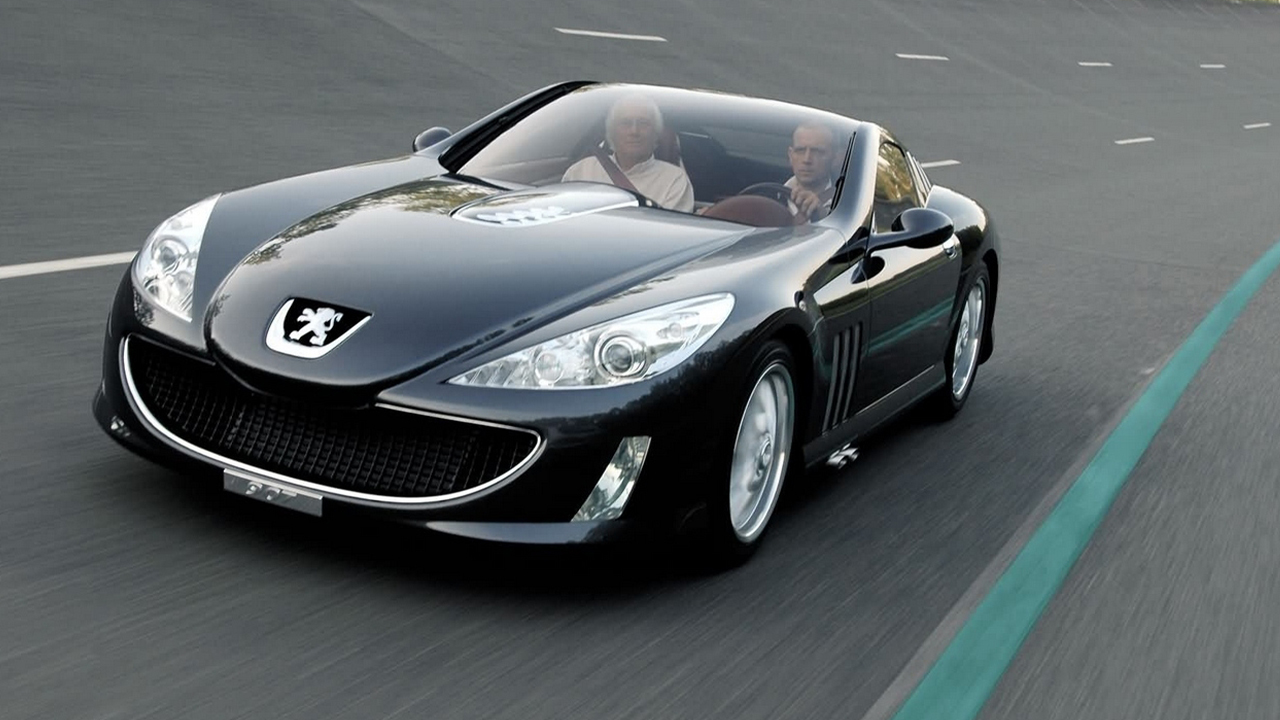
Really, the design is the most important aspect of the 907. That was this concept’s intent from the very beginning: it was never designed to go into production; it was simply a styling exercise that showed us what to expect from future Peugeot models, as well as to celebrate the move to a new design studio for the company, according to Mike Fernie of DriveTribe.
Looking at some of the finer details of the 907 makes this very clear. The front end, with its big and highly controversial smiling grille, the shape of the headlights, the taillight configuration itself, a lot of those styling elements would go on to appear in stuff like the first generation 308.
Massive Tires

Obviously, a car with a good amount of horsepower and RWD needs some good rubber to put the power down. Peugeot took this a little bit too seriously. For perspective, the previous generation BMW M2, a 400 hp RWD car, was able to put the power down with 245 width front tires and 265 width rear tires, according to Wheel-Size.
Peugeot clearly thought that wasn’t enough, which is why, according to Story Cars, it outfitted its nearly 500 horsepower grand tourers with 275-width front tires and truly ridiculous, muscle car-rivaling 345-width rear tires. It would have made for a good dragster with that tire setup! It’s almost like Peugeot knew that it would, one day, be part of the same company as Dodge.
The Theoretical Speed Was Crazy

The man behind the Peugeot 907 claimed that it was capable of 180 miles per hour after testing it out in a wind tunnel, and hitting 155 mph during some test drives. Yes, Peugeot made a working prototype of the 907, despite never having intentions to build a production model.
However, that speed was only what the prototype could do. If the 907 had undergone proper testing and reached production, it could have gone a lot faster. According to Peugeot, the 907 would have been able to reach 221 mph. For context, as Barry Winfield of C&D reports, the McLaren SLR’s top speed is 207 mph, while the Ferrari 575 managed a “paltry” 202 mph.
Impressively Lightweight

The 907 looks very impressive in photos, yes; it also looks like it might be massive and quite heavy. Given its focus as a grand touring coupe, similar to the Bentley Continental, you’d be forgiven for thinking it’s a big, heavy car, but that’s not the case.
According to Peugeot, at just 172 inches in length, it’s almost a foot shorter than a modern Toyota Corolla. Since the body is built using lightweight carbon fiber, this allowed the 907 to weigh in, according to Top Gear, at just under 3,100 pounds. Despite the fact that the internet seemingly tries its best to convince us otherwise, suddenly 500 hp comes off as more than enough.
An Aerodynamic Dream

When dealing with theoretical top speeds of 221 mph and a car with a 500 hp V12 engine, you’ll need some solid aerodynamics to help it stick to the ground. We already mentioned the obscene rear tire width, which is plenty on its own.
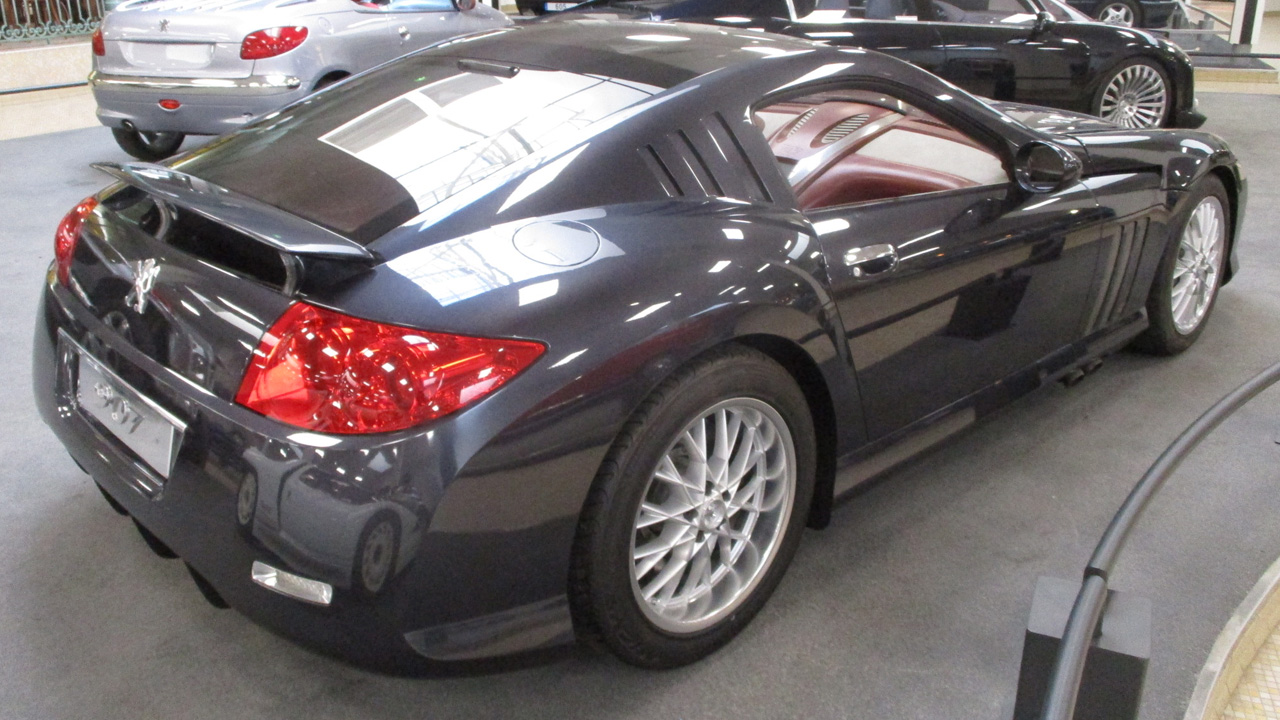
However, as Evo Magazine reports, the prototype of the 907 might have had a rudimentary form of active aerodynamics. There was a rear diffuser, and while there is what appears to be a rear spoiler, it wasn’t actually functional on the prototype, according to John Simister and Julian Mackie of Evo. If this did end up being a production car, it might have had even more involved active aero. Interestingly, Peugeot’s parent company would end up building a production car with an active rear spoiler — the Citroën C6, the last true Citroën. It still works on mine, surprisingly.
A Glorious Noise

There are few things in the automotive world better than the noise a V12 engine can produce. Some of the greatest-sounding cars of all time, like the Pagani Zonda and a number of Ferraris and Lambos, used V12 powertrains.
It will not surprise you that the Peugeot 907 also sounded pretty glorious. While not as loud and brash as, say, a Zonda, it still put out that glorious V12 howl, while also sounding pretty smooth. We’d imagine the smoothness would have been on point if it were a production model.
A Special Interior

Even if concept cars tend to look a little more tame on the outside, it’s the interior where the designers really let their hair down. It’s the same with the 907 concept, but Peugeot’s interior team also managed to remain pretty restrained.
Just about every surface of the interior is covered in either gorgeous brown leather or exquisite polished metal. The gauges are mostly analog, with the speed and revs placed on the silver outer ring, but the center is taken up by color screens. There’s also a screen in the center that, according to Peugeot, could play MP3s and DVDs. As photos from Peugeot also show, there was even some lovely-looking fitted luggage in the same brown leather. The graphics on the screen were also very 2000s, and would you just take a look at that shifter!
Did The 907 Survive?

Sometimes, we’ll hear sad stories about automakers’ concept cars, and running prototypes of said concept cars get crushed or forgotten about. As Alexander Stoklosa of Motor Trend reported, General Motors crushed a few of its concept cars last year. You’d think that a similar fate befell the Peugeot 907, but thankfully, that’s not the case.
The one-off prototype of the 907 is still alive and well, and according to DriveTribe’s Mike Fernie, it’s currently displayed at Peugeot’s museum, Musée de L’Aventure Peugeot in Sochaux, France. What’s more, DriveTribe Mike also reports that Peugeot allegedly has a few parts lying around to build another one of these V12 engines. With EV-focused CEO Carlos Tavares stepping down last year, this might just be possible now.
The Peugeot 907 Shows Us An Alternate Reality
This really is an alternate reality that we’d like to live in. Just imagine a world where the McLaren SLR and the Ferrari 575 had a direct competitor from Peugeot, of all companies. Sadly, the 907 was never built, and it would also usher in what is often said to be a dark era for Peugeot that Top Gear relentlessly mocked. Yes, in the “Maniac!” episode.
Frankly, we think that Peugeot should have built this car. Even if it were an ultra-limited production model, it would have definitely shaken up the world of the two-door super grand tourer. We’ll leave it to the YouTube DIYers to build a replica based on a different platform.